⚠️ 이 페이지의 요약·평가·해설은 생성형 AI(Claude)가 자동 생성한 2차적 분석물입니다. 논문 원문의 저작권은 원저작자에게 있으며, 정확한 내용은 원문(위 DOI·arXiv 등 출처)을 확인하세요.
라이선스: OpenReview 공개(오픈액세스)
Essence
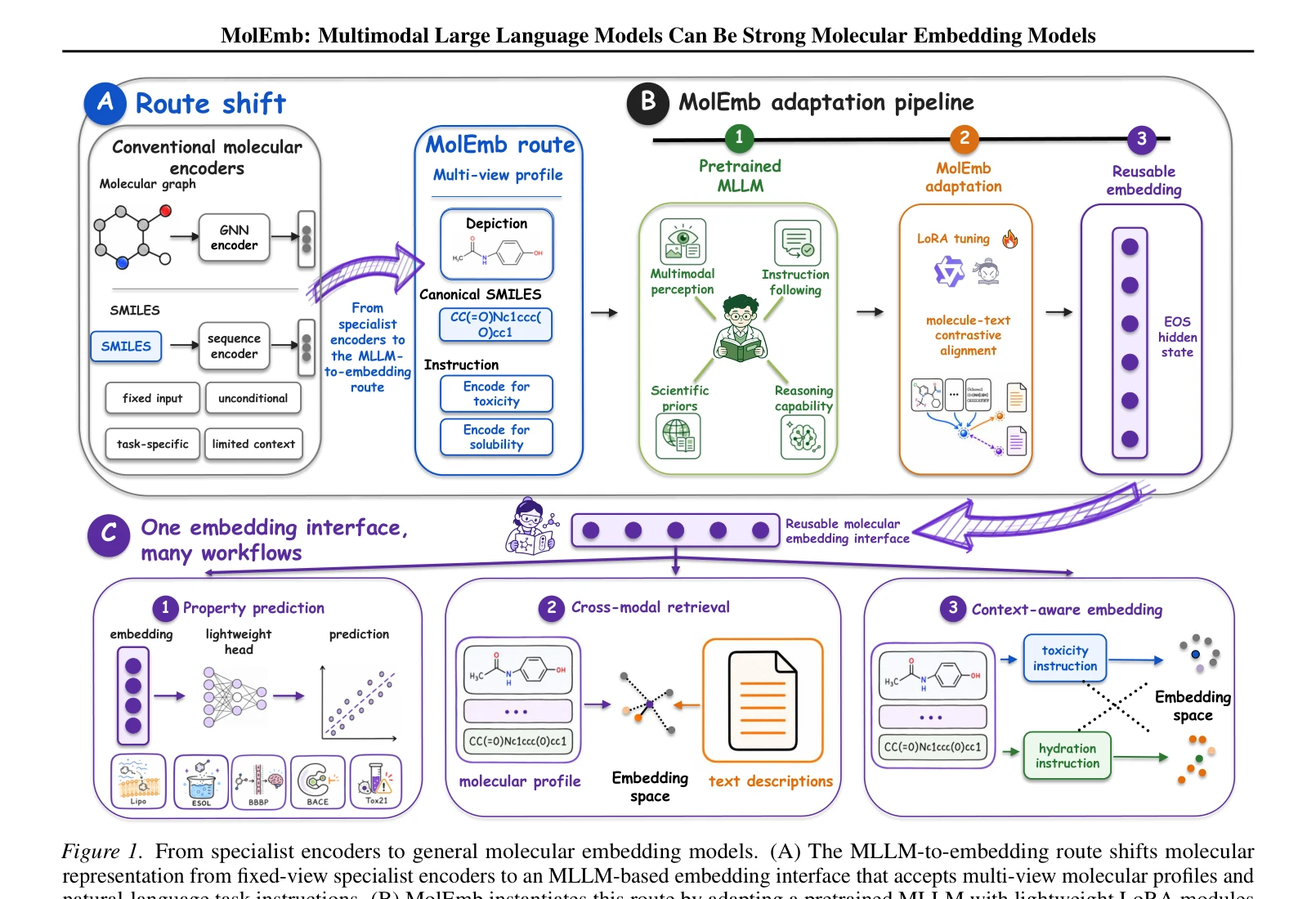
Figure 1. From specialist encoders to general molecular embedding models. (A) The MLLM-to-embedding route shifts molecul
MolEmb은 MLLM을 경량 LoRA 기반 bidirectional contrastive alignment로 적응시켜, 2D depiction과 canonical SMILES로 구성된 multi-view 분자 profile과 자연어 semantic context를 함께 조건화하는 general molecular embedding model을 만드는 프레임워크이다.
Motivation
Known: 기존 분자 표현학습은 GNN, SMILES sequence encoder, geometry encoder와 같은 specialist encoder를 통해 단일 molecular view를 고정된 unconditional vector로 인코딩하는 방식이 주류였으며, LLM2Vec, VLM2Vec, Qwen3-VL-Embedding, Gemini Embedding 등 generative backbone을 embedding model로 전환하는 흐름은 NLP/vision-language 영역에서 이미 나타나고 있다.
Gap: 화학 분야 MLLM 연구는 여전히 chemistry assistant, captioner, reasoner, direct predictor 등 generative framing에 집중되어 있어, 다양한 molecular view와 task별 semantic context에 조건화된 재사용 가능한 embedding 인터페이스로서의 잠재력은 충분히 탐구되지 않았다.
Why: molecular embedding model은 property prediction, virtual screening, toxicity assessment, retrieval 등 신약 개발과 화학생물학 워크플로우의 기반 인프라로 기능하므로, 하나의 backbone으로 multi-view 입력과 semantic conditioning을 모두 지원하는 general embedding model은 다양한 다운스트림 워크플로우에 확장성 있게 적용될 수 있어 실용적 중요성이 크다.
Approach: MLLM에 2D depiction과 canonical SMILES로 구성된 multi-view 분자 profile과 자연어 instruction을 입력하고, LoRA를 통한 경량 튜닝과 molecule-text bidirectional contrastive objective로 EOS hidden state를 공유 embedding space에 정렬시켜 재사용 가능한 embedding을 얻는다.
Achievement
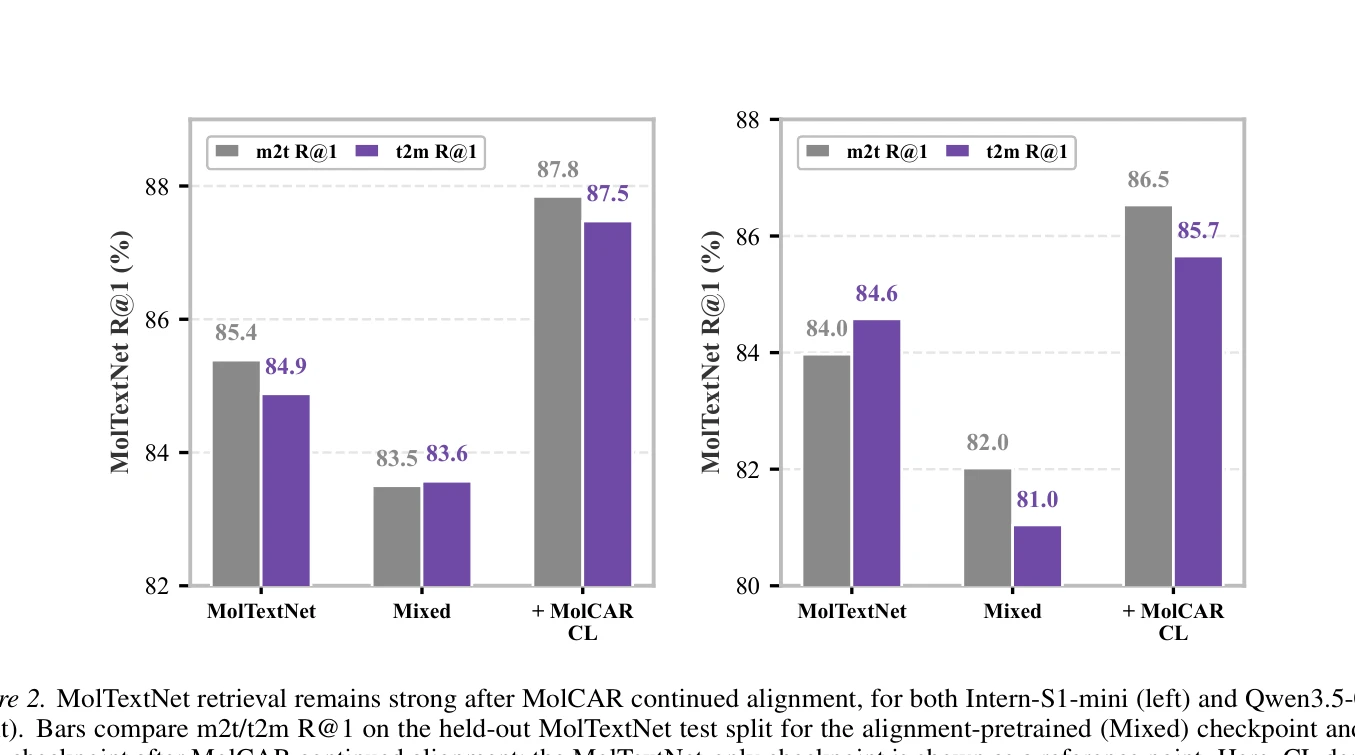
Figure 2. MolTextNet retrieval remains strong after MolCAR continued alignment, for both Intern-S1-mini (left) and Qwen3
General molecular embedding model 정식화: 분자 identity, profile(관측 가능한 view), semantic context(c)를 분리하여 Eθ: V×C→Rd로 formalize함으로써 기존 unconditional vector 패러다임을 확장했다.
다중 벤치마크 검증: molecular property prediction에서 경쟁력 있는 성능을 보였고, 동일 embedding space에서 cross-modal molecule-text retrieval도 지원함을 입증했다.
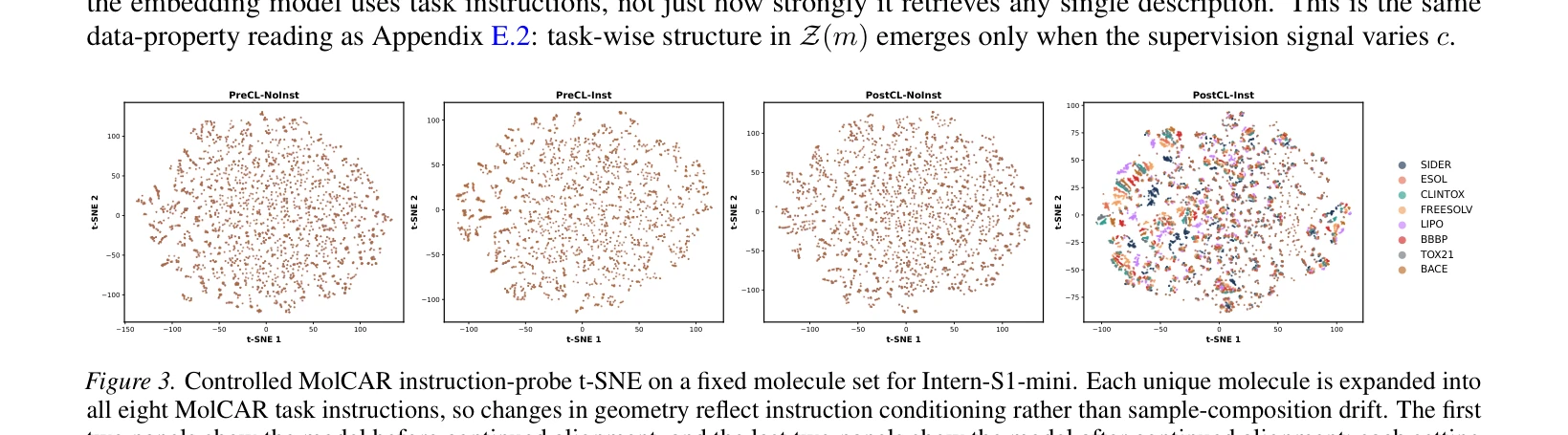
MolCAR 벤치마크 도입: context-aware retrieval을 진단하기 위한 벤치마크를 제안하고, context-aware molecular embedding이 주로 supervision data의 속성임을 실증적으로 밝혔다.
How
Figure 3. Controlled MolCAR instruction-probe t-SNE on a fixed molecule set for Intern-S1-mini. Each unique molecule is
분자를 2D depiction과 canonical SMILES string으로 구성된 multi-view profile P(m)으로 표현하고, 필요 시 natural-language instruction c를 추가해 MLLM 입력 시퀀스 x(m,c)=ϕ(P(m),c)를 구성한다.
MLLM의 EOS hidden state를 고정 길이 molecular embedding으로 pooling하여 사용한다.
LoRA를 이용한 경량 파라미터 효율적 fine-tuning으로 사전학습 MLLM(예: Intern-S1-mini)을 조정한다.
학습된 embedding model을 property prediction(경량 head 부착), cross-modal retrieval, MolCAR를 통한 context-aware retrieval 세 가지 워크플로우에서 평가한다.
MolCAR에서는 instruction(예: toxicity, hydration/solubility)을 달리하며 동일 분자 집합에 대한 embedding 분포를 t-SNE 등으로 분석해 context 조건화 효과를 진단한다.
Originality
분자 표현학습을 embedding model 관점(재사용 가능한 벡터 인터페이스)으로 재구성하고, 이를 molecular identity, profile, semantic context 세 요소로 분리해 formalize한 점이 개념적으로 독창적이다.
기존에는 chemistry assistant/generator로만 다뤄지던 MLLM을 general molecular embedding model의 backbone으로 전환하는 시도로, LLM2Vec/VLM2Vec 계열 아이디어를 분자 도메인에 최초로 적용했다.
context-aware retrieval을 정량적으로 진단하는 MolCAR 벤치마크를 새로 제안하여, semantic conditioning 능력이 모델 구조가 아닌 supervision data 속성임을 보인 실증적 통찰이 독창적이다.
Limitation & Further Study
발췌된 내용만으로는 구체적인 베이스라인 대비 정량적 성능 향상 폭, 사용한 MLLM 백본의 규모, 학습 데이터셋(MolTextNet 등) 구성의 세부사항이 명확히 드러나지 않아 재현성과 비교 우위 평가가 제한적이다.
MolCAR가 "context-aware embedding은 데이터의 속성"이라는 결론에 도달했다는 것은 곧 모델 자체의 architectural inductive bias보다 supervision 설계가 성능을 좌우한다는 의미이며, 이는 새로운 context 유형에 대한 일반화(zero-shot semantic conditioning)의 한계를 시사하므로 후속 연구에서 다양한 context 분포에 대한 robustness 검증이 필요하다.
3D conformer 등 geometry 기반 view는 profile에 포함되지 않아(2D depiction과 SMILES만 사용), 3D 구조 의존적 물성(binding affinity 등)에 대한 적용 가능성은 추가 검증이 필요하다.
경량 LoRA 튜닝의 계산 비용 및 대규모 molecule-text pair 데이터 확보의 실용적 부담에 대한 논의가 부족하다.
총평: MLLM을 generative chemistry assistant를 넘어 general molecular embedding model로 재구성하는 참신하고 시의적절한 시도로, MolCAR라는 새로운 진단 도구까지 제시했다는 점에서 의미가 크지만, 워크숍 페이퍼 특성상 실험적 세부사항과 정량적 비교가 제한적이어서 완결성 있는 검증은 후속 full paper를 통해 확인될 필요가 있다.
기반 연구SPECTER2 유사도 0.93로 Computational Molecular Design와 LLMs for Molecular Biology & Chemistry가 맞닿아, 'Efficient Evolutionary Search Over Chemical Space with Large Language Models'가 이 ICML 2026 논문의 배경·대안·응용 맥락을 보완한다.
기반 연구SPECTER2 유사도 0.93로 Computational Molecular Design와 AI-Driven Drug and Materials Discovery가 맞닿아, 'Hallucinations can improve large language models in drug discovery'가 이 ICML 2026 논문의 배경·대안·응용 맥락을 보완한다.
기반 연구SPECTER2 유사도 0.93로 Computational Molecular Design와 AI-Driven Drug and Materials Discovery가 맞닿아, 'Bolek: A Multimodal Language Model for Molecular Reasoning'가 이 ICML 2026 논문의 배경·대안·응용 맥락을 보완한다.