⚠️ 이 페이지의 요약·평가·해설은 생성형 AI(Claude)가 자동 생성한 2차적 분석물입니다. 논문 원문의 저작권은 원저작자에게 있으며, 정확한 내용은 원문(위 DOI·arXiv 등 출처)을 확인하세요.
라이선스: OpenReview 공개(오픈액세스)
Essence
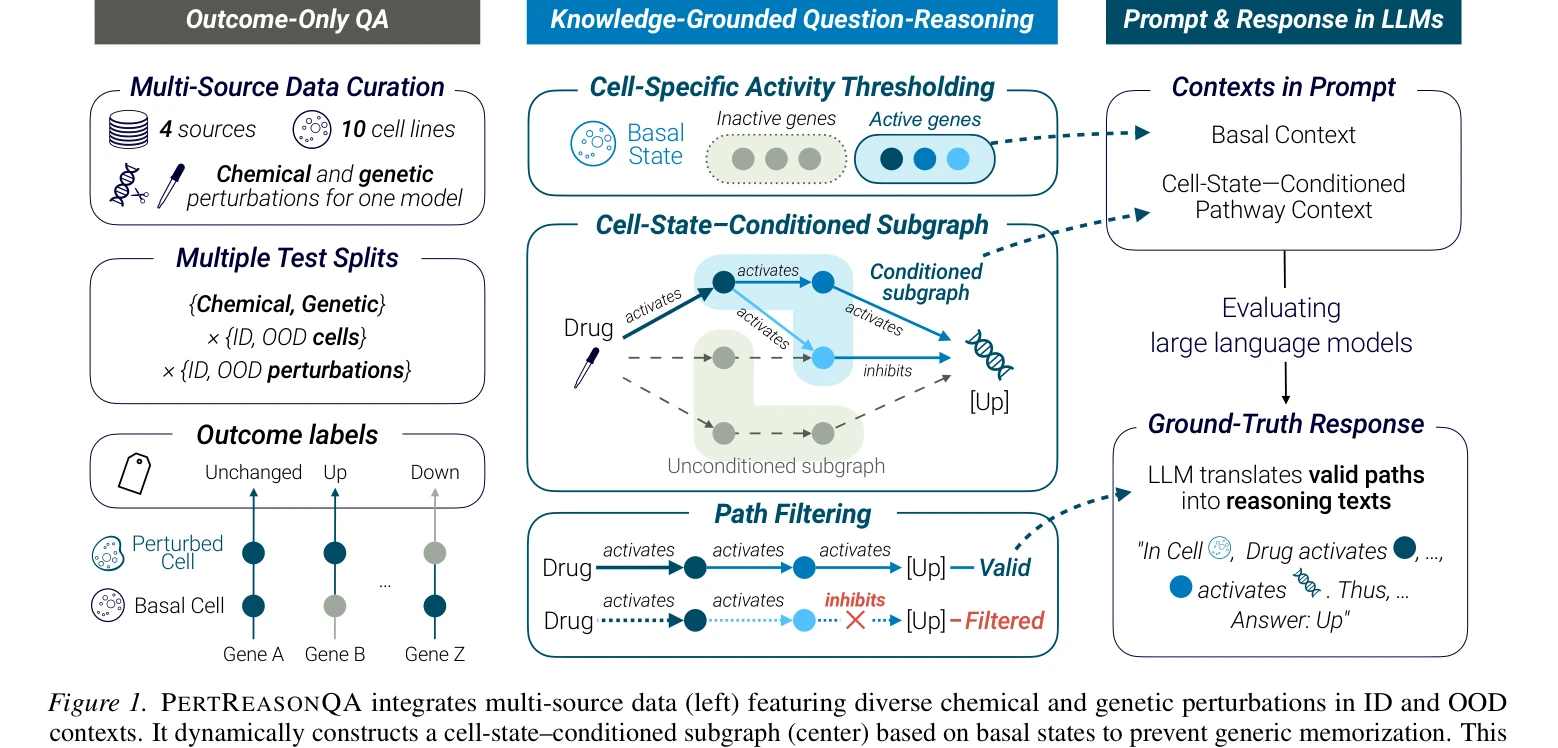
Figure 1. PERTREASONQA integrates multi-source data (left) featuring diverse chemical and genetic perturbations in ID an
PertReasonQA는 세포 상태(basal state)에 조건화된 knowledge graph 기반 경로 추론을 통해, perturbation 효과 예측 모델이 정답을 맞히는 것과 올바른 메커니즘적 이유로 그 정답에 도달하는 것을 구분할 수 있게 하는 QA 벤치마크이며, 이를 검증하는 reference 모델 PertReasonLM을 함께 제시한다.
Motivation
Known: 기존 virtual cell foundation model들은 화학적·유전적 perturbation에 의한 transcriptomic 변화를 예측하는 데 상당한 진전을 이루었으며, PerturbQA와 같은 label-centric 벤치마크로 outcome 예측 성능을 평가해왔다.
Gap: 그러나 기존 모델들은 established biological pathway를 우회하여 mechanistic reasoning 없이 예측하는 경우가 많고, label 중심 평가로는 모델이 진짜 생물학적 추론을 하는지 아니면 spurious correlation에 의존하는지 구분할 수 없다는 한계가 있다.
Why: 과학 도메인에서 ML을 신뢰성 있게 활용하려면 distribution shift(새로운 세포, unseen perturbation) 하에서도 정답 예측뿐 아니라 그 근거가 되는 mechanistic reasoning이 타당한지 검증할 수 있어야 하며, 이는 신약 개발과 질병 모델링 등 실제 활용에 직결되는 문제이다.
Approach: PertReasonQA는 다중 single-cell perturbation 데이터와 knowledge graph를 결합하고, 각 세포의 basal state에 따라 pathway를 동적으로 조건화하여 generic memorization을 방지하는 knowledge-grounded QA 벤치마크이며, 이를 보완하는 reference probe로 PertReasonLM을 제시한다.
Achievement
Figure 1. PERTREASONQA integrates multi-source data (left) featuring diverse chemical and genetic perturbations in ID an
PertReasonQA 벤치마크 구축: 10개 세포주에 걸친 화학적·유전적(CRISPRi) perturbation 데이터를 knowledge graph와 결합하여 1.4M outcome-only QA 샘플과 237k reasoning 샘플을 생성했다.
Cell-State–Conditioned 경로 추출 기법: KS 통계 기반 세포별 활성 임계값(τlow, τhigh)과 basal expression 조건화된 edge weight를 이용해 Dijkstra 탐색으로 세포 특이적 high-confidence pathway를 추출하고, sign propagation 필터링으로 관측된 발현 방향과 일치하는 reference reasoning path만 남겼다.
다중 OOD 분할 설계: {Chemical, Genetic} × {ID, OOD cells} × {ID, OOD perturbations} 조합의 test split을 구성하여 복잡한 distribution shift 하에서의 모델 강건성을 평가할 수 있게 했다.
시스템적 실패 모드 발견: RAG 기반 baseline 및 범용 LLM(Qwen3 계열 등)이 최종 예측은 맞더라도 결함 있거나 방향이 불일치하는 메커니즘을 생성하는 경향을 실증적으로 드러냈다.
PertReasonLM 제시: outcome 예측과 context-specific regulatory reasoning을 정렬시키는 reference LLM을 통해 mechanistic faithfulness가 개선됨을 보였다.
How
Figure 1. PERTREASONQA integrates multi-source data (left) featuring diverse chemical and genetic perturbations in ID an
여러 대규모 single-cell perturbation 소스(Srivatsan et al., Szałata et al., Replogle et al., Nadig et al.)를 aggregate하여 pseudobulk 및 basal expression profile을 구성
Wilcoxon signed-rank test와 Benjamini-Hochberg 보정을 이용해 differential expression label(Up/Down/Unchanged) 산출
gene network embedding 기반 cluster split으로 pathway leakage를 최소화한 OOD cell/perturbation 분할 생성
KS 통계 기반 cell-specific activity thresholding으로 basal expression을 low/medium/high로 discretize
basal expression에 조건화된 edge weight(sigmoid 기반 활성도 페널티)를 사용해 knowledge graph 상에서 Dijkstra 탐색으로 cell-state-conditioned pathway 추출
Qwen3-4B를 이용해 검증된 causal path를 자연어 reasoning text로 변환하고, keyword matching 기반 post-generation quality control 적용
balanced accuracy(3-way outcome classification)와 새로 도입한 Mechanistic Faithfulness 지표로 평가
Originality
기존 벤치마크(PerturbQA 등)가 outcome-only label 평가에 그쳤던 것과 달리, cell-state에 동적으로 조건화된 knowledge-grounded reasoning path를 처음으로 결합한 점
고정된 embedding lookup이나 static graph에 의존하는 기존 방법(Adduri et al., Roohani et al., Wenkel et al.)과 달리, novel experimental condition을 actionable regulatory state로 번역하는 PertReasonLM 제안
basal state 기반 edge weight 조건화 및 sign propagation 필터링을 결합한 pathway 추출 알고리즘 설계로 generic memorization을 방지하는 독창적 데이터 구축 파이프라인
Limitation & Further Study
Reasoning path의 타당성을 자동 필터링(sign propagation, keyword matching)에 의존하므로 실제 생물학적 타당성에 대한 전문가 검증이 제한적일 수 있음
pseudobulk aggregation 및 knowledge graph(INDRA CoGEx, OmniPath 등) 커버리지에 의존하므로, 알려지지 않은 상호작용이나 knowledge graph의 편향이 reasoning path 품질에 영향을 줄 수 있음
Qwen3-4B로 생성된 reasoning text의 언어적 자연스러움과 사실 충실도 사이의 trade-off에 대한 추가 검증이 필요
향후 연구로 더 다양한 세포 유형과 perturbation modality(예: combinatorial perturbation)로 확장, mechanistic faithfulness metric의 정교화가 요구됨
총평: outcome 예측과 mechanistic reasoning을 명확히 분리해 평가하는 새로운 진단 도구로서 가치가 크며, 특히 cell-state 조건화라는 세밀한 설계가 돋보이지만, 자동화된 필터링 파이프라인의 생물학적 타당성 검증이 보강되면 더욱 신뢰도 높은 벤치마크가 될 것이다.
기반 연구SPECTER2 유사도 0.94 기준으로 'PertReasonQA: A Knowledge-Grounded Benchmark and Framework for Cell-State–Conditioned Mechanistic Reasoning of Perturbation Effects'의 AI4S 방법론을 'What are the best AI tools for research? Nature's guide'의 과학 생산·평가 맥락과 함께 보면 연구 자동화의 의미를 입체적으로 볼 수 있다.