⚠️ 이 페이지의 요약·평가·해설은 생성형 AI(Claude)가 자동 생성한 2차적 분석물입니다. 논문 원문의 저작권은 원저작자에게 있으며, 정확한 내용은 원문(위 DOI·arXiv 등 출처)을 확인하세요.
라이선스: OpenReview 공개(오픈액세스)
Essence
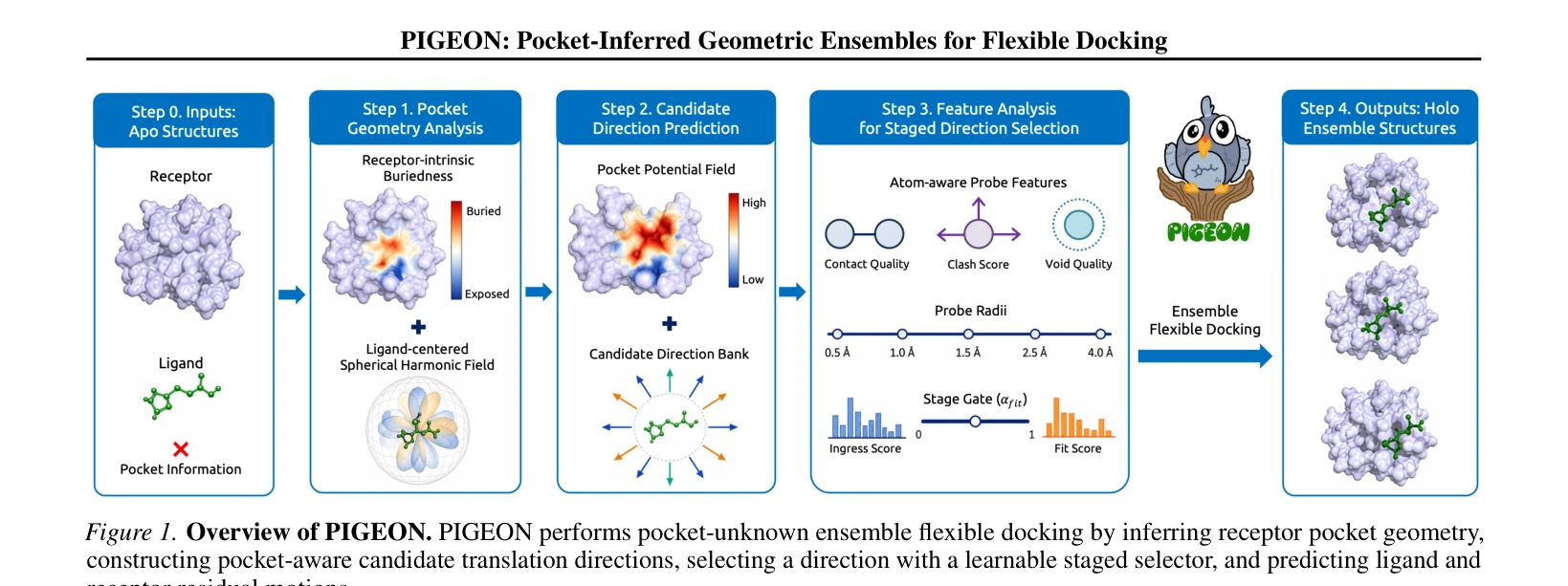
Figure 1. Overview of PIGEON. PIGEON performs pocket-unknown ensemble flexible docking by inferring receptor pocket geom
PIGEON은 pocket 정보 없이 receptor-ligand 복합체의 flexible docking을 manifold flow-matching으로 수행하는 프레임워크로, receptor-intrinsic buriedness field와 ligand-centered spherical harmonic pocket field를 통해 ligand translation을 유도하고 학습 가능한 staged selector로 pocket-ingress와 local-fitting 동작을 선택한다.
Motivation
Known: 기존 flexible docking 모델(DiffDock-Pocket, Re-Dock, DynamicBind, FlexDock, FlowDock 등)은 diffusion 또는 flow matching을 이용해 ligand pose와 receptor adaptation을 함께 예측하지만 대부분 single-endpoint pose generation으로 평가되며, classical ensemble docking은 pre-generated receptor conformation을 대상으로 하는 two-stage 방식이다. 또한 site-specific docking 방법들은 명시적 pocket center나 residue set을 요구하여 prospective 상황에서 편향이 발생하며, pocket-free 방법들은 receptor-intrinsic pocket geometry를 명시적으로 모델링하지 않는다.
Gap: receptor flexibility, 복합체당 다중 안정 holo state, 그리고 실제 응용에서 미지의 binding-pocket residue라는 세 가지 문제가 결합되어 있음에도, ligand와 receptor의 결합 conformation을 pocket residue 없이 하나의 coupled conditional distribution으로 직접 생성하는 방법이 부재하다.
Why: binding pocket이 알려지지 않은 prospective drug discovery 상황에서도 신뢰할 수 있는 ensemble flexible docking을 가능하게 함으로써, virtual screening과 lead optimization에서 실제 사용 조건에 더 부합하는 실용적 도구를 제공할 수 있다.
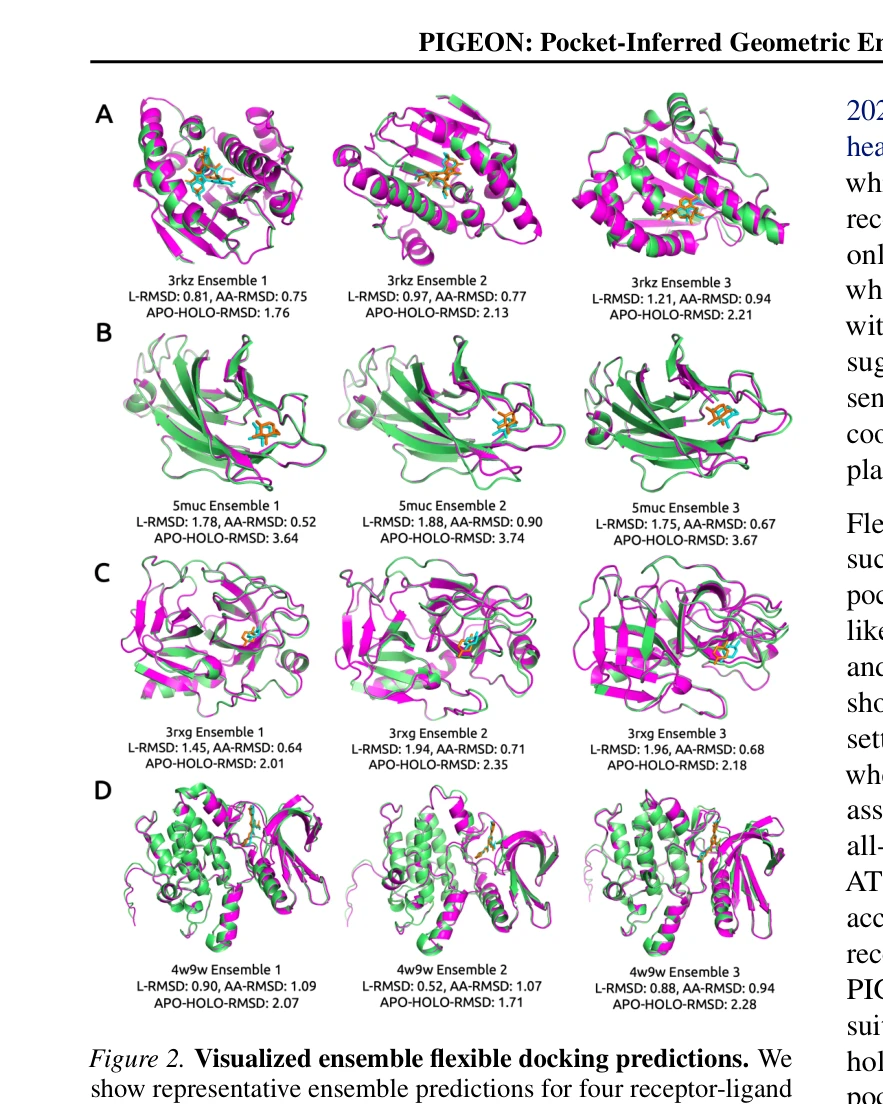
Figure 2. Visualized ensemble flexible docking predictions. We
PIGEON은 ground-truth pocket residue 없이도 정확한 ligand pose를 복원하면서 physically plausible한 full-complex geometry를 유지하는 ensemble flexible docking을 실현했다.
How
Figure 1. Overview of PIGEON. PIGEON performs pocket-unknown ensemble flexible docking by inferring receptor pocket geom
flexible docking 상태를 receptor residue frame(SO(3)×R3), side-chain torsion(TKi), ligand centroid(R3), ligand rotation(SO(3)), ligand torsion(TKL)의 product manifold M 위의 점으로 정식화
각 apo-holo state pair에 대해 geodesic interpolant xt를 구성하고, polynomial schedule α(t)=t2를 사용한 manifold flow matching(residual 예측 형태 Lres)으로 학습
ligand atom, receptor atom, receptor residue 세 해상도를 포함하는 heterogeneous graph를 구성하고, FiLM-style time modulation과 edge-type-specific projection을 가진 time-conditioned message-passing network로 임베딩 생성
receptor atom별로 Kprobe개의 probe direction을 쏘아 occlusion 여부를 판단해 receptor-intrinsic buriedness ba를 계산 (pocket label 불필요)
ligand centroid를 중심으로 6개의 Gaussian radial shell과 order L=2까지의 real spherical harmonic 계수를 이용해 buriedness-weighted pocket field를 구성, L=0(buried mass), L=1(dipole direction), L=2(비대칭성 등) 정보를 추출
이로부터 pocket-aware candidate translation direction bank를 생성하고, contact quality/clash avoidance/void avoidance/contact uniformity/contact count를 측정하는 atom-aware probe feature를 이용한 learnable staged selector로 pocket-ingress와 local-fitting 동작 중 선택
기반 연구SPECTER2 유사도 0.92로 Computational Molecular Design와 AI-Driven Drug and Materials Discovery가 맞닿아, 'Fragment and Geometry Aware Tokenization of Molecules for Structure-Based Drug Design Using Language Models'가 이 ICML 2026 논문의 배경·대안·응용 맥락을 보완한다.
기반 연구SPECTER2 유사도 0.92 기준으로 'PIGEON: Pocket-Inferred Geometric Ensemble Flexible Docking'의 AI4S 방법론을 'Efficient Prediction of SO(3)-Equivariant Hamiltonian Matrices via SO(2) Local Frames'의 과학 생산·평가 맥락과 함께 보면 연구 자동화의 의미를 입체적으로 볼 수 있다.
기반 연구SPECTER2 유사도 0.93로 Computational Molecular Design와 AI-Driven Drug and Materials Discovery가 맞닿아, 'An equivariant pretrained transformer for unified 3D molecular representation learning'가 이 ICML 2026 논문의 배경·대안·응용 맥락을 보완한다.