⚠️ 이 페이지의 요약·평가·해설은 생성형 AI(Claude)가 자동 생성한 2차적 분석물입니다. 논문 원문의 저작권은 원저작자에게 있으며, 정확한 내용은 원문(위 DOI·arXiv 등 출처)을 확인하세요.
라이선스: OpenReview 공개(오픈액세스)
Essence
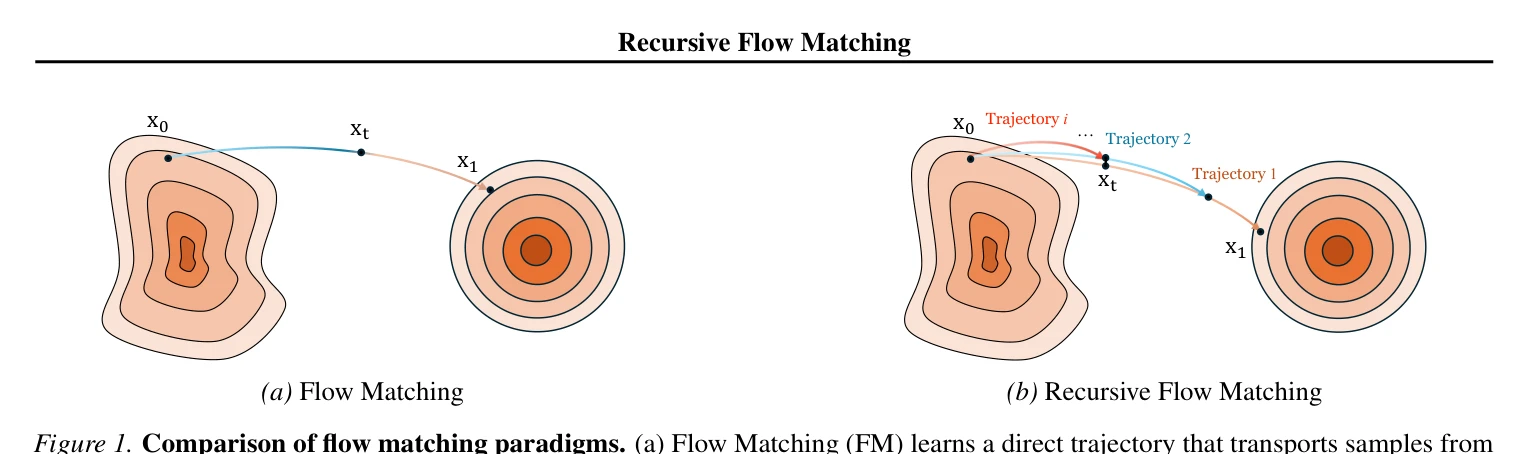
Figure 1. Comparison of flow matching paradigms. (a) Flow Matching (FM) learns a direct trajectory that transports sampl
RecFM은 서로 다른 discretization scale에 걸친 trajectory 간 self-consistency를 강제하는 recursive flow matching 프레임워크로, one-step 및 few-step(2-4 step) 생성에서 multi-step solver에 준하는 물리적 정확도를 달성한다.
Motivation
Known: diffusion model과 flow matching은 물리 시스템의 spatiotemporal dynamics를 생성적으로 모델링하는 데 효과적이지만, 고품질 예측을 위해서는 수십~수백 번의 iterative sampling step이 필요하다.
Gap: 기존 방법들은 inference step 수를 줄이면 정확도가 저하되는 speed-fidelity trade-off를 겪으며, consistency model이나 distillation 기법들은 aggressive step reduction 시 물리적 필드의 spectral richness와 spatiotemporal fidelity를 손상시키는 한계가 있다.
Why: 실시간 과학적 시뮬레이션(기후 모델링, 유체역학, 날씨 예측 등)에서 물리적 정확도를 유지하면서도 계산 비용을 획기적으로 낮추는 것은 실용적 배포에 필수적이며, 이는 traditional numerical solver의 대안으로서 data-driven 접근법의 실질적 가치를 좌우한다.
Approach: wall-bouncing pendulum의 recursive velocity attenuation 물리적 직관에서 영감을 받아, 여러 스케일의 trajectory들이 공유된 spatial state에서 교차하도록 만들고 이들 간 cross-scale consistency를 강제하는 학습 목적함수를 설계했다.
Achievement
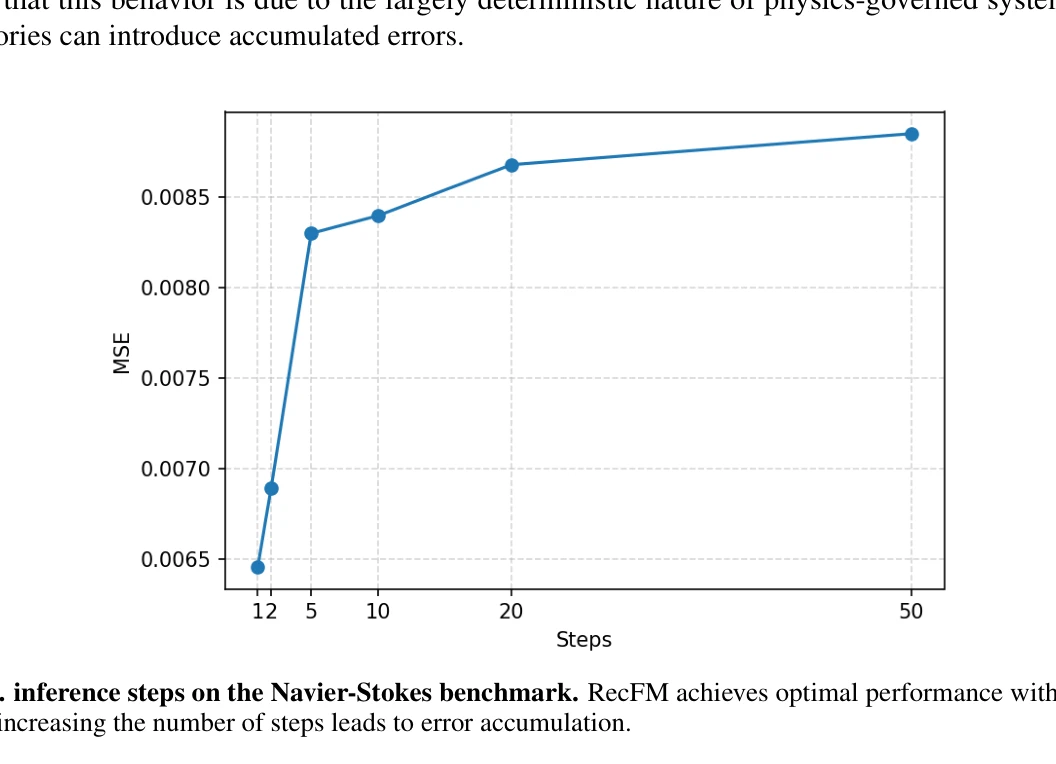
Figure 5. MSE vs. inference steps on the Navier-Stokes benchmark. RecFM achieves optimal performance with one- and two-s
속도 향상: 선도적인 diffusion 기반 emulator 대비 최대 20배의 inference 속도 향상을 달성했다.
정확도 개선: vanilla flow matching 대비 mean squared error(MSE)를 15% 이상 감소시켰다.
few-step 고충실도 생성: one-step 및 few-step(2-4 step) 생성에서 state-of-the-art multi-step solver에 필적하는 성능을 최초로 달성했다.
How
Figure 1. Comparison of flow matching paradigms. (a) Flow Matching (FM) learns a direct trajectory that transports sampl
Conditional Flow Matching(CFM)의 기본 primary trajectory에 더해, 서로 다른 inference-time traversal scale을 갖는 recursive한 secondary trajectory들을 도입
이 trajectory들이 동일한 underlying point에 해당하는 shared state x_t에서 교차하도록 커플링하여 cross-scale trajectory alignment를 구성
flow map X_{s,t}의 semigroup condition(self-consistency)에 기반한 손실 항을 추가하여 여러 discretization scale 간 예측이 일관되도록 정규화
1D wall-bouncing pendulum의 velocity retention coefficient α를 이용한 velocity attenuation 모델(v^(i+1) = α v^(i))을 물리적 영감으로 삼아 recursive trajectory 스케일링을 설계
Helmholtz Staircase 방정식 및 Navier-Stokes benchmark 등 과학적 벤치마크에서 NFE(number of function evaluations) 대비 검증 MSE를 측정하여 평가
Originality
기존 consistency model과 distillation 기법이 단일 축소된 trajectory에 집중하는 것과 달리, 여러 discretization scale에 걸친 trajectory family를 명시적으로 모델링하고 이들 간 정합성을 강제하는 새로운 관점 제시
물리적 직관(wall-bouncing pendulum의 recursive velocity attenuation)을 생성 모델의 multi-scale trajectory 설계에 직접 연결한 점이 독창적
explicit PDE 기반 시스템과 implicit data-driven dynamics 시스템을 통합적으로 다룰 수 있는 프레임워크 제안
Limitation & Further Study
발췌된 abstract 및 서론/방법론 초반부만으로는 recursive trajectory의 정확한 수학적 정의, 스케일 개수 선택 방식, α와 유사한 하이퍼파라미터의 학습/설정 방법이 불명확함
물리적 직관으로 사용된 1D wall-bouncing pendulum은 에너지 손실(마찰) 없는 이상적 모델을 가정하고 있어, 실제 복잡한 고차원 시스템으로의 일반화 근거가 충분히 논증되었는지 추가 검증이 필요
벤치마크가 Helmholtz Staircase, Navier-Stokes 등 특정 물리 시스템에 국한되어 있어, 더 다양한 실세계 기후/기상 데이터셋에 대한 확장성 검증이 후속 연구로 필요
consistency 손실과 CFM 손실 간의 균형(가중치) 설정이 학습 안정성에 미치는 영향에 대한 심층 분석이 요구됨
기반 연구SPECTER2 유사도 0.92로 Scientific Machine Learning for Dynamics와 Scientific AI for Physics and Environment가 맞닿아, 'MENO: MeanFlow-Enhanced Neural Operators for Dynamical Systems'가 이 ICML 2026 논문의 배경·대안·응용 맥락을 보완한다.