⚠️ 이 페이지의 요약·평가·해설은 생성형 AI(Claude)가 자동 생성한 2차적 분석물입니다. 논문 원문의 저작권은 원저작자에게 있으며, 정확한 내용은 원문(위 DOI·arXiv 등 출처)을 확인하세요.
라이선스: OpenReview 공개(오픈액세스)
Essence
PDE의 global interaction kernel이 급격한 spectral decay로 인해 low-rank로 근사 가능하다는 관찰에 기반하여, 기존 neural operator들의 global mixing 모듈을 compress-process-reconstruct라는 공통 low-rank 템플릿으로 통합하고, 이를 표준 Transformer primitive만으로 구현한 Low-Rank Spatial Attention (LRSA)을 제안한다.
Motivation
Known: FNO 및 그 변형들은 Fourier basis 기반 truncation으로 global mixing을 수행하며, Galerkin Transformer나 linear attention 변형들은 attention kernel을 근사하여 quadratic complexity를 완화한다. Transolver 등의 latent-token 방법은 point feature를 slice로 aggregation하여 near-linear complexity를 달성한다.
Gap: 기존 latent bottleneck 기반 방법들(Transolver 등)은 slice 배정의 degeneration을 막기 위해 비표준적인 aggregation이나 normalization 모듈에 의존해야 하며, 이는 hardware-optimized kernel(e.g., FlashAttention)의 직접적인 활용을 어렵게 하고 구현을 복잡하게 만든다.
Why: 표준 Transformer primitive만으로 low-rank global mixing을 구현할 수 있다면 구현이 간단해지고 hardware-optimized kernel과 호환되어 mixed-precision training의 안정성과 효율성을 높일 수 있으며, 이는 대규모 PDE 시뮬레이션의 실용적 확장성에 직접적으로 기여한다.
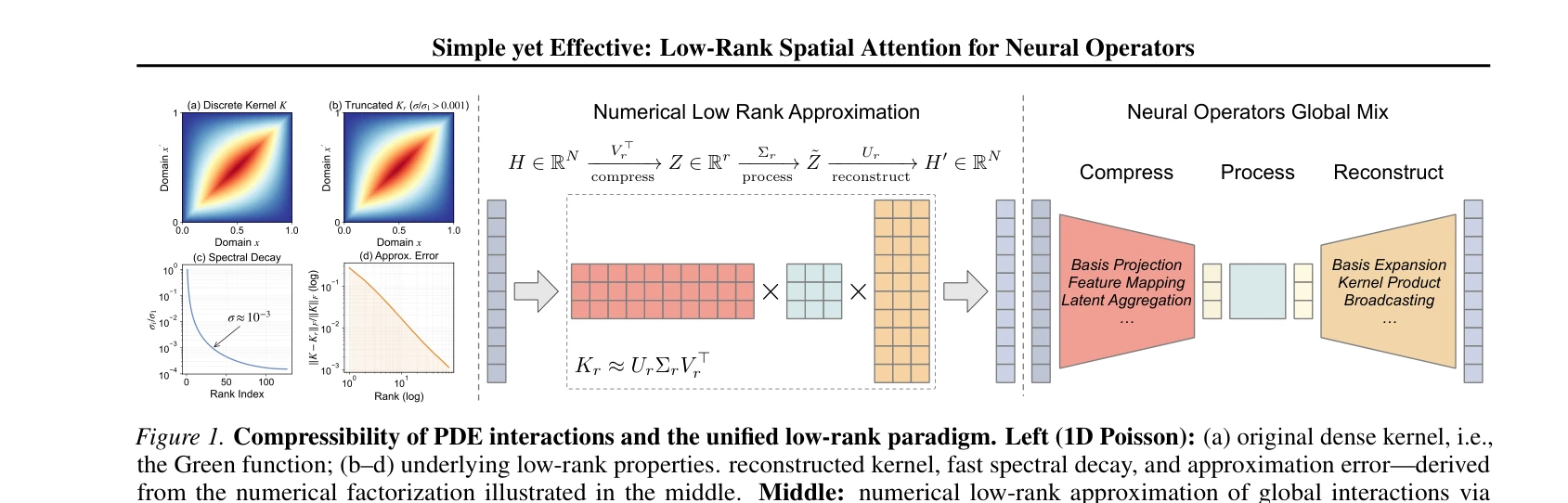
Approach: PDE 물리 시스템의 dense interaction kernel(예: Green's function)이 rapid spectral decay를 보여 numerical low-rank approximation(Kr≈UrΣrVr⊤)이 가능하다는 관찰로부터 출발하여, 다양한 neural operator의 global mixing 모듈을 compress-process-reconstruct라는 공유 low-rank 템플릿으로 재해석한다.
Achievement
통합 관점 제시: FNO, Galerkin/linear attention, Transolver 등 대표적 neural operator의 global mixing 모듈들을 compress-process-reconstruct라는 공통 low-rank 템플릿의 인스턴스로 통합적으로 해석하였다.
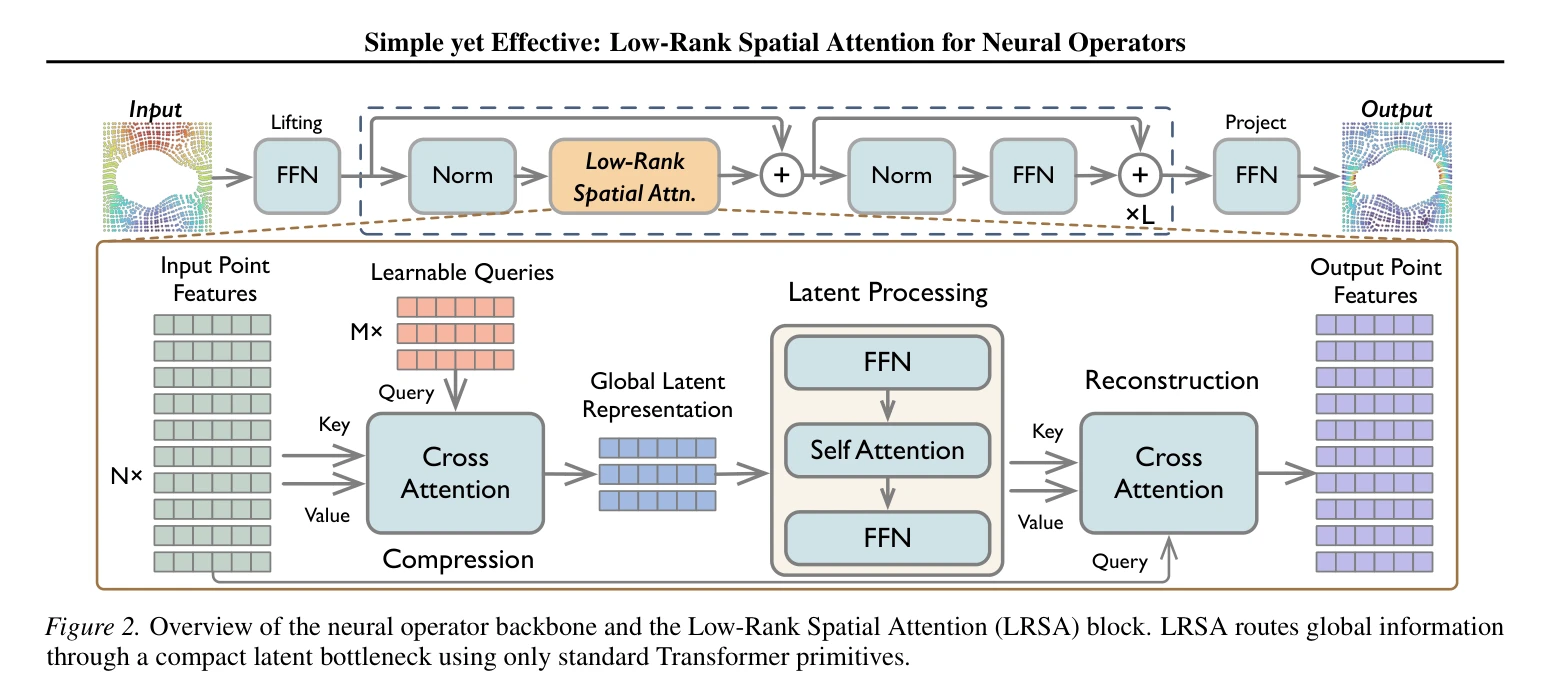
LRSA 제안: cross-attention을 이용한 compression, self-attention/FFN을 이용한 latent 내 processing, 별도의 cross-attention을 이용한 reconstruction으로 구성된, 순수하게 표준 Transformer primitive만으로 이루어진 minimal block을 설계하였다.
성능 향상: 다양한 PDE benchmark에서 second-best 방법 대비 평균 17% 이상의 error reduction을 달성하였다.
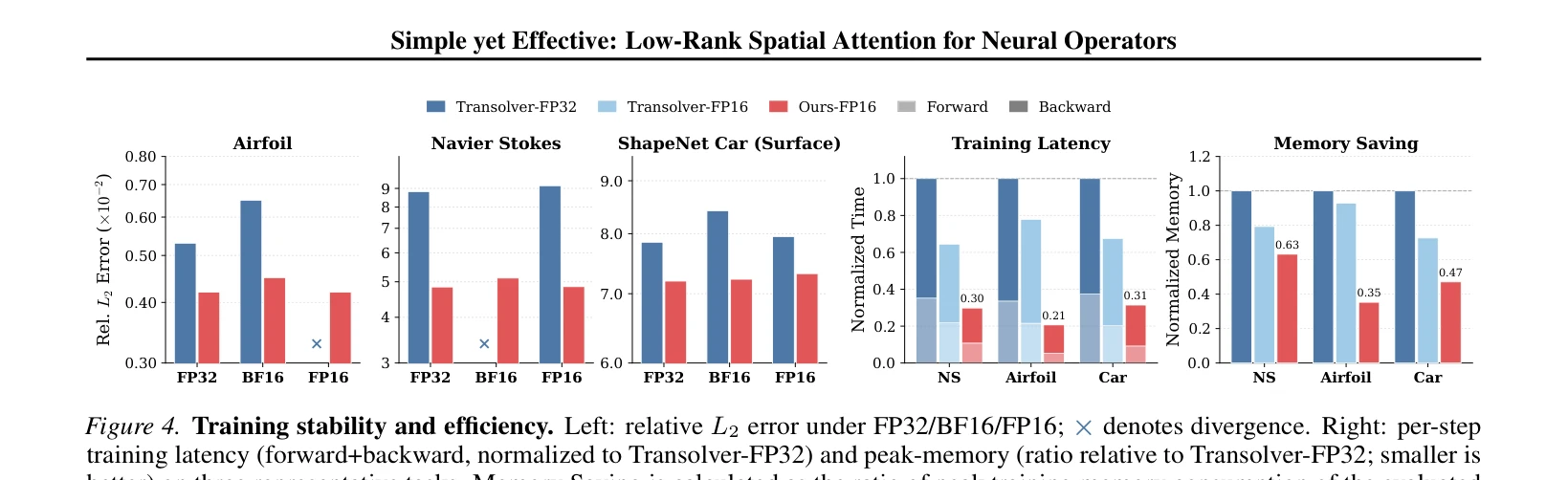
훈련 안정성/효율성: mixed-precision training에서 기존 방법 대비 우수한 안정성과 효율성을 보였으며, 이는 hardware-optimized kernel과의 호환성 덕분이다.
How
1D Poisson 등 PDE 예시를 통해 dense interaction kernel의 spectral decay 및 low-rank approximation 가능성을 수치적으로 분석 (Fig. 1)
Learnable latent query와 point feature 간 cross-attention을 통해 point feature를 compact latent token set으로 compression
Latent bottleneck 내에서 standard self-attention과 FFN을 이용해 latent token 간 global mixing 수행
두 번째 cross-attention을 이용해 latent bottleneck으로부터 spatial point feature를 reconstruction (compression basis와 reconstruction basis를 분리하여 유연성 확보)
다양한 PDE benchmark(구조화/비구조화 discretization 포함)에서 정확도, qualitative 성능(Fig. 3), FP32/mixed-precision 훈련 안정성(Fig. 4), rank 및 component에 대한 ablation(Fig. 5)을 통해 검증
Originality
PDE 물리 kernel의 spectral decay라는 물리적 관찰과 neural operator 아키텍처 설계라는 모델링 관점을 하나의 low-rank compress-process-reconstruct 템플릿으로 통합하여 설명한 이론적 프레임워크가 신선하다.
기존 latent bottleneck 방법들이 비표준 모듈(예: Gumbel-Softmax 기반 stochastic sampling, 추가 normalization)에 의존했던 것과 달리, 순수하게 표준 attention/normalization/FFN만으로 low-rank global mixing을 구현한 최초의 시도로 보인다.
Perceiver IO나 UPT와 달리 latent token을 backbone representation이 아닌 layer 내부의 low-rank routing 메커니즘으로 사용하여, spatial point를 여전히 주된 state로 유지하는 neural operator convention을 보존한 설계적 차별점이 있다.
Limitation & Further Study
논문 발췌에는 LRSA의 latent token 수(rank r)를 어떻게 선택하는지에 대한 이론적 가이드라인이 명확히 제시되지 않아, PDE 문제별 최적 rank 선택에 대한 추가 연구가 필요해 보인다.
제안된 low-rank 템플릿이 매우 급격한 spectral decay를 보이지 않는 PDE(예: 강한 국소적 특이점이나 충격파를 포함하는 문제)에서도 잘 작동하는지에 대한 이론적/실험적 검증이 부족하다.
두 번의 cross-attention과 self-attention을 포함하는 구조가 여전히 latent token 수와 point 수에 따라 계산 비용이 어떻게 확장되는지에 대한 명시적 복잡도 분석이 발췌 부분에서는 드러나지 않는다.
후속 연구로 다양한 도메인(3D 비정형 메쉬, 시계열 PDE)에서의 일반화 가능성과 rank 적응 메커니즘(adaptive rank selection)을 탐구할 필요가 있다.
총평: PDE interaction kernel의 low-rank 특성이라는 물리적 통찰을 활용해 기존 neural operator의 global mixing 설계를 통합적으로 재해석하고, 이를 순수 표준 Transformer 구성요소만으로 구현한 LRSA는 단순함과 효과성을 동시에 달성한 실용적이고 우아한 기여로 평가된다.
기반 연구SPECTER2 유사도 0.90로 Scientific Machine Learning for Dynamics와 Scientific Information Extraction and QA가 맞닿아, 'Splade v2: Sparse lexical and expansion model for information retrieval'가 이 ICML 2026 논문의 배경·대안·응용 맥락을 보완한다.
기반 연구SPECTER2 유사도 0.91로 Scientific Machine Learning for Dynamics와 Scientific Information Extraction and QA가 맞닿아, 'A survey on transformer context extension: Approaches and evaluation'가 이 ICML 2026 논문의 배경·대안·응용 맥락을 보완한다.