⚠️ 이 페이지의 요약·평가·해설은 생성형 AI(Claude)가 자동 생성한 2차적 분석물입니다. 논문 원문의 저작권은 원저작자에게 있으며, 정확한 내용은 원문(위 DOI·arXiv 등 출처)을 확인하세요.
라이선스: OpenReview 공개(오픈액세스)
Essence
SurvDiff는 mixed-type covariates, event time, right-censoring을 하나의 end-to-end diffusion model로 결합 생성하고 survival-tailored loss로 학습하여, 기존 방법 대비 covariate fidelity와 downstream survival 성능 모두를 개선하는 synthetic survival data 생성 기법이다.
Motivation
Known: Survival analysis에서는 time-to-event outcome과 right-censoring을 함께 다루는 것이 중요하며, tabular data 생성을 위한 diffusion model(TabDiff 등)이나 GAN/VAE 기반 방법(CTGAN, TVAE)이 존재하고, survival 전용 생성기법으로는 SurvivalGAN과 Ashhad framework가 있다.
Gap: 기존 survival 전용 생성 모델(SurvivalGAN, Ashhad)은 covariate와 event time/censoring을 분리된 다단계(staged) 파이프라인으로 생성해 end-to-end 학습이 불가능하고 error propagation에 취약하며, 일반 tabular diffusion model은 censoring mechanism과 time-to-event 구조를 전혀 고려하지 않아 survival 데이터에 그대로 적용하면 성능이 떨어진다.
Why: 임상 연구에서 합성 데이터가 실제 event-time distribution과 censoring mechanism을 충실히 재현하지 못하면 downstream 임상 결론에 편향을 초래할 수 있어, 이를 해결하는 신뢰성 있는 survival synthetic data 생성 기법은 데이터 접근성이 제한된 의료 환경에서 중요한 의의를 가진다.
Approach: SurvDiff는 covariate, event time, censoring indicator를 하나의 diffusion process 내에서 jointly 생성하며, censoring을 명시적으로 인코딩하는 survival-tailored loss function과 sparsity-aware weighting scheme을 도입하여 학습 안정성과 fidelity를 동시에 확보한다.
Achievement
최초의 end-to-end diffusion 기반 survival synthetic data 생성 모델 제안: SurvDiff는 covariate, event time, right-censoring을 별도 단계 없이 단일 모델에서 jointly 생성하는 최초의 diffusion model이다.
survival-tailored loss function 설계: time-to-event 구조와 censoring을 직접 인코딩하여 downstream survival task 성능을 최적화하는 loss를 제안했다.
sparsity-aware weighting scheme 도입: 초기 event time에 더 높은 가중치를, 후기 event time에 낮은 가중치를 부여함으로써 censoring으로 인한 데이터 희소성 문제를 완화하고 학습 안정성을 높였다.
다수의 의료 데이터셋에서 state-of-the-art 성능 입증: distributional fidelity와 survival model evaluation metric 모두에서 SurvivalGAN, Ashhad, TabDiff 등 기존 baseline을 능가함을 실험적으로 보였다.
How
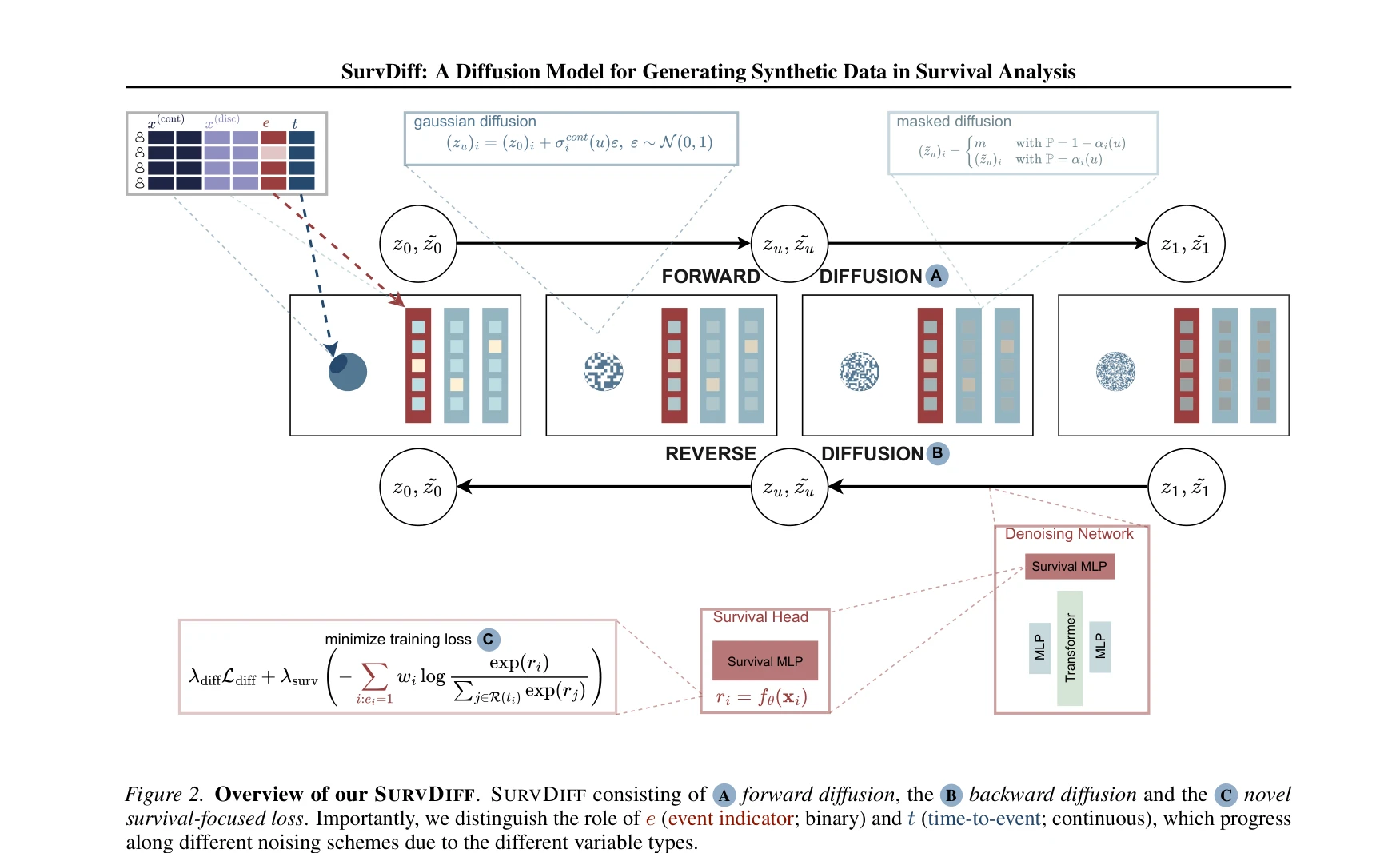
Forward diffusion 과정에서 mixed-type covariate(continuous/discrete), event time, censoring indicator를 결합된 latent space로 확산시키고, reverse process에서 이를 jointly denoising하여 synthetic sample을 생성한다.
survival-tailored loss는 time-to-event 구조(예: 순서 정보, 생존 함수 형태)를 반영하도록 설계되어 단순 reconstruction loss가 아닌 survival task에 최적화된 학습 신호를 제공한다.
censoring mechanism을 별도 지표로 보존하기 위해 event/censoring indicator를 covariate 및 event time과 함께 모델링한다.
sparsity-aware weighting scheme을 통해 right-censoring으로 인해 support가 적은 후기 event time에 대한 loss 기여도를 조정한다.
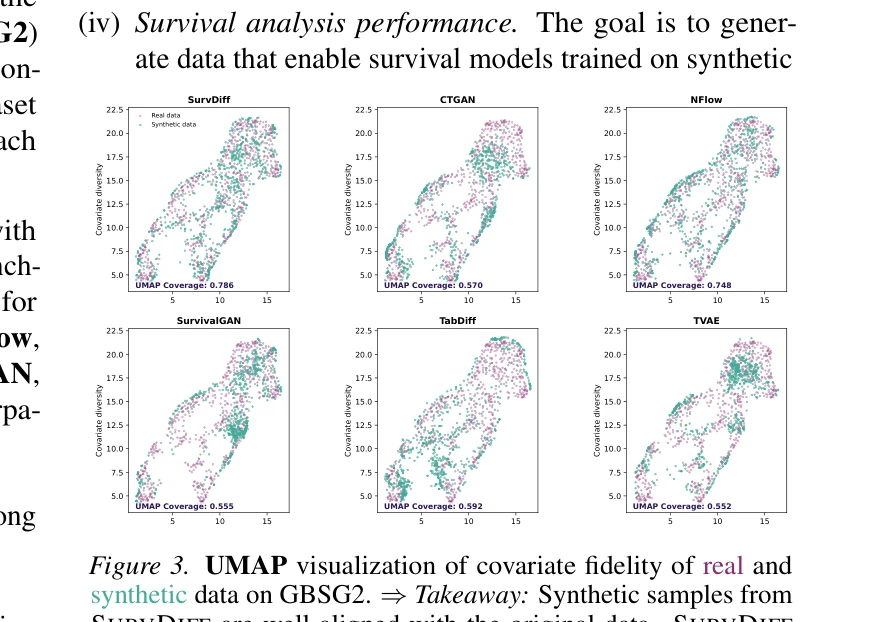
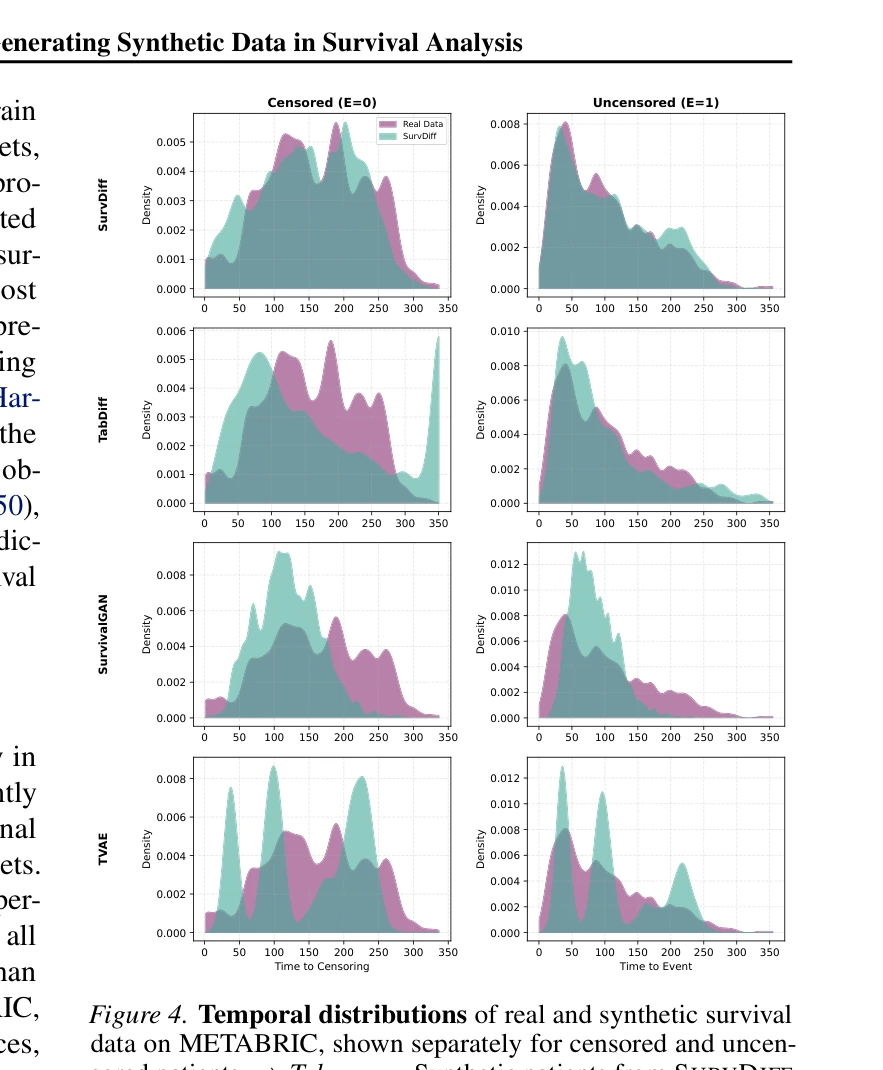
여러 의료 데이터셋(예: cancer, AIDS 등)에 대해 UMAP visualization과 temporal distribution 비교를 통해 covariate 및 event-time fidelity를 정성적으로, survival model evaluation metric을 통해 정량적으로 평가한다.
Originality
survival data 생성을 위한 최초의 end-to-end diffusion model로서, 기존의 다단계(staged) 접근(SurvivalGAN, Ashhad)과 차별화된 joint generative 구조를 제안했다.
censoring mechanism을 명시적으로 모델링하는 survival-tailored loss function과 sparsity-aware weighting scheme이라는 독창적 학습 기법을 도입했다.
일반적인 tabular diffusion model(TabDiff)을 survival 맥락에 단순 적용했을 때의 실패 사례를 분석하고 이를 극복하는 구조적 개선을 제시했다.
Limitation & Further Study
본문 발췌만으로는 다양한 censoring 비율(예: 매우 높은 censoring rate)이나 competing risks와 같은 복잡한 survival 설정에서의 일반화 성능이 충분히 검증되었는지 불분명하다.
실험이 의료 도메인의 특정 데이터셋에 국한되어 있어, 다른 도메인(예: 산업 reliability data)으로의 확장성에 대한 논의가 부족할 수 있다.
diffusion model 특성상 생성 속도(inference time)나 계산 비용에 대한 분석이 제시되지 않아 실제 임상 활용 시 practical overhead에 대한 후속 연구가 필요하다.
privacy 보장 수준(예: differential privacy 관련 지표)에 대한 정량적 평가가 명시적으로 다뤄지지 않아, 실제 patient-level data 대체 용도로 사용 시 privacy-utility trade-off에 대한 추가 검증이 요구된다.
총평: survival analysis라는 임상적으로 중요한 도메인에 diffusion model을 처음으로 end-to-end 적용하여 censoring mechanism까지 충실히 재현한 점에서 실질적 기여가 크며, 여러 의료 데이터셋에서의 실험적 우위가 설득력 있게 제시된 완성도 높은 연구이다.
기반 연구SPECTER2 유사도 0.91로 Statistical Causal Inference Methods와 AI-Driven Drug and Materials Discovery가 맞닿아, 'stVCR: spatiotemporal dynamics of single cells from time-series spatial transcriptomics'가 이 ICML 2026 논문의 배경·대안·응용 맥락을 보완한다.
기반 연구SPECTER2 유사도 0.91로 Statistical Causal Inference Methods와 Molecular Simulation and Generative Modeling가 맞닿아, 'A collaborative constrained graph diffusion model for the generation of realistic synthetic molecules'가 이 ICML 2026 논문의 배경·대안·응용 맥락을 보완한다.