⚠️ 이 페이지의 요약·평가·해설은 생성형 AI(Claude)가 자동 생성한 2차적 분석물입니다. 논문 원문의 저작권은 원저작자에게 있으며, 정확한 내용은 원문(위 DOI·arXiv 등 출처)을 확인하세요.
라이선스: OpenReview 공개(오픈액세스)
Essence
TSAssistant는 Target Safety Assessment(TSA) 보고서 생성을 Research Subagents와 Synthesis Subagents로 구성된 multi-agent workflow로 분해하고, 계층적 instruction architecture와 human-in-the-loop 정제 루프를 통해 재현 가능하고 근거 기반이며 전문가 통제가 가능한 보고서를 생성하는 프레임워크이다.
Motivation
Known: TSA는 유전학, 전사체, target homology, 약리학, 임상 데이터를 통합해 치료 표적의 안전성 위험을 평가하는 과정으로, AstraZeneca 5R 가이드라인과 같은 구조화된 프레임워크가 존재하지만 실행은 여전히 수작업이며 표준화되지 않았다. LLM 기반 agentic framework(tool-augmented LLMs, multi-agent coordination, RAG)와 AI Co-Scientist, AI Scientist 같은 autonomous scientific system이 지식 집약적 연구 작업에서 가능성을 보여주었다.
Gap: 기존 autonomous scientific agent들은 개방형 탐색(open-ended exploration)에 초점을 맞추고 있어, TSA처럼 사전 정의된 보고서 스키마에 따른 구조화된 증거 종합(structured evidence synthesis)과 규제 산업에서 요구되는 traceability, reproducibility, human accountability, section-level 전문가 통제를 충분히 지원하지 못한다.
Why: 제약 산업의 안전성 평가 워크플로우는 단순 자동화를 넘어 인간 감독, 투명한 근거 추적성, 세밀한 전문가 통제가 필수적이며, TSA는 후기 단계 임상 실패의 주요 원인인 표적 관련 안전성 문제를 조기에 발견해 신약개발 자원 낭비를 줄이는 데 핵심적인 역할을 하기 때문에 중요하다.
Approach: 여러 도메인(유전학, 전사체, homology, 약리학, 임상)에 특화된 Research Subagent와 이를 통합하는 Synthesis Subagent로 구성된 human-in-the-loop multi-agent 프레임워크를 설계하여, 각 subagent가 curated biomedical sources에서 근거를 검색·인용하고 계층적 instruction과 programmatic enforcement로 hard/soft constraint를 모두 만족시킨다.
Achievement
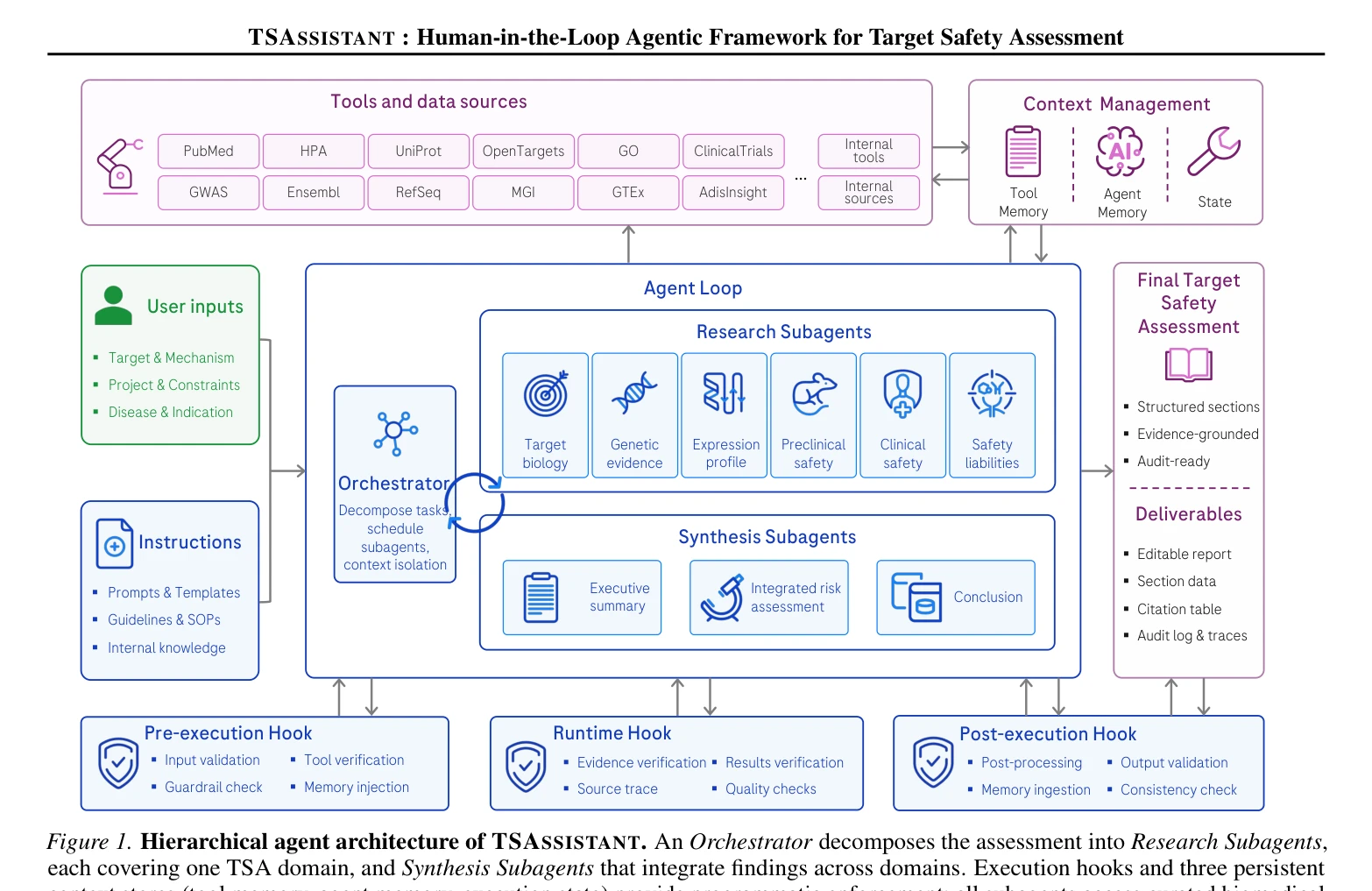
section-based multi-agent workflow: 각 TSA 도메인을 독립적으로 근거화하고 인용하는 특화된 subagent로 보고서 생성을 분해하는 구조를 제안함.
three-layer instruction architecture: 조정 로직(coordination logic), 도메인 전문성(domain skills), 런타임 사용자 의도(runtime user intent)를 분리하는 계층적 instruction 구조를 설계함.
programmatic enforcement layer: execution hooks와 persistent memory store를 통해 soft constraint(prompt)를 보완하는 hard constraint를 워크플로우 전반에 적용함.
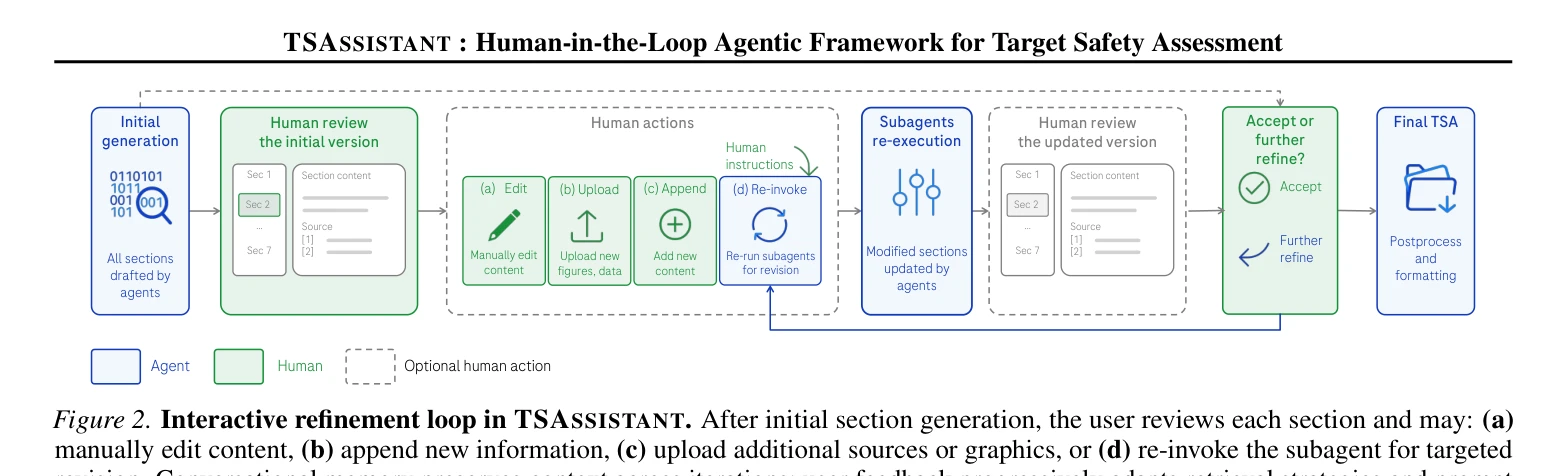
interactive refinement loop: tool 및 agent memory를 활용해 대화 맥락을 유지한 채 section 단위로 전문가가 검토·수정할 수 있는 HITL 루프를 구현함.
다차원 품질 평가: 단일 총체적 비교 대신 reproducibility, evidential grounding, task-level accuracy, controllability라는 네 가지 축으로 보고서 품질을 분해하여 평가함으로써, 높은 재현성과 근거성, 인간 참조와의 상당한 일치, 전문가 주도 정제의 순긍정 효과를 확인함.
How
Orchestrator가 사용자 입력(gene ID/symbol, UniProt accession, 질환 치료영역, 화합물 modality)을 받아 TSA 도메인별 Research Subagent(genetic, transcriptomic, homology, pharmacological, clinical)에 작업을 위임함
각 Research Subagent는 표준화된 tool interface를 통해 curated biomedical source(예: GTEx, DisGeNET 등 유사 데이터베이스)에서 증거를 검색·종합하고 개별적으로 인용 가능한 section을 생성함
Synthesis Subagent가 도메인 간 findings를 통합해 최종 보고서를 구성함
세 계층(coordination logic, domain expertise, user intent)으로 분리된 instruction architecture가 각 subagent의 행동을 형성함
총평: TSA라는 실질적이고 고부가가치의 제약 산업 문제에 대해 human-in-the-loop multi-agent 프레임워크를 체계적으로 설계하고, 재현성·근거성·정확성·통제성이라는 다차원 평가 틀을 제시한 실용적이고 시의적절한 연구이다. 다만 발췌된 내용만으로는 정량적 실험 결과와 일반화 가능성에 대한 충분한 근거가 부족해 추가 검증이 필요하다.
기반 연구SPECTER2 유사도 0.94로 LLM Reasoning and Safety Benchmarks와 Agentic AI for Scientific Automation가 맞닿아, 'Biomni: A General-Purpose Biomedical AI Agent'가 이 ICML 2026 논문의 배경·대안·응용 맥락을 보완한다.
기반 연구SPECTER2 유사도 0.94로 LLM Reasoning and Safety Benchmarks와 Agentic AI for Scientific Automation가 맞닿아, 'Kosmos: An AI Scientist for Autonomous Discovery'가 이 ICML 2026 논문의 배경·대안·응용 맥락을 보완한다.