⚠️ 이 페이지의 요약·평가·해설은 생성형 AI(Claude)가 자동 생성한 2차적 분석물입니다. 논문 원문의 저작권은 원저작자에게 있으며, 정확한 내용은 원문(위 DOI·arXiv 등 출처)을 확인하세요.
라이선스: OpenReview 공개(오픈액세스)
Essence
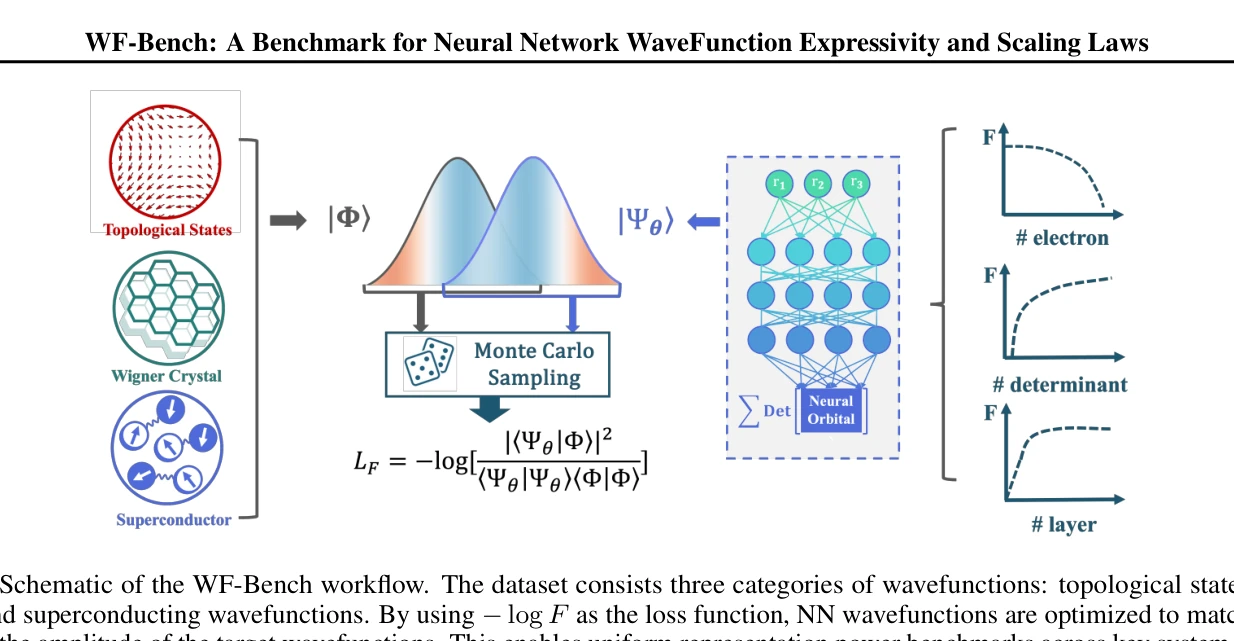
Figure 1. Schematic of the WF-Bench workflow. The dataset consists three categories of wavefunctions: topological states
WF-Bench는 topological states, Wigner crystals, superconducting wavefunction 등 30여 개의 유명한 many-body target wavefunction을 대상으로 neural network wavefunction의 표현력을 정량적으로 벤치마킹하는 데이터셋과 fidelity 기반 프로토콜을 제시하고, 전자 수·determinant 수·layer 수에 따른 경험적 scaling law를 도출한다.
Motivation
Known: Ferminet, Psiformer, DeepSolid, 메시지 패싱 기반 graph neural network 등 다양한 NN wavefunction 아키텍처가 ground-state 최적화, excited-state spectroscopy, real-time evolution 등 여러 quantum many-body 문제에서 뛰어난 성능을 보였다는 것은 알려져 있다.
Gap: 그러나 서로 다른 아키텍처와 물리적 시스템 클래스에 걸쳐 표현력(representation power)이 어떻게 변화하는지에 대한 체계적 이해가 부족하며, expressivity와 scaling law를 평가할 통일된 벤치마킹 프레임워크가 없다.
Why: NN wavefunction 설계는 계산 효율성과 표현 정확도 사이의 균형이 핵심인데, 이를 아키텍처 간에 공정하고 재현 가능하게 비교할 표준이 없으면 새로운 아키텍처의 개선 여부를 판단하거나 미래 설계를 가이드하기 어렵기 때문에 통일된 벤치마크가 중요하다.
Approach: 저자들은 topological states, superconducting wavefunctions, Wigner crystal 등 세 가지 물리적으로 중요한 클래스에 걸친 30개 이상의 target wavefunction으로 구성된 WF-Bench 데이터셋을 구축하고, Monte-Carlo 샘플링 기반의 fidelity 최적화 프로토콜을 통해 Psiformer와 Ferminet의 표현력을 시스템적으로 측정한다.
Achievement
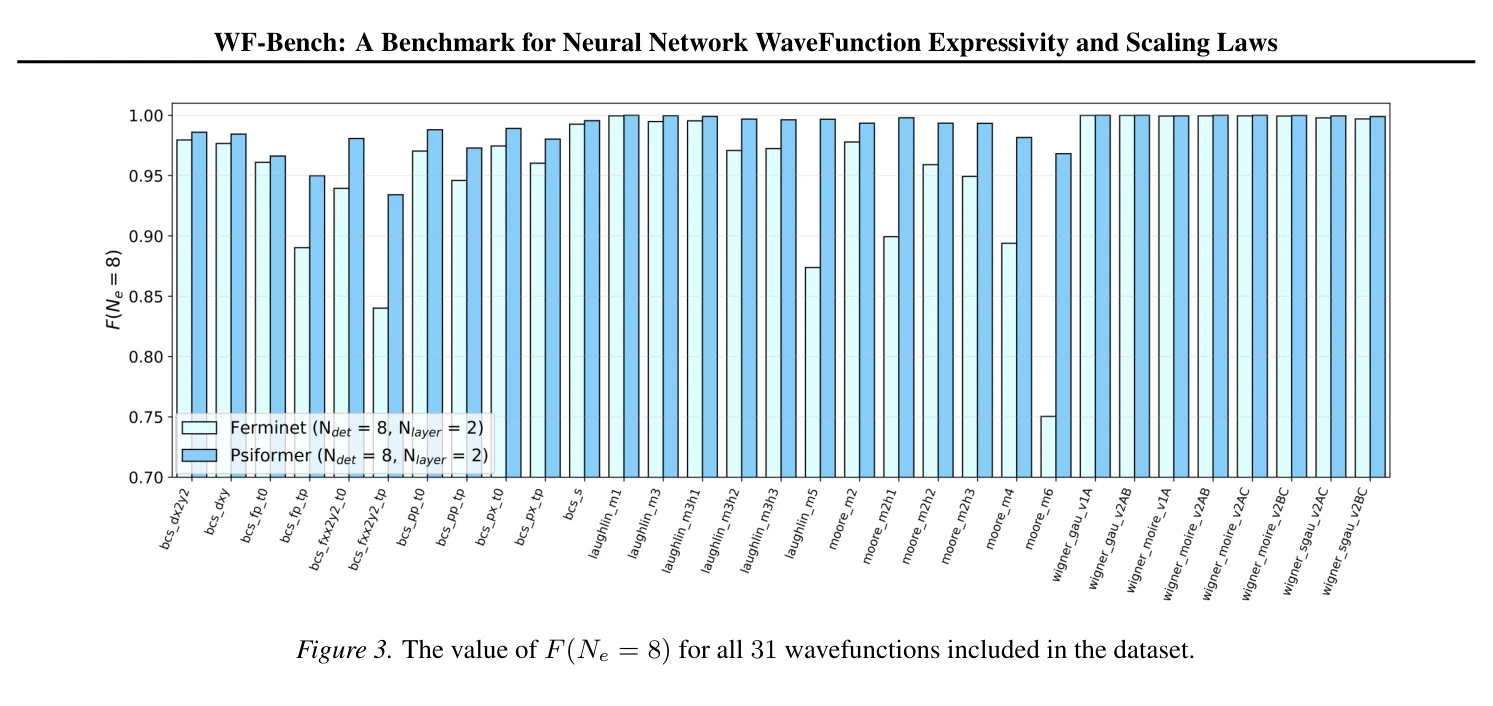
Figure 3. The value of F(Ne = 8) for all 31 wavefunctions included in the dataset.
포괄적 데이터셋 구축: topological states(Laughlin, Moore-Read 등), superconducting BCS-type wavefunctions, Wigner crystal 등 다양한 correlation 구조와 pairing symmetry, phase complexity를 아우르는 30개 이상의 target wavefunction 데이터셋을 제시했다.
통일된 벤치마킹 프로토콜 제안: −log F를 loss function으로 사용하는 fidelity 최적화 기반의 재현 가능한 학습·평가 프로토콜(Algorithm 1)을 도입하여 서로 다른 NN wavefunction 아키텍처 간 공정한 비교를 가능하게 했다.
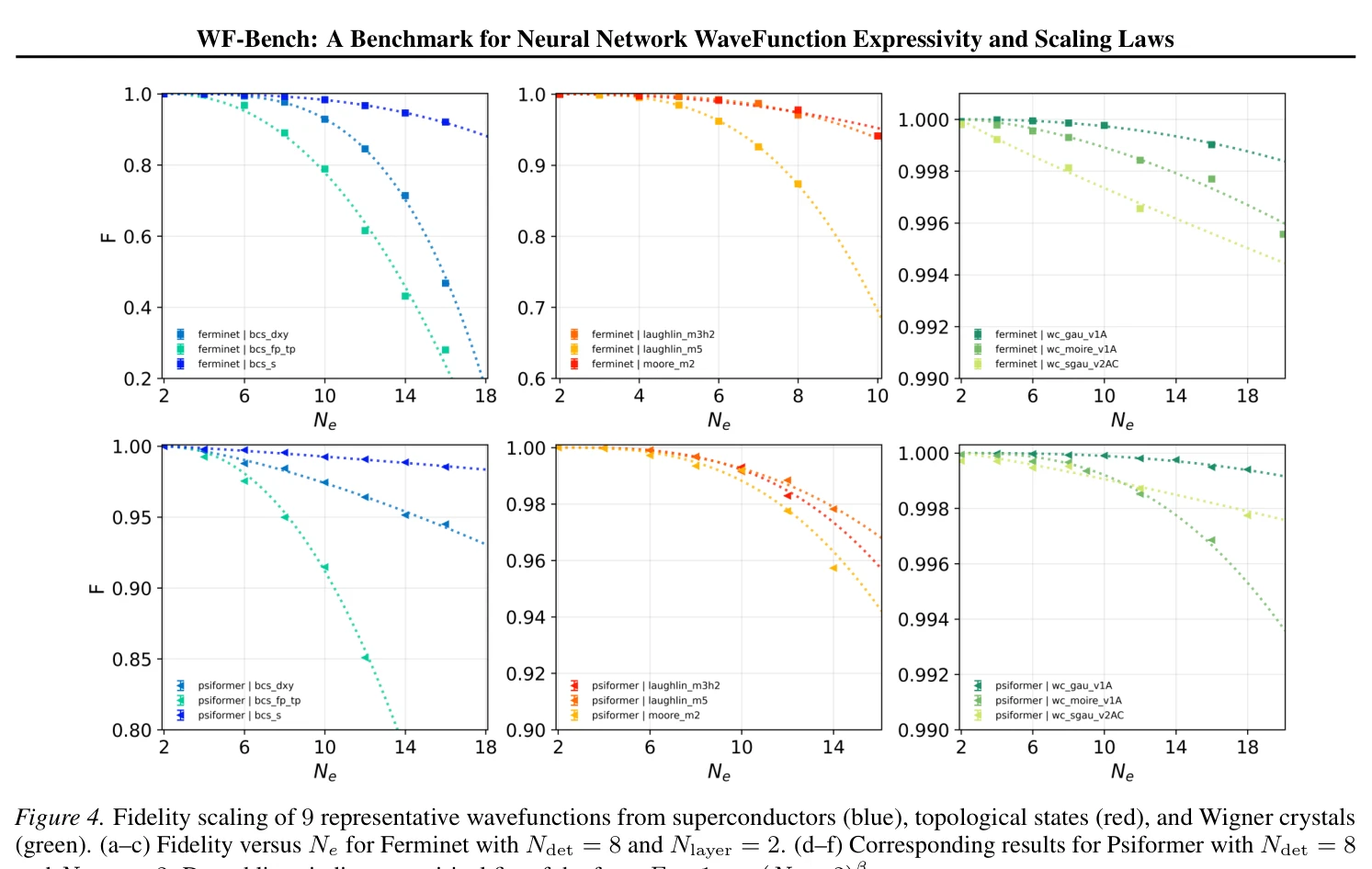
경험적 scaling law 발견: 전자 수 Ne에 대해 1−F가 power-law scaling을 따르고, determinant 수 Ndet와 layer 수 Nlayer 증가에 따라 fidelity가 초기 급격한 향상 후 포화(diminishing returns)되는 현상을 발견했으며, scaling exponent를 target wavefunction의 물리적 특성과 연관지었다.
How
Figure 4. Fidelity scaling of 9 representative wavefunctions from superconductors (blue), topological states (red), and
Slater determinant 또는 Pfaffian 형태로 fermionic antisymmetry를 구현한 30개 이상의 target wavefunction으로 데이터셋 구성
Fidelity F를 uniform metric으로 채택하고 −log F를 loss function으로 하여 NN wavefunction(phase와 amplitude 모두)을 target에 매칭
Monte Carlo 샘플링을 통해 burn-in, pretraining(topological states의 경우 pmix 샘플링), fidelity loss 최적화, 최종 fidelity 평가의 4단계로 구성된 Algorithm 1 프로토콜 실행
전자 수 Ne, determinant 수 Ndet, layer 수 Nlayer를 체계적으로 변화시키며 Psiformer와 Ferminet에 프로토콜 적용, F(Ne) scaling 곡선 및 saturation 거동 분석
Originality
기존 연구들이 특정 모델이나 특정 물리 영역(quantum chemistry, fractional quantum Hall 등)에 국한된 expressivity 분석을 수행한 것과 달리, topological/superconducting/Wigner crystal이라는 이질적인 세 물리 클래스를 하나의 데이터셋으로 통합한 최초의 시도
fidelity를 uniform metric으로 삼아 아키텍처 간 직접 비교가 가능한 재현 가능한 벤치마킹 프로토콜(Algorithm 1)을 공식화
Ne, Ndet, Nlayer라는 다중 축에 대해 scaling law를 동시에 관찰하고 이를 target wavefunction의 물리적 특성(pairing symmetry, phase complexity)과 연결하려는 시도
Limitation & Further Study
벤치마크가 Psiformer와 Ferminet 두 아키텍처에만 적용되어, message-passing 기반 GNN이나 DeepSolid 등 더 다양한 아키텍처에 대한 일반화 검증이 부족함
fidelity가 실제 물리적 관심 대상인 에너지, 상관함수 등과 어떤 관계를 갖는지에 대한 논의가 제한적이며, fidelity 최적화가 실제 ground-state 탐색 성능과 얼마나 상관되는지 추가 검증 필요
scaling exponent와 물리적 특성 간의 이론적 근거가 경험적 관찰에 머물러 있어, 왜 특정 클래스가 특정 scaling을 보이는지에 대한 해석적 설명이 부족함
시스템 크기(Ne)가 상대적으로 작은 범위(예: Ne=8 근방)에서 주로 실험되어, 더 큰 스케일에서도 동일한 power-law가 유지되는지 확인이 필요함
기반 연구SPECTER2 유사도 0.89 기준으로 'WF-Bench: A Benchmark for Neural-Network WaveFunction Expressivity and Scaling Laws'의 AI4S 방법론을 'Extending the range of graph neural networks with global encodings'의 과학 생산·평가 맥락과 함께 보면 연구 자동화의 의미를 입체적으로 볼 수 있다.
기반 연구SPECTER2 유사도 0.90 기준으로 'WF-Bench: A Benchmark for Neural-Network WaveFunction Expressivity and Scaling Laws'의 AI4S 방법론을 'Stochastic Neural Networks for Quantum Devices'의 과학 생산·평가 맥락과 함께 보면 연구 자동화의 의미를 입체적으로 볼 수 있다.
기반 연구SPECTER2 유사도 0.91로 Computational Molecular Design와 Molecular Simulation and Generative Modeling가 맞닿아, 'A Systematic Survey and Benchmark of Deep Learning for Molecular Property Prediction in the Foundation Model Era'가 이 ICML 2026 논문의 배경·대안·응용 맥락을 보완한다.