저자: Joseph L. Watson, David Juergens, Nathaniel R. Bennett, Brian L. Trippe, Jason Yim, Helen E. Eisenach, Woody Ahern, Andrew J. Borst, Robert J. Ragotte, Lukas F. Milles, Basile I. M. Wicky, Nikita Hanikel, Samuel J. Pellock, Alexis Courbet, William Sheffler, Jue Wang, Preetham Venkatesh, Isaac Sappington, Susana Vázquez Torres, Anna Lauko, Valentin De Bortoli, Emile Mathieu, Sergey Ovchinnikov, Regina Barzilay, Tommi S. Jaakkola, Frank DiMaio, Minkyung Baek, David Baker | 날짜: 2023-08-31 | DOI: 10.1038/s41586-023-06415-8 📄 PDF
Essence
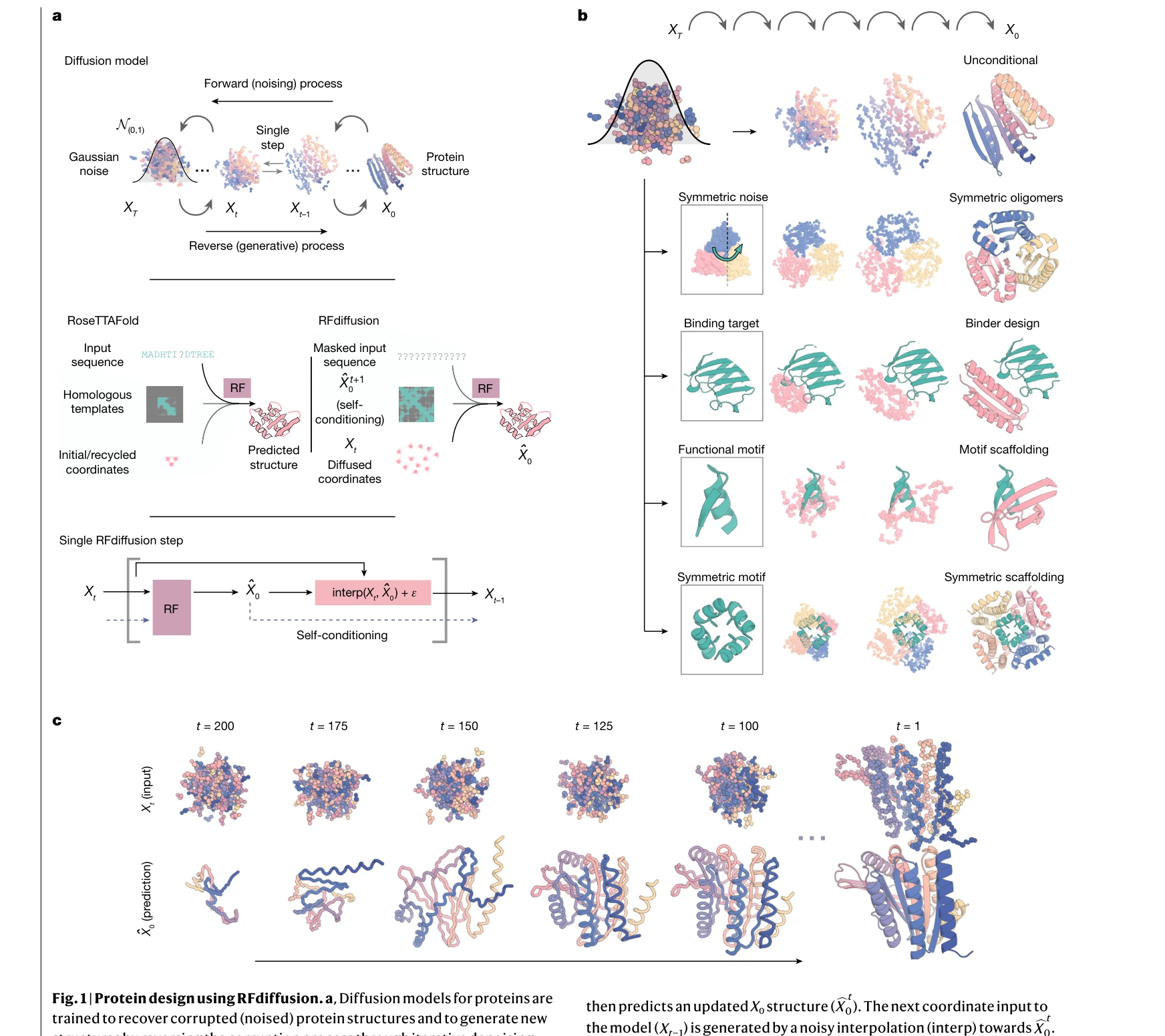
Fig. 1 | Protein design using RFdiffusion. a, Diffusion models for proteins are
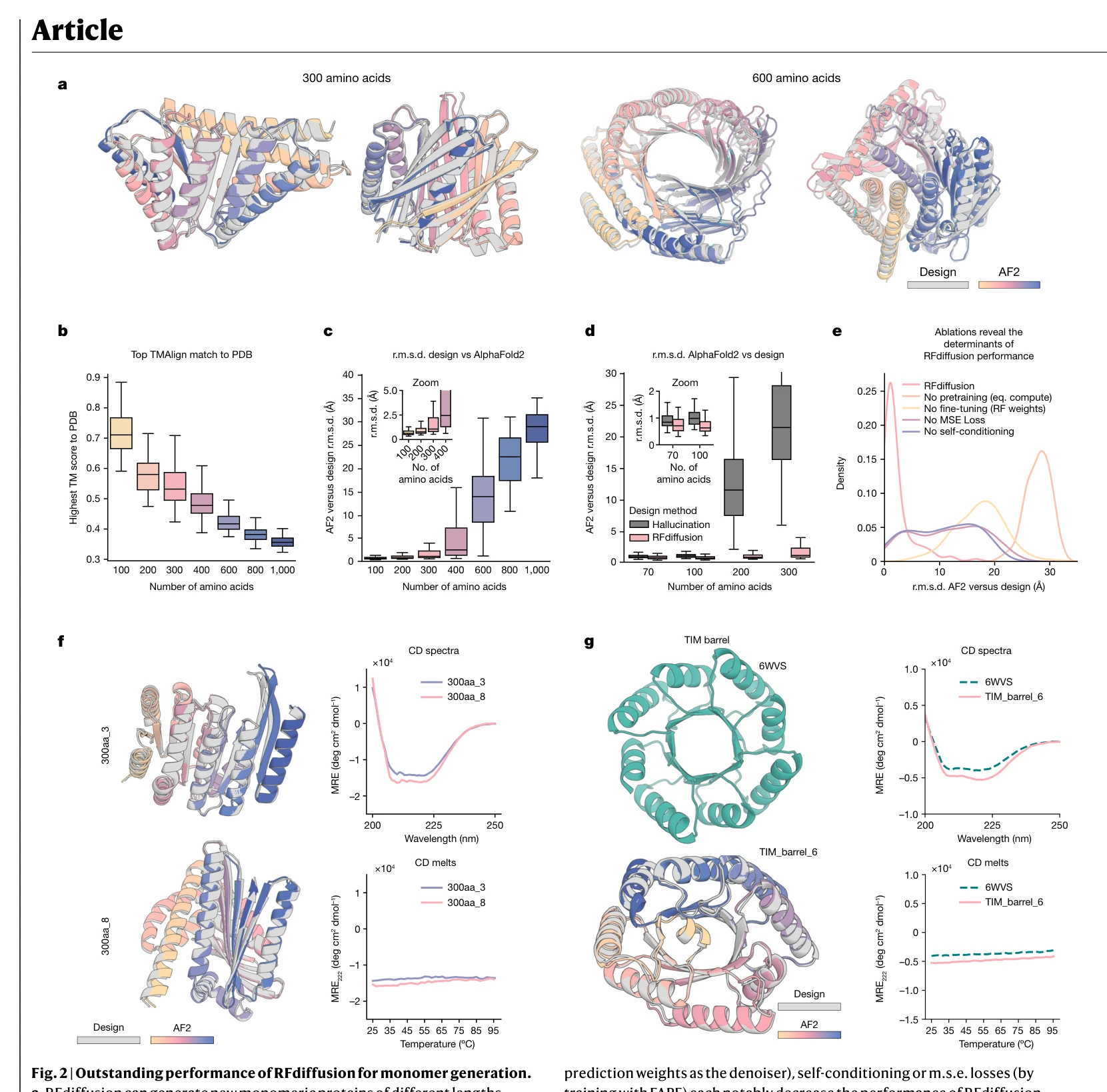
RFdiffusion은 RoseTTAFold 구조 예측 네트워크를 단백질 구조 denoising 작업으로 fine-tuning하여 다양한 단백질 설계 문제(de novo binder, 대칭 올리고머, 효소 scaffolding 등)를 해결하는 생성형 diffusion model이다.
Evaluation
Novelty: 4/5 Technical Soundness: 3/5 Significance: 4/5 Clarity: 4/5 Overall: 4/5
총평: RFdiffusion은 구조 예측 네트워크의 강력한 표현력을 generative diffusion model로 전환하여 단백질 설계의 다양한 도전을 통일적으로 해결하는 획기적 방법론이며, 광범위한 실험적 검증과 cryo-EM 구조 확인으로 그 실용성과 정확성을 입증한 매우 중요한 기여이다.
같이 보면 좋은 논문
다른 접근동일 저자 그룹의 단백질 설계 프레임워크로 매우 밀접하게 관련된 후속 또는 병행 연구
다른 접근de novo 단백질 설계 문제에 대한 관련 응용 연구임
다른 접근단백질 구조 설계를 위한 생성 모델의 대안적 접근법을 제시함
다른 접근단백질 구조 및 기능 설계를 위한 다른 생성 모델 접근이다.
다른 접근diffusion 기반 단백질 설계 방법론의 확장 연구임
후속 연구SPECTER2 유사도 0.93 기준으로 'MotifCraft: scalable functional protein binder design with AlphaFold2 hallucination'의 AI4S 방법론을 'De novo design of protein structure and function with RFdiffusion'의 과학 생산·평가 맥락과 함께 보면 연구 자동화의 의미를 입체적으로 볼 수 있다.
후속 연구SPECTER2 유사도 0.92 기준으로 'MutAtlas: A PDB-Wide Energy-Guided Atlas of Protein Mutation Effects'의 AI4S 방법론을 'De novo design of protein structure and function with RFdiffusion'의 과학 생산·평가 맥락과 함께 보면 연구 자동화의 의미를 입체적으로 볼 수 있다.
후속 연구SPECTER2 유사도 0.92 기준으로 'PROPHET: Phylogenetically Robust Antiviral Peptide Design Against Heterogeneous Evolutionary Trajectories'의 AI4S 방법론을 'De novo design of protein structure and function with RFdiffusion'의 과학 생산·평가 맥락과 함께 보면 연구 자동화의 의미를 입체적으로 볼 수 있다.
후속 연구SPECTER2 유사도 0.92 기준으로 'SwitchCraft: A Programmatic Framework for Designing State-Switching Proteins'의 AI4S 방법론을 'De novo design of protein structure and function with RFdiffusion'의 과학 생산·평가 맥락과 함께 보면 연구 자동화의 의미를 입체적으로 볼 수 있다.
후속 연구SPECTER2 유사도 0.93로 Computational Molecular Design와 AI-Driven Drug and Materials Discovery가 맞닿아, 'De novo design of protein structure and function with RFdiffusion'가 이 ICML 2026 논문의 배경·대안·응용 맥락을 보완한다.
후속 연구SPECTER2 유사도 0.92로 Computational Molecular Design와 AI-Driven Drug and Materials Discovery가 맞닿아, 'De novo design of protein structure and function with RFdiffusion'가 이 ICML 2026 논문의 배경·대안·응용 맥락을 보완한다.
후속 연구SPECTER2 유사도 0.92 기준으로 'Flexible Kernels for Protein Property Prediction'의 AI4S 방법론을 'De novo design of protein structure and function with RFdiffusion'의 과학 생산·평가 맥락과 함께 보면 연구 자동화의 의미를 입체적으로 볼 수 있다.
후속 연구SPECTER2 유사도 0.91 기준으로 'Interpretability Driven Evolutionary Approach for the Design of Biological Sequences'의 AI4S 방법론을 'De novo design of protein structure and function with RFdiffusion'의 과학 생산·평가 맥락과 함께 보면 연구 자동화의 의미를 입체적으로 볼 수 있다.
후속 연구SPECTER2 유사도 0.91 기준으로 'Learning Protein Fitness Landscapes with Multimodal Stability Priors'의 AI4S 방법론을 'De novo design of protein structure and function with RFdiffusion'의 과학 생산·평가 맥락과 함께 보면 연구 자동화의 의미를 입체적으로 볼 수 있다.
후속 연구de novo binder 설계 성능을 개선한 후속 연구이다.
응용 사례RFdiffusion 방법론을 특정 단백질 설계 문제에 적용한 사례이다.