저자: Pierfrancesco Beneventano, Riccardo Neumarker, Theodoros Evgeniou, Marc Gong Bacvanski, Kushagra Tiwary, Emanuele Rimoldi, Mehdi Hajoub, Yulu Gan, Qianli Liao, Mahmoud Abdelmoneum, Liu Ziyin, Tomer Galanti, Andrea Pinto, Tomaso Poggio | 날짜: 2026 | URL: https://openreview.net/forum?id=iAfYyiCzev📄 PDF
⚠️ 이 페이지의 요약·평가·해설은 생성형 AI(Claude)가 자동 생성한 2차적 분석물입니다. 논문 원문의 저작권은 원저작자에게 있으며, 정확한 내용은 원문(위 DOI·arXiv 등 출처)을 확인하세요.
라이선스: OpenReview 공개(오픈액세스)
Essence
이 논문은 AI scientist 시스템들이 가설 생성부터 논문 작성, 리뷰까지 수행하는 상황에서, agent count·autonomy 같은 총괄적 지표가 시스템의 실질적 기여나 신뢰성을 설명하지 못한다고 지적하며, "verifier-matched autonomy"라는 원칙과 task coverage·artifact type·verification regime의 3차원 프레임워크를 제안한다.
Motivation
Known: AI scientist 시스템은 문헌 검색, 가설 제안, 실험 설계·실행, 분석, 논문 작성, 리뷰와 같은 연구 라이프사이클 전반에 걸쳐 점점 더 자율적으로 참여하고 있으며, 기존 서베이들은 이러한 시스템들을 tool, co-author, founder, autonomous scientist 등의 라벨로 분류해왔다.
Gap: 기존의 agent count, tool use, autonomy 같은 총괄적(aggregate) 기술어는 시스템이 실제로 무엇을 기여하는지, 어떤 artifact를 만드는지, 그 claim을 무엇이 검증할 수 있는지를 specify하지 못하며, 기존 서베이들은 시스템을 나열하는 exhaustive inventory에 그쳐 claim-bearing layer에서의 검증 병목을 다루지 못한다.
Why: AI scientist 시스템이 claim-bearing scientific artifact(섹션, survey, full paper, review, rebuttal 등)를 생산하는 방향으로 이동하면서, 그 claim이 충분히 검증되기도 전에 artifact가 완결된 것처럼 보이는 "closure failure" 위험이 커지고 있으며, 이는 review, credit, institutional decision에 직접적 영향을 미치기 때문에 중요하다.
Approach: 연구자들은 AI scientist 시스템의 claim-bearing layer를 정의하고, task coverage, artifact type, verification regime이라는 세 축으로 구성된 프레임워크를 통해 시스템들을 positioning하는 개념적·분석적 접근을 취한다.
Achievement
Claim-bearing scope 정의: 자동화된 워크플로우가 review, credit, institutional decision에 영향을 미치는 scholarly artifact로 전환되는 지점을 claim-bearing layer로 명시적으로 정의했다.
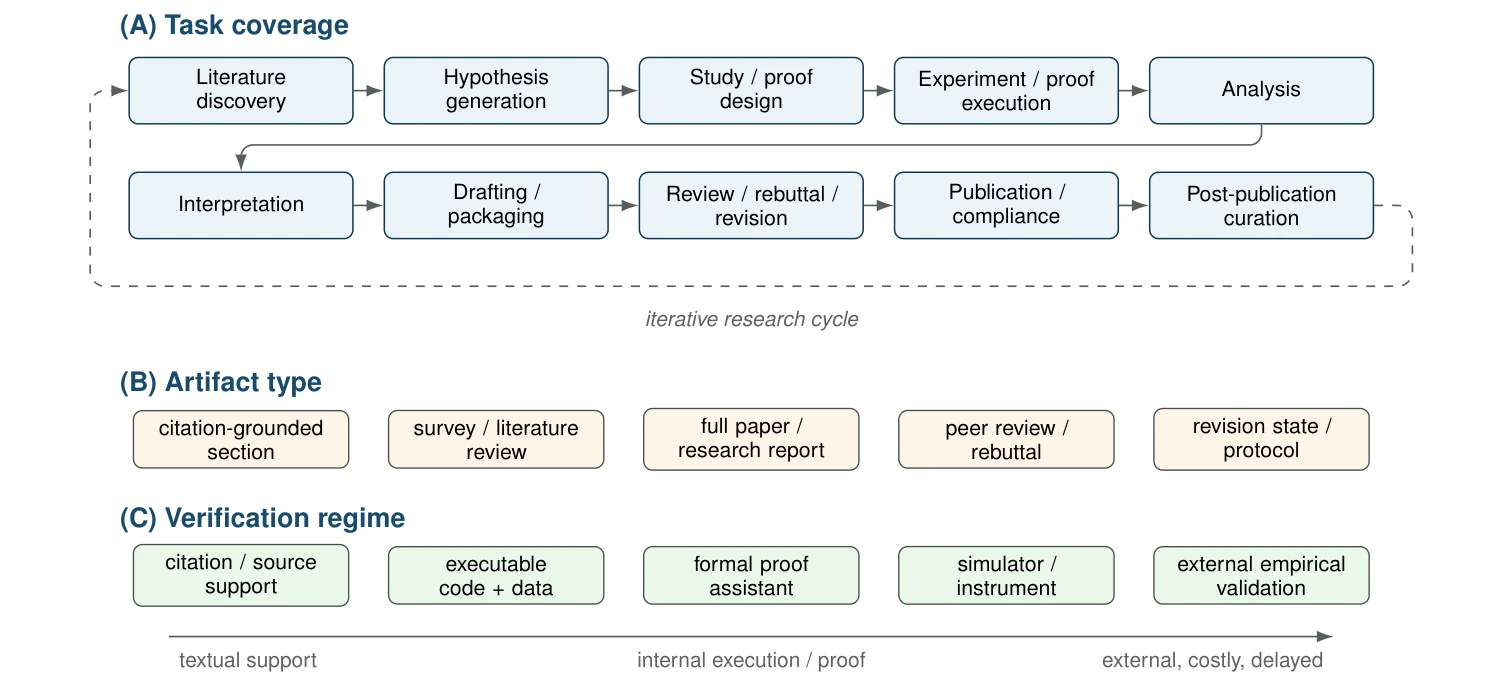
3차원 프레임워크 제시: task coverage(연구 라이프사이클 단계), artifact type(citation-grounded section, survey, full paper, peer review/rebuttal, revision state/protocol), verification regime(citation support, executable code+data, formal proof assistant, simulator/instrument, external empirical validation)이라는 세 축으로 대표적 시스템군들을 positioning했다.
verifier-matched autonomy 원칙 종합: 시스템의 autonomy가 agent count가 아니라 이용 가능한 verifier의 strength, cost, latency에 상대적으로만 의미를 가진다는 원칙을 제시했다.
평가·provenance·governance에 대한 함의 도출: tool, co-author, founder 같은 라벨이 시스템 전체의 속성이 아니라 workflow-specific role로 부여되어야 함을 논증하고, closure failure 개념을 통해 평가·거버넌스에 대한 시사점을 도출했다.
How
citation-grounded writing systems, survey generators, full-paper research pipeline, review agents, domain-specific discovery systems 등 대표적 시스템 패밀리들을 문헌 조사를 통해 수집
각 시스템을 Panel A(task coverage: literature discovery부터 post-publication curation까지의 iterative research cycle), Panel B(artifact type), Panel C(verification regime: textual support, internal execution/proof, external·costly·delayed 검증)에 따라 위치시킴
evidence tier 개념을 도입해 peer-reviewed paper·reproducible artifact와 public demo·informal repository 간 증거 강도를 구분
세 가지 질문(연구 라이프사이클 어디에 개입하는가, 어떤 artifact를 책임지는가, 어떤 verifier가 주요 claim을 governance하는가)을 각 시스템에 적용하는 방식으로 프레임워크를 도출 및 적용
Originality
기존 서베이들이 시스템의 exhaustive inventory나 architecture 나열에 초점을 맞춘 것과 달리, claim-bearing layer라는 새로운 분석 단위를 isolate하여 제시함
autonomy를 scalar property가 아니라 verifier의 strength/cost/latency에 상대적인 개념으로 재정의한 verifier-matched autonomy라는 새로운 원칙을 도입함
tool/co-author/founder 라벨을 시스템 전체 속성이 아닌 workflow-specific role로 재해석하는 관점 전환을 제시함
closure failure라는 새로운 위험 개념을 정식화하여, fluent하고 citation이 있고 code가 실행되는 artifact도 여전히 claim이 검증되지 않을 수 있음을 지적함
Limitation & Further Study
본문 발췌 상 실증적 실험이나 정량적 평가 없이 개념적·서술적 프레임워크 제시에 그치는 것으로 보이며, 프레임워크의 실제 적용 가능성이나 재현성에 대한 검증이 부족할 수 있음
시스템 분류가 저자들의 주관적 판단에 의존할 가능성이 있어, 세 차원(task coverage, artifact type, verification regime) 간의 경계 설정이나 채점 기준이 명확히 정량화되지 않으면 다른 연구자들이 일관되게 적용하기 어려울 수 있음
후속 연구로는 이 프레임워크를 실제 다수의 AI scientist 시스템에 적용하여 검증하는 실증 연구, verifier strength를 정량적으로 측정하는 지표 개발, closure failure를 탐지하는 자동화된 방법론 개발 등이 필요해 보임
총평: AI scientist 시스템의 급증 속에서 단순한 라벨링을 넘어 claim-bearing layer와 verifier-matched autonomy라는 개념적 도구를 제시한 시의적절하고 통찰력 있는 워크숍 논문이나, 실증적 검증이나 정량적 적용 사례가 부족해 향후 후속 연구를 통한 검증이 필요하다.
기반 연구SPECTER2 유사도 0.93로 LLM Reasoning and Safety Benchmarks와 Agentic AI for Scientific Automation가 맞닿아, 'Discoverybench: Towards data-driven discovery with large language models'가 이 ICML 2026 논문의 배경·대안·응용 맥락을 보완한다.
기반 연구SPECTER2 유사도 0.93로 LLM Reasoning and Safety Benchmarks와 AI-Assisted Academic Scholarly Communication가 맞닿아, 'OpenReview Should be Protected and Leveraged as a Community Asset for Research in the Era of Large Language Models'가 이 ICML 2026 논문의 배경·대안·응용 맥락을 보완한다.
기반 연구SPECTER2 유사도 0.94 기준으로 'Agent Systems for Academic Research Automation'의 AI4S 방법론을 'ARA: Agentic Reproducibility Assessment For Scalable Support Of Scientific Peer-Review'의 과학 생산·평가 맥락과 함께 보면 연구 자동화의 의미를 입체적으로 볼 수 있다.