Agent-Guided De Novo Design of Nanobody Binders Against a Novel Cancer Target
저자: Yue Zhao, Melih Yilmaz, Edward Lee, Chuanyui Teh, Lan Guo, Kemal Sonmez, Luca Giancardo, Gordon Trang, Fangda Xu, Madelyn Espinosa-Cotton, Nai-Kong Cheung, Jiwon Kim, Nina Cheng | 날짜: 2026 | URL: https://openreview.net/forum?id=HhfzpAPPpZ📄 PDF
⚠️ 이 페이지의 요약·평가·해설은 생성형 AI(Claude)가 자동 생성한 2차적 분석물입니다. 논문 원문의 저작권은 원저작자에게 있으며, 정확한 내용은 원문(위 DOI·arXiv 등 출처)을 확인하세요.
라이선스: OpenReview 공개(오픈액세스)
Essence
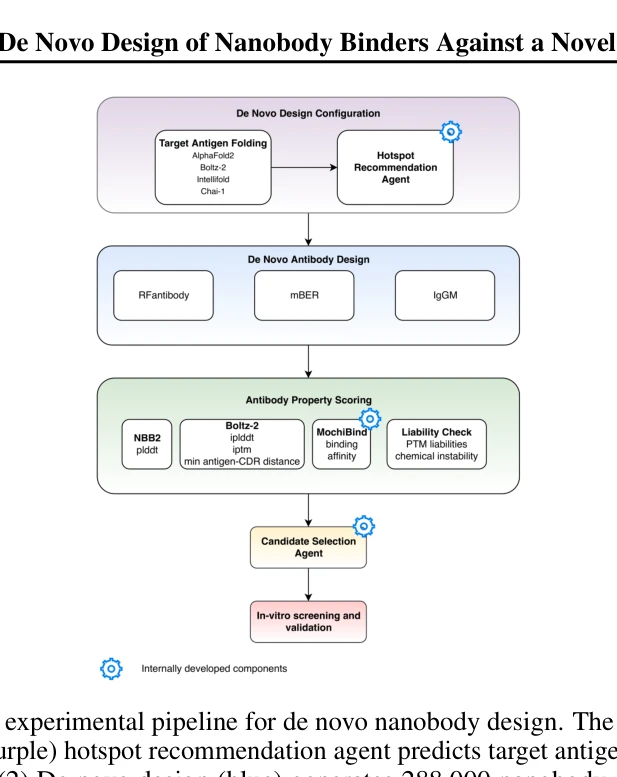
Figure 1. Integrated computational and experimental pipeline for de novo nanobody design. The workflow proceeds through
에이전트 기반 워크플로우를 활용해 실험적 구조나 사전 항체 정보 없이도 새로운 암 표적(Desmoplastic Small Round Cell Tumor target)에 대한 nanobody 결합체를 de novo로 설계하고, yeast surface display와 SPR을 통해 46개의 nanomolar~sub-nanomolar 결합체(KD 0.66-305 nM)를 실험적으로 검증했다.
Motivation
Known: 기존 항체 발굴 방법(동물 면역화, phage display, 합성 라이브러리 스크리닝)은 성공 사례가 있지만 epitope 선택과 서열/파라토프 구조에 대한 통제력이 제한적이며 수개월의 반복 최적화가 필요하다. AlphaFold, Boltz, Chai, RFdiffusion, IgGM, mBER, ESM2 등 ML 기반 구조예측 및 de novo 설계 도구들이 개발되어 명시적 epitope 통제가 가능한 단백질 결합체 설계를 가능케 했다.
Gap: 다양한 ML 모델을 통합된 발굴 파이프라인으로 결합하는 것은 여전히 병목이며, 보고된 실험적 hit rate는 0.1%~39%로 편차가 크다. 특히 실험적으로 해석된 구조가 없고 사전 항체 정보가 전혀 없는 진정한 novel target(다중 도메인 구조, 유연한 도메인 간 영역, 잠재적 glycosylation 부위 보유)에 대한 검증은 최근에야 등장하기 시작했다.
Why: 실험적 구조나 선행 항체 정보 없이도 컴퓨터적으로 예측된 구조만으로 novel target에 대해 고친화도 nanobody를 설계할 수 있음을 입증한다면, 치료용 항체 발굴의 속도와 범위를 근본적으로 확장하고 기존에 다루기 어려웠던 cryptic epitope 및 미지 표적에 대한 신약 개발 가능성을 열 수 있다.
Approach: hotspot recommendation agent로 epitope을 식별하고, 세 가지 독립적 de novo 설계 방법(RFantibody, IgGM, mBER)과 다중 예측 항원 구조를 결합해 대규모 후보군을 생성한 뒤, 구조/서열 기반 다중 지표 스코어링과 Pareto 기반 후보 선택 에이전트로 필터링하고, yeast surface display 및 SPR로 실험 검증하는 통합 workflow를 제시한다.
Achievement
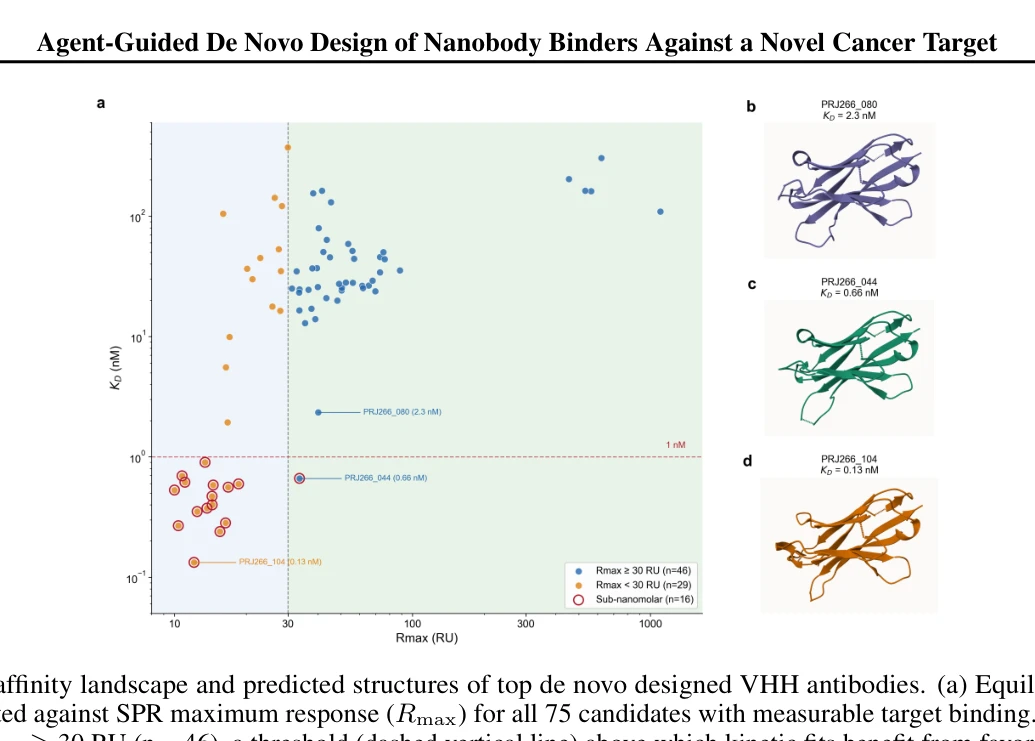
Figure 2. Binding affinity landscape and predicted structures of top de novo designed VHH antibodies. (a) Equilibrium di
대규모 de novo 설계 및 스크리닝 파이프라인 구축: 8개 epitope 영역과 3개 VHH framework에 걸쳐 288,000개의 nanobody 후보를 설계하고, Pareto 기반 필터링으로 100,000개를 선별했다.
실험적 결합체 검증 성공: yeast display 및 2회 FACS enrichment를 거쳐 116개 후보를 SPR로 특성화했으며, 이 중 46개(39.7%)가 신뢰할 수 있는 kinetic fit(Rmax≥30 RU)을 보였고 KD는 0.66 nM~305 nM(중간값 31.7 nM)이었다.
최고 성능 결합체 도출: 최상위 후보 PRJ266_044는 KD=0.66 nM을 달성했으며, sub-nanomolar 범위의 추가 후보(PRJ266_104, KD=0.13 nM)도 확인했다.
설계 파라미터 영향 분석: framework, 설계 방법(RFantibody/IgGM/mBER), 구조예측 방법, hotspot 그룹별 결합 친화도 분포를 비교 분석하여 framework가 강한 결합체 산출 여부를 좌우하는 핵심 요인임을 규명했다.
비특이적 결합 부재 확인: 116개 후보 전부에서 무관 항원(TfR1)에 대한 결합이 없음을 확인해 표적 특이성을 입증했다.
How
Figure 1. Integrated computational and experimental pipeline for de novo nanobody design. The workflow proceeds through
실험적으로 해석된 구조가 없는 표적에 대해 4가지 folding 방법으로 항원 구조를 예측하고 TM-score로 구조적 일치성을 검증함
내부 개발한 hotspot recommendation agent를 통해 8개의 결합 epitope을 추천
RFantibody, mBER, IgGM 세 가지 상호보완적 방법과 여러 epitope·framework 조합으로 288,000개 후보 생성
NanobodyBuilder2 pLDDT, Boltz-2 복합체 품질, CDR-항원 거리 등 구조 기반 지표와 MochiBind 같은 서열 기반 결합 친화도 예측 및 항체 서열 liability 검사를 포함한 다중 지표 스코어링 수행
Candidate Selection Agent가 다중 목적 최적화를 통해 100,000개 최종 후보 선정
yeast surface display(발현율 90.6%)와 2회의 FACS enrichment로 항원 특이적 결합체 식별, MFI 기준으로 116개 후보를 SPR 특성화 단계로 진출시킴
SPR을 통해 KD와 Rmax를 측정하고, Kruskal-Wallis 검정 등 통계 분석으로 framework, 설계 방법, 구조예측 방법, hotspot 그룹 간 차이를 비교
Boltz-2 co-folding으로 설계된 서열의 접촉 부위가 agent가 추천한 hotspot 근처에 집중되는지 독립적으로 검증
Originality
실험적 구조나 사전 항체 정보가 전무한 진정한 novel target에 대해 완전히 de novo로 nanobody 결합체를 설계하고 실험적으로 검증한 드문 사례
단일 설계 방법이 아닌 세 가지 독립적 de novo 생성 방법(RFantibody, IgGM, mBER)을 병렬적으로 활용하고 그 성능을 직접 비교한 점
hotspot recommendation agent와 candidate selection agent라는 자동화된 의사결정 에이전트를 파이프라인 전 과정에 통합해 대규모(288,000개) 후보군을 효율적으로 처리한 agent-guided 접근
구조 기반 지표와 서열 기반 결합 친화도 예측 모델(MochiBind)을 결합한 multi-metric Pareto 스코어링 전략
Limitation & Further Study
SPR은 표적 결합을 확인하지만 실제 epitope을 규명하지는 못하며, 설계 시 조건화한 hotspot과 실제 결합 부위 간 매핑이 엄밀히 일대일이 아니어서 추가적인 실험적 epitope mapping이 필요함
Rmax<30 RU인 29개 후보의 KD 값은 잠정적 추정치로, 낮은 활성 농도나 부분적 면역반응성 등으로 인한 신뢰도 저하 문제가 있어 orthogonal 검증이 요구됨
3개 framework 중 2개만 고신호 결합체를 산출했고 결과가 Framework B에 강하게 편중되어 있어, framework 선택이 성공률을 좌우하는 요인으로 작용하지만 그 기전은 충분히 규명되지 않음
hotspot 그룹, 구조예측 방법 간 통계적으로 유의한 차이가 없었으나 그룹별 표본 크기가 작아 통계적 검정력이 제한적임
이번 결과는 단일 설계-검증 cycle(첫 DBTL cycle)의 결과이며, 반복적인 최적화(affinity maturation) 및 추가 cycle을 통한 개선 여지가 남아 있음
표적 특이적 결합 확인은 이루어졌으나 실제 치료 후보로서의 developability(면역원성, 안정성 등)에 대한 심층 검증은 이후 과제로 남음
총평: 실험적 구조나 사전 항체 정보 없이 진정한 novel target에 대해 agent-guided computational workflow로 nanomolar~sub-nanomolar 결합체를 성공적으로 설계·검증한 실용적이고 의미 있는 성과이며, 향후 반복적 DBTL cycle과 epitope mapping 등 추가 검증을 통해 완성도를 높일 여지가 있다.
기반 연구SPECTER2 유사도 0.92 기준으로 'Agent-Guided De Novo Design of Nanobody Binders Against a Novel Cancer Target'의 AI4S 방법론을 'De novo design and Rosetta‐based assessment of high‐affinity antibody variable regions (Fv) against the <span style="font-variant:small-caps;">SARS‐CoV</span> ‐2 spike receptor binding domain ( <span style="font-variant:small-caps;">RBD</span> )'의 과학 생산·평가 맥락과 함께 보면 연구 자동화의 의미를 입체적으로 볼 수 있다.
기반 연구SPECTER2 유사도 0.94로 Computational Molecular Design와 AI-Driven Drug and Materials Discovery가 맞닿아, 'Atomically accurate de novo design of antibodies with RFdiffusion'가 이 ICML 2026 논문의 배경·대안·응용 맥락을 보완한다.
기반 연구SPECTER2 유사도 0.93로 Computational Molecular Design와 AI-Driven Drug and Materials Discovery가 맞닿아, 'AI/ML-Assisted Computational Design and Immunoinformatics Evaluation of a Multi-Epitope Vaccine Targeting Podoplanin in Glioblastoma Multiforme'가 이 ICML 2026 논문의 배경·대안·응용 맥락을 보완한다.
다른 접근면역정보학 기반 백신 후보 설계를 다른 표적 단백질에 대해 수행한 유사 연구이다.
기반 연구SPECTER2 유사도 0.93로 Computational Molecular Design와 AI-Driven Drug and Materials Discovery가 맞닿아, 'InstructNA leverages nucleic acid large language models with HT-SELEX for de novo generation of functional nucleic acids'가 이 ICML 2026 논문의 배경·대안·응용 맥락을 보완한다.