Aggregate Models, Not Explanations: Improving Feature Importance Estimation

저자: Joseph Paillard, Angel David REYERO LOBO, Denis-Alexander Engemann, Bertrand Thirion | 날짜: 2026 | URL: https://openreview.net/forum?id=tGu4bsqD3T 📄 PDF


⚠️ 이 페이지의 요약·평가·해설은 생성형 AI(Claude)가 자동 생성한 2차적 분석물입니다. 논문 원문의 저작권은 원저작자에게 있으며, 정확한 내용은 원문(위 DOI·arXiv 등 출처)을 확인하세요.

라이선스: OpenReview 공개(오픈액세스)

Essence

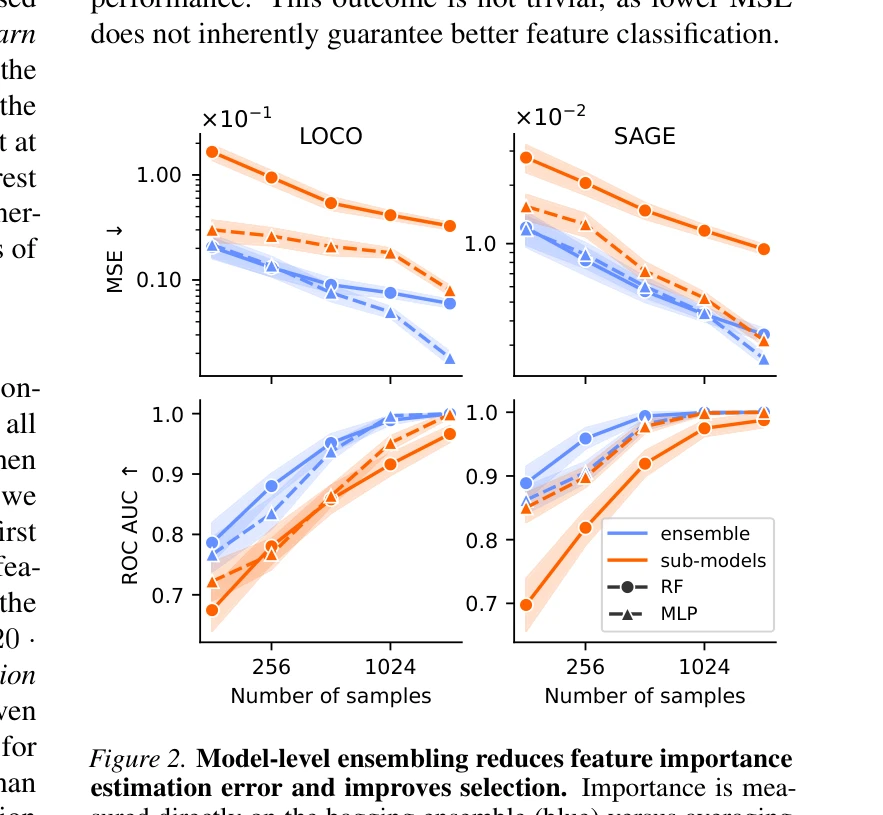
Figure 2

Figure 2. Model-level ensembling reduces feature importance
Feature importance 추정 시 개별 모델의 explanation을 aggregate하는 것보다 model-level ensemble(예측값 자체를 평균)을 explain하는 것이 excess risk를 줄여 더 정확한 variable importance 추정을 제공함을 이론적·실증적으로 보인 논문이다.

Motivation

Achievement

Figure 2

Figure 2. Model-level ensembling reduces feature importance

  1. 이론적 오차 분해: risk 및 excess risk를 approximation error(Eapp), estimation error(Eest), optimization error(Eopt)로 분해하고, 이를 feature importance 추정 오차와 연결하는 프레임워크를 modern complex ML 모델에 적용 가능하도록 완화된 가정 하에서 제시했다.
  2. model-level ensembling의 우월성 입증: 기존 문헌과 달리, 특히 expressive 모델에서 model-level에서 예측을 ensemble한 뒤 이를 explain하는 것이 excess risk라는 leading error term을 줄여 개별 explanation을 aggregate하는 것보다 더 정확한 variable importance 추정을 제공함을 이론적·실증적으로 보였다.
  3. 다양한 importance measure에 대한 체계적 비교: LOCO, marginal/conditional SAGE, CFI, PFI, Integrated Gradients 등 여러 measure에 걸쳐 aggregation 전략의 이점이 어떻게 달라지는지 규명했다.
  4. 대규모 실증 검증: 고전적 벤치마크와 UK Biobank의 대규모 proteomic 코호트 데이터에 적용하여 이론적 통찰의 실용적 유용성을 확인하고 BMI에 대한 proteomic signature를 식별했다.

How

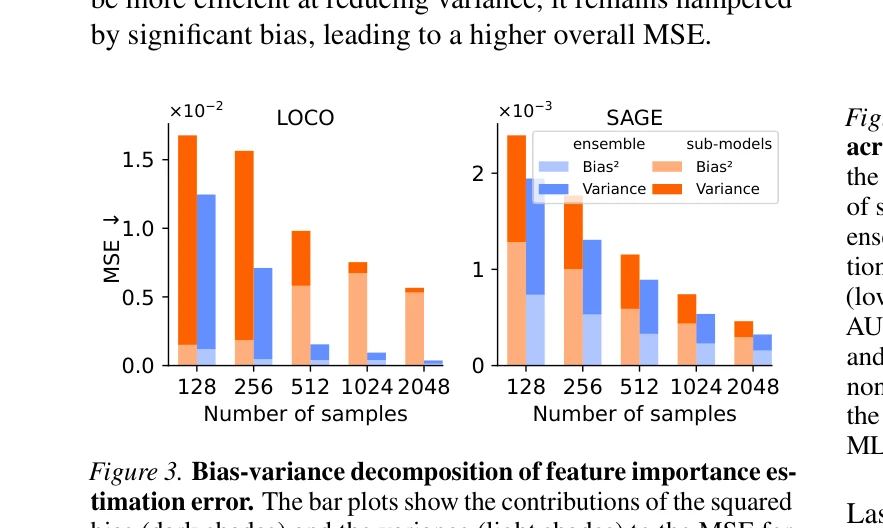
Figure 3

Figure 3. Bias-variance decomposition of feature importance es-

Originality

Limitation & Further Study

Evaluation

Novelty: 4/5 Technical Soundness: 4/5 Significance: 4/5 Clarity: 4/5 Overall: 4/5

총평: Rashomon effect 완화를 위한 두 가지 ensembling 전략을 excess risk 분해라는 명확한 이론적 틀로 비교하여 실무적으로 중요한 지침(model-level ensembling 우선)을 제공하는 견고한 연구이며, 생물의학 데이터에 대한 대규모 실증까지 갖춘 완성도 높은 논문이다.

같이 보면 좋은 논문

기반 연구SPECTER2 유사도 0.91로 Statistical Causal Inference Methods와 LLM Benchmarking and Agent Evaluation가 맞닿아, 'A Survey on Uncertainty Quantification Methods for Deep Learning'가 이 ICML 2026 논문의 배경·대안·응용 맥락을 보완한다.
기반 연구SPECTER2 유사도 0.91 기준으로 'Aggregate Models, Not Explanations: Improving Feature Importance Estimation'의 AI4S 방법론을 'REFORMS: Consensus-based Recommendations for Machine-learning-based Science'의 과학 생산·평가 맥락과 함께 보면 연구 자동화의 의미를 입체적으로 볼 수 있다.
기반 연구test-time 복잡도 조정 기법을 확장한 연구이다.
반론/비판explanation aggregate 방식의 한계를 지적하는 반대 관점을 제공한다.
기반 연구ensemble 모델의 이론적 특성에 대한 기반을 제공한다.
기반 연구SPECTER2 유사도 0.91로 Statistical Causal Inference Methods와 Molecular Simulation and Generative Modeling가 맞닿아, 'SamplingDesign: RNA design via continuous optimization with coupled variables and Monte-Carlo sampling'가 이 ICML 2026 논문의 배경·대안·응용 맥락을 보완한다.
기반 연구SPECTER2 유사도 0.93로 Statistical Causal Inference Methods와 AI-Driven Drug and Materials Discovery가 맞닿아, 'Knowing when to trust machine-learned interatomic potentials'가 이 ICML 2026 논문의 배경·대안·응용 맥락을 보완한다.
다른 접근feature importance 추정을 위한 다른 통계적 접근을 제시한다.
다른 접근feature importance 추정을 위한 다른 ensemble 접근법을 제시한다.
다른 접근explanation aggregation의 대안적 방법론을 논의한다.
후속 연구variable importance 추정 정확도 개선 방법을 확장한다.
← 목록으로 돌아가기

🎧 Audio Overview

이 논문 리뷰를 팟캐스트형 오디오로 생성합니다. (Gemini · 키는 브라우저에만 저장 · 완성본은 이메일로도 전송)
▸ 고급: 구성 방향(대본 작성 지침) 직접 수정
속도 1.0x
⬇ MP3 다운로드