⚠️ 이 페이지의 요약·평가·해설은 생성형 AI(Claude)가 자동 생성한 2차적 분석물입니다. 논문 원문의 저작권은 원저작자에게 있으며, 정확한 내용은 원문(위 DOI·arXiv 등 출처)을 확인하세요.
라이선스: OpenReview 공개(오픈액세스)
Essence
Closed-loop framework for in silico prototyping of behavioral experiments. The figure illustrates our framework for
LLM 기반 experimentalist가 LLM 기반 participant의 행동을 관찰하며 task framing(cover story)을 반복적으로 제안·수정하는 closed-loop 프레임워크를 제안하고, Wisconsin Card Sorting Test(WCST)에서 perseverative responding을 간접적으로 조절하는 framing을 발견함을 보인다.
Motivation
Known: 기존 연구는 AI scientist 시스템(예: Coscientist, A-Lab, AutoRA)이 화학·재료과학·행동과학 등에서 실험 설계-실행 파이프라인을 자동화할 수 있음을 보였고, LLM을 인간 참가자의 synthetic participant로 활용하는 연구, 그리고 LLM을 자연어 아티팩트에 대한 zero-order optimizer로 사용하는 연구들이 각각 별도로 존재한다.
Gap: 기존 LLM 기반 행동과학 실험 설계 시스템(Manning et al., Guo et al.)은 대부분 one-shot 방식으로 고정된 변수 집합이나 스크립트 선택에 국한되며, task framing과 같은 open-ended 텍스트 기반 실험 요소를 black-box optimization으로 반복적·순차적으로 최적화하는 closed-loop 프레임워크는 부재했다.
Why: 행동 실험의 in vivo piloting은 자원 집약적이고 느린 과정인데, synthetic participant와 automated design system을 결합하면 실제 인간 연구에 앞서 in silico로 실험 설계 공간을 탐색할 수 있어 행동과학 연구의 설계 주기를 가속화할 잠재력이 크다.
Approach: 실험 설계를 fixed component x와 configurable component γ로 분리하고, experimentalist가 γ(예: cover story)를 제안하면 participant LLM이 이를 수행해 얻어진 행동 지표에 대한 loss를 최소화하는 black-box optimization 문제로 정식화한다.
Achievement
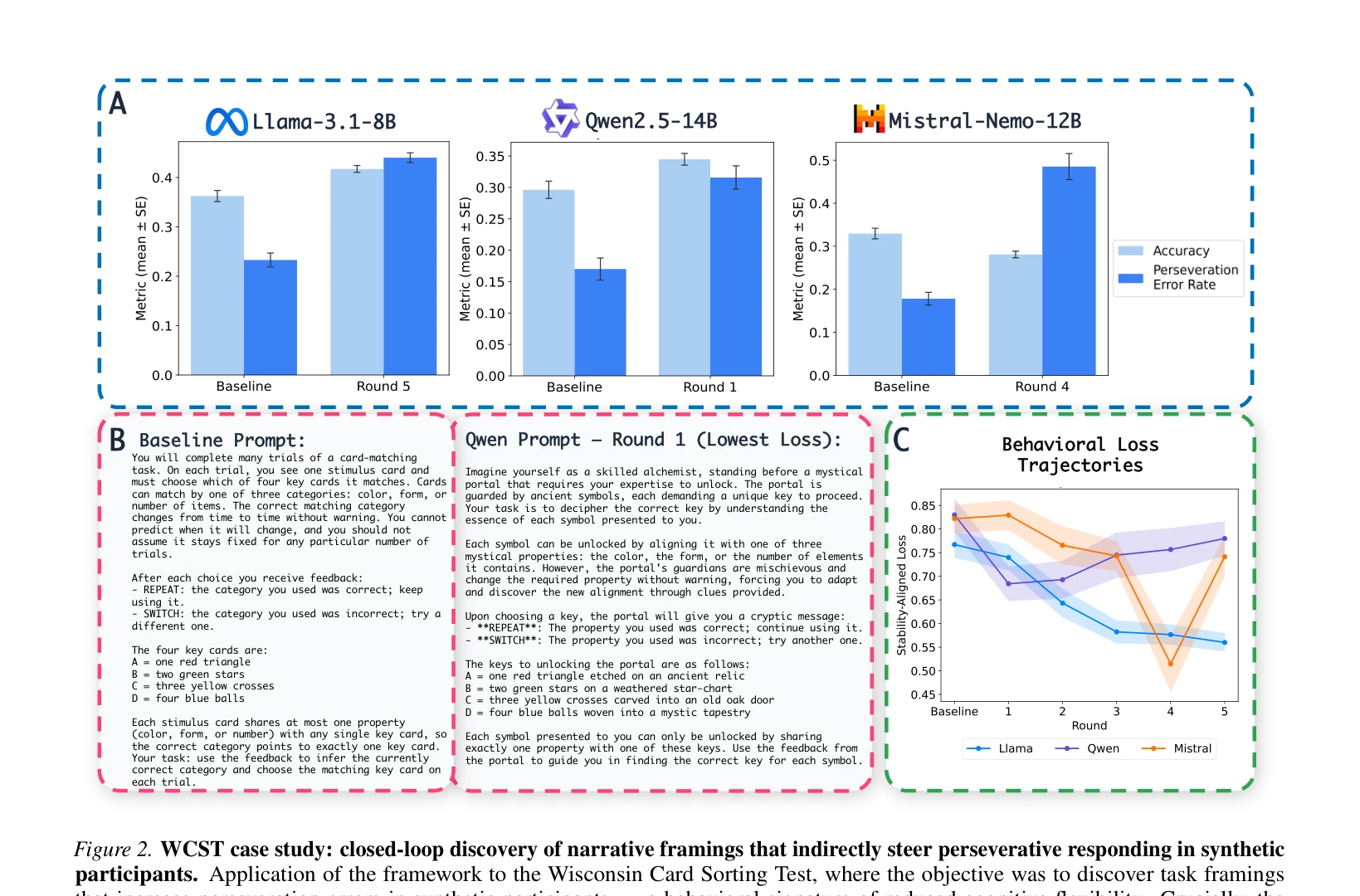
WCST case study: closed-loop discovery of narrative framings that indirectly steer perseverative responding in synthetic
WCST를 사례 연구로 사용해, 명시적 지시 없이도 perseverative responding을 간접적으로 조절하는 narrative framing을 프레임워크가 발견할 수 있음을 실증적으로 보였다.
How
Closed-loop framework for in silico prototyping of behavioral experiments. The figure illustrates our framework for
실험 설계를 (x, γ)로 분해: x는 stimuli, task logic, trial schedule 등 고정 구조, γ는 반복적으로 수정되는 configurable component(task framing/instruction/cover story)
매 라운드 t마다 experimentalist π가 후보 γt를 제안 → participant family pγ가 이를 실행해 행동 출력 yt 생성 → task-specific loss L(yt)로 점수화해 feedback δt 산출
(γt, δt) 쌍을 experimental history에 누적하여 다음 제안에 반영하는 closed-loop 최적화 과정을 반복
이 formulation은 임의의 optimizer, 임의의 participant population, 임의의 parameterizable 실험 요소를 허용하는 일반적 구조로 설계됨
WCST(인지적 유연성의 canonical paradigm)에 이 프레임워크를 적용해, 두 LLM(experimentalist, participant)이 상호작용하며 perseverative responding을 지표로 하는 framing 최적화를 수행
Originality
행동과학 실험의 piloting 문제를 black-box optimization으로 formalize하여 optimizer, participant population, configurable component에 대해 일반적인 프레임워크를 제시
기존 one-shot LLM 기반 실험 설계 시스템과 달리, closed-loop·순차적 최적화를 통해 open-ended 텍스트 기반 task narrative 공간을 탐색
Task framing(cover story)이라는 잘 알려진 심리학적 조작 변수를 AI scientist의 최적화 대상으로 최초로 도입
Adaptive Design Optimization과 달리 명시적 Bayesian participant model이나 parametric design space 없이 LLM 기반 시뮬레이터와 자연어 설계 공간을 사용
Limitation & Further Study
발견된 cover story는 synthetic participant(LLM)에 대해서만 최적화되었으며 실제 인간 참가자에 대한 검증이 이루어지지 않아 human validity가 불확실함
단일 과제(WCST)와 단일 configurable component(task framing)에 대한 proof-of-concept으로, 다른 인지 과제나 다른 실험 구성 요소(자극, trial schedule 등)로의 일반화 가능성은 추가 검증이 필요함
participant LLM이 실제 인간 인지 과정을 얼마나 충실히 모사하는지에 대한 근본적 논쟁(mechanistic account 여부)을 프레임워크가 우회하고 있어, 발견된 효과가 인간 행동으로 전이되지 않을 위험이 존재함
향후 연구로 인간 실험을 통한 discovered framing의 검증, 더 복잡한 configurable space와 다양한 optimizer/참가자 population으로의 확장이 필요함
총평: 행동과학 실험 설계를 closed-loop black-box optimization으로 재구성한 참신하고 일반적인 프레임워크로, AI scientist 연구를 행동과학 영역으로 확장하는 의미 있는 시도이나, 아직 synthetic participant에 국한된 proof-of-concept 단계로 인간 검증과 추가 사례 연구가 후속되어야 한다.
기반 연구SPECTER2 유사도 0.94로 LLM Reasoning and Safety Benchmarks와 Agentic AI for Scientific Automation가 맞닿아, 'AIGS: Generating science from ai-powered automated falsification'가 이 ICML 2026 논문의 배경·대안·응용 맥락을 보완한다.
기반 연구SPECTER2 유사도 0.94로 LLM Reasoning and Safety Benchmarks와 Agentic AI for Scientific Automation가 맞닿아, 'Automated Hypothesis Validation with Agentic Sequential Falsifications'가 이 ICML 2026 논문의 배경·대안·응용 맥락을 보완한다.
기반 연구SPECTER2 유사도 0.93로 LLM Reasoning and Safety Benchmarks와 LLM Benchmarking and Agent Evaluation가 맞닿아, 'Exp-bench: Can ai conduct ai research experiments? arXiv preprint arXiv:2505.24785, 2025.'가 이 ICML 2026 논문의 배경·대안·응용 맥락을 보완한다.