Essence
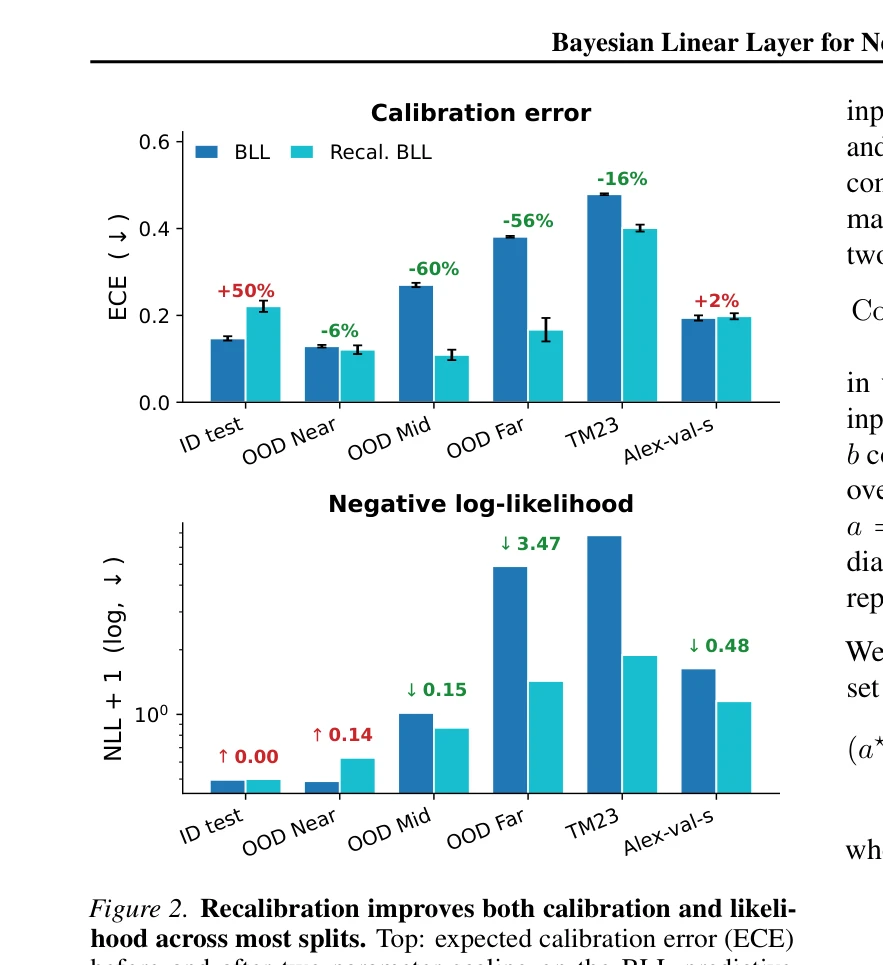
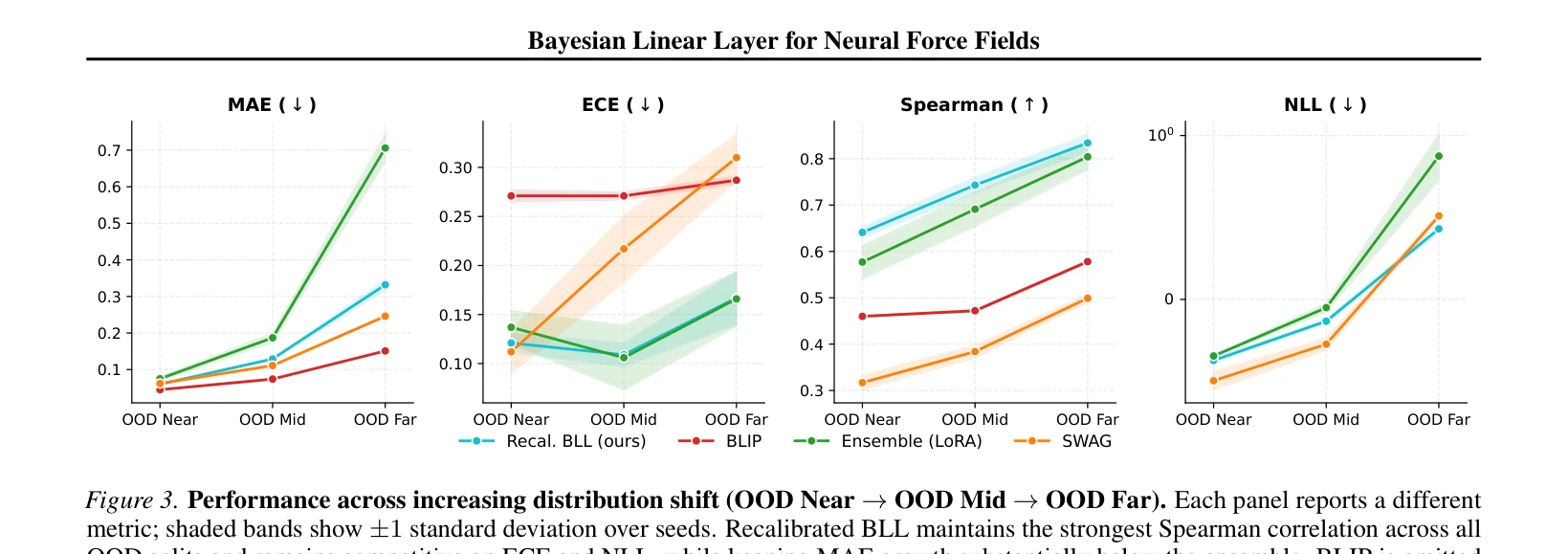
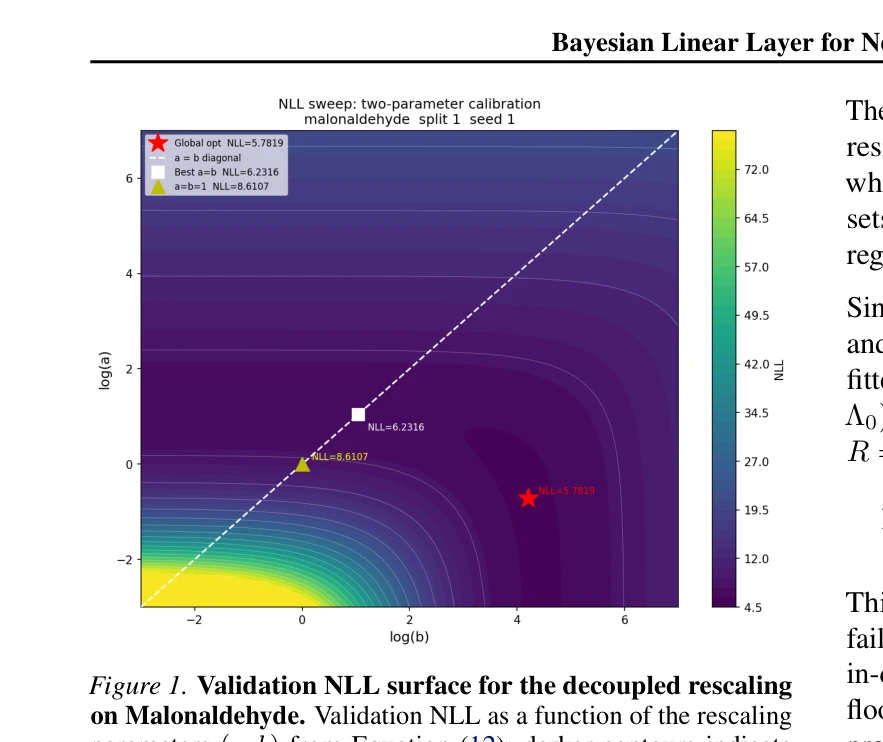
Bayesian Linear Last Layer(BLL)를 Neural Force Field(MLIP)의 마지막 force-prediction layer에 적용하여, 단일 pretrained backbone만으로 deep ensemble에 필적하는 예측 불확실성 추정치를 저비용으로 얻는 방법을 제안한다. BLL이 본질적으로 불확실성을 과소추정하는 두 가지 원인을 분석하고, 이를 보정하는 간단한 post-hoc recalibration 기법을 도입한다.
Evaluation
Novelty: 4/5 Technical Soundness: 4/5 Significance: 4/5 Clarity: 4/5 Overall: 4/5
총평: Deep ensemble의 계산 비용 문제를 해결하기 위해 이론적으로 잘 근거된 BLL 기반 recalibration 기법을 제시하며, foundation MLIP 시대에 실용적으로 중요한 기여를 한다. 다만 miscalibration의 근본 원인 분석과 다양한 backbone·OOD 극단 상황에서의 강건성에 대한 추가 검증이 향후 연구로 요구된다.
같이 보면 좋은 논문
기반 연구SPECTER2 유사도 0.93로 Computational Molecular Design와 AI-Driven Drug and Materials Discovery가 맞닿아, 'Boltz-1 Democratizing Biomolecular Interaction Modeling'가 이 ICML 2026 논문의 배경·대안·응용 맥락을 보완한다.
기반 연구SPECTER2 유사도 0.92로 Computational Molecular Design와 LLMs for Molecular Biology & Chemistry가 맞닿아, '34 examples of llm applications in materials science and chemistry: Towards automation, assistants, agents, and accelerated scientific discovery'가 이 ICML 2026 논문의 배경·대안·응용 맥락을 보완한다.
기반 연구Bayesian Last Layer 방법론의 이론적 기반을 공유한다.
기반 연구SPECTER2 유사도 0.93로 Computational Molecular Design와 Molecular Simulation and Generative Modeling가 맞닿아, 'MBD-ML: Many-body dispersion from machine learning for molecules and materials'가 이 ICML 2026 논문의 배경·대안·응용 맥락을 보완한다.
기반 연구SPECTER2 유사도 0.92로 Computational Molecular Design와 AI-Driven Drug and Materials Discovery가 맞닿아, 'Knowing when to trust machine-learned interatomic potentials'가 이 ICML 2026 논문의 배경·대안·응용 맥락을 보완한다.
다른 접근deep ensemble 대신 다른 불확실성 정량화 기법을 사용한다.
다른 접근MLIP에서의 불확실성 추정을 위한 유사한 대안적 방법론이다.
다른 접근Neural Force Field의 불확실성 추정을 위한 다른 방법을 제시한다.
후속 연구dynamic programming과 attention 메커니즘 연결의 이론적 기초를 제공함
후속 연구trajectory truncation 문제의 이론적 배경을 제공하는 연구로 판단됨