⚠️ 이 페이지의 요약·평가·해설은 생성형 AI(Claude)가 자동 생성한 2차적 분석물입니다. 논문 원문의 저작권은 원저작자에게 있으며, 정확한 내용은 원문(위 DOI·arXiv 등 출처)을 확인하세요.
라이선스: OpenReview 공개(오픈액세스)
Essence
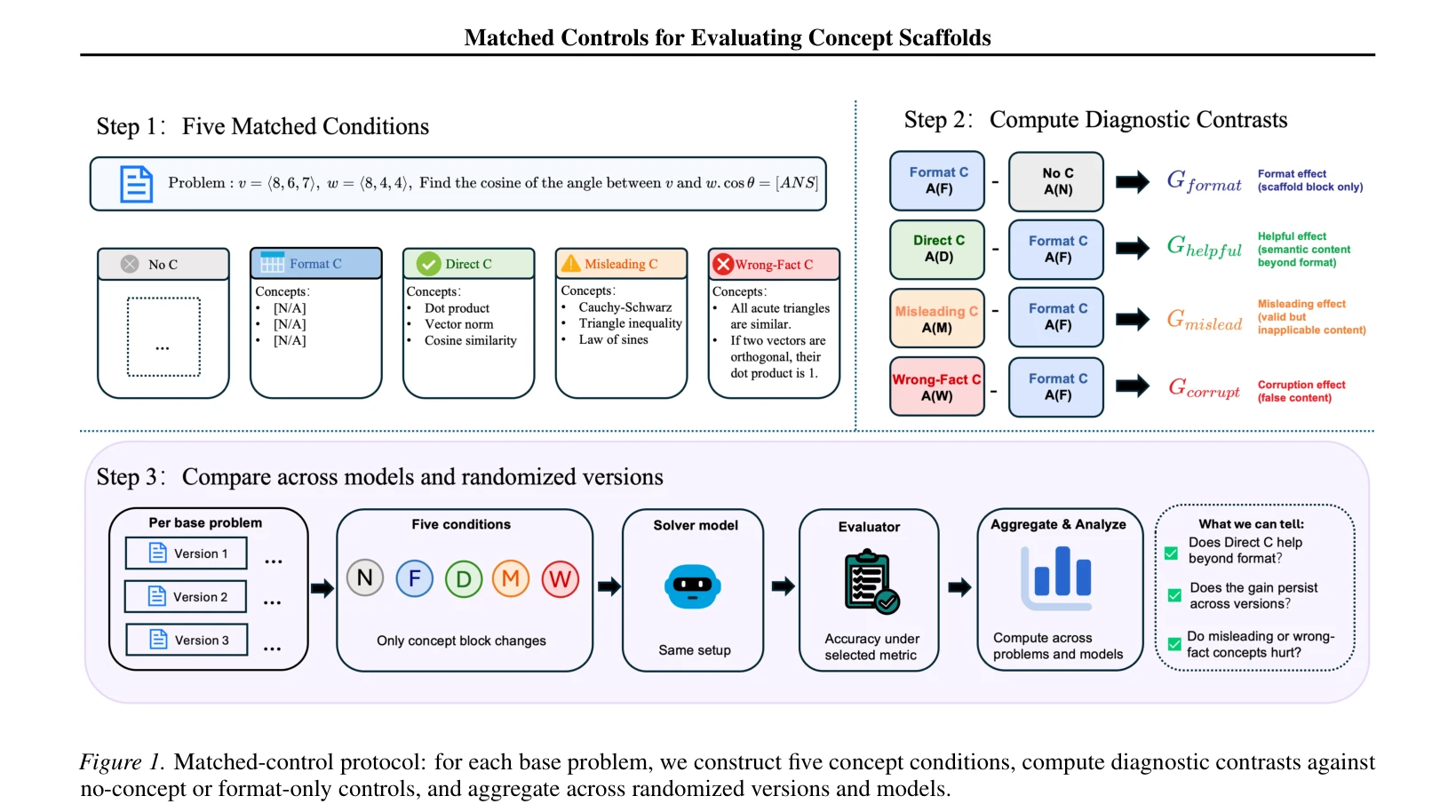
Figure 1. Matched-control protocol: for each base problem, we construct five concept conditions, compute diagnostic cont
본 논문은 concept scaffold(개념 힌트)가 수학 문제 풀이 정확도를 높인다는 기존 평가 방식이 실제로는 semantic content, prompt format, plausible-but-wrong auxiliary information에 대한 민감도가 뒤섞인 under-identified 비교임을 지적하고, 이를 분리하기 위한 matched-control protocol을 제안한다.
Motivation
Known: rationale, plan, generated knowledge, concept, hint 등 reasoning scaffold가 language model의 추론을 돕는다는 것은 널리 알려져 있으며, helpful scaffold 추가 시 accuracy가 개선되는 현상이 여러 연구에서 보고되어 왔다.
Gap: 기존의 helpful-vs-no-scaffold 직접 비교는 accuracy 개선이 scaffold의 semantic content 때문인지, scaffold-shaped prompt block의 존재(format) 때문인지, 혹은 그럴듯하지만 부적용 가능한 보조 정보에 대한 민감도 때문인지 구분하지 못하는 under-identified 문제를 안고 있다.
Why: concept/hint scaffold의 효과를 semantic content 기여로 잘못 귀속시키면 reasoning scaffold 설계 및 평가에 대한 잘못된 결론을 이끌 수 있으며, in-context learning, prompt sensitivity, misleading information, rationale faithfulness에 관한 최근 연구들과 연결되는 근본적 평가 방법론 문제이기 때문에 중요하다.
Approach: no-scaffold(N), format-only(F), helpful(D), misleading(M), wrong-fact(W)의 다섯 가지 matched 조건을 정의하고, format-only 대비 helpful gain(G_helpful) 등 네 가지 진단적 delta를 계산하는 matched-control protocol을 제안하며, 2,000개 학부 수학 문제에 대해 문제당 3개의 randomized version을 사용해 per-instance accuracy와 stable accuracy를 구분해 평가한다.
Achievement
Figure 1. Matched-control protocol: for each base problem, we construct five concept conditions, compute diagnostic cont
Matched-control protocol 제안: N, F, D, M, W 다섯 조건과 G_format, G_helpful, G_mislead, G_corrupt 네 가지 diagnostic delta를 정의하여 concept scaffold의 효과를 semantic content, format, misleading sensitivity로 분해했다.
대규모 실증 평가: UGMathBench 기반 2,000개 base problem, 문제당 3개 randomized version, 조건당 6,000개 solver prompt로 총 9개 instruction-compatible model setting(Qwen2.5, Qwen2.5-Math, DeepSeek-R1 distilled, Qwen3, Gemma 3, Phi-4-mini, Llama 3.2)에 대해 평가했다.
stable accuracy 개념 도입: 문제의 3개 randomized version 모두 정답이어야 correct로 인정하는 stable accuracy S를 주요 지표로 채택하여, 단일 표본 버전에서의 우연한 개선과 근본적 reasoning objective에 대한 안정적 개선을 구분했다.
핵심 실증 결과: 대부분의 setting에서 helpful concept이 format-only 대비 stable accuracy를 개선하지만 평균 gain은 미미함(G_helpful=+1.22점)을 보였고, 이를 semantic effect의 순수 추정치가 아닌 진단적 helpful-over-format contrast로 해석해야 함을 논증했다.
Pseudo-concept 구축 파이프라인: UGMathBench에 CHAMP-style concept label이 없다는 한계를 극복하기 위해 Qwen2.5-72B-Instruct를 teacher로 활용한 concept 생성 및 reference-answer 기반 검증, 필터링 절차를 마련했다.
How
Figure 1. Matched-control protocol: for each base problem, we construct five concept conditions, compute diagnostic cont
각 base problem q와 gold answer y에 대해 N(문제만 제공), F(scaffold block은 유지하되 concept을 [N/A]로 대체), D(problem-level helpful concept 제공), M(다른 문제에서 샘플링한 mathematically valid하지만 inapplicable한 concept 제공), W(subject-level false mathematical fact 제공)의 다섯 조건을 구성
네 가지 diagnostic delta 계산: G_format=A(F)-A(N), G_helpful=A(D)-A(F), G_mislead=A(M)-A(F), G_corrupt=A(W)-A(F)
UGMathBench에서 subject-stratified proportional sampling(seed 42)으로 5,061개 문제 중 2,000개 base problem 선정, 문제당 3개 solver version으로 조건당 6,000개 prompt 구성
Qwen2.5-72B-Instruct가 version 1과 reference answer를 이용해 1-3개의 재사용 가능한 concept을 생성하고, teacher가 문제를 풀어 도출된 답이 reference와 일치하지 않으면 annotation을 invalid 처리하는 방식으로 검증
per-instance accuracy I와 stable accuracy S(세 버전 모두 정답이어야 정답 인정) 두 지표를 병행 보고하며, S를 주요 지표로 채택
10,000회 paired bootstrap resampling(2,000개 base problem 단위, 각 문제의 세 버전 보존)으로 불확실성 추정
Qwen2.5, Qwen2.5-Math, DeepSeek-R1 distilled, Qwen3(thinking disabled), Gemma 3, Phi-4-mini, Llama 3.2 등 9개 instruction-compatible setting에서 deterministic decoding과 rule-based answer-equivalence evaluator로 평가
Originality
concept scaffold 평가를 causal identification 문제로 재구성하여, 기존의 단순 helpful-vs-no accuracy 비교가 여러 요인을 conflate한다는 점을 명시적으로 지적한 프레이밍이 독창적임
format-only, misleading, wrong-fact라는 세 가지 negative/neutral control을 동시에 도입하여 semantic content, format effect, plausibility sensitivity를 분리한 5-condition 설계는 기존 prompt sensitivity/misleading information 연구를 scaffold 평가에 체계적으로 확장한 것
per-instance accuracy와 stable accuracy(randomized version 전체 정답)를 구분해 도입한 점은 다중 버전 평가에서 안정성 개념을 정량화하는 새로운 시도
Limitation & Further Study
Ghelpful 자체도 저자들이 인정하듯 순수한 semantic effect의 추정치가 아니며, format-only 조건이 진정한 counterfactual인지에 대한 추가적 검증이 부족함
concept annotation이 Qwen2.5-72B-Instruct라는 단일 teacher model로 생성된 pseudo-label이므로, teacher model의 편향이나 한계가 concept 품질과 misleading/wrong-fact 조건의 대표성에 영향을 줄 수 있음
평가 대상이 UGMathBench 기반 수학 문제로 한정되어 있어, 다른 도메인(과학, 코딩 등)의 concept scaffold에 일반화되는지는 불확실함
Qwen3는 thinking disabled 상태로만 평가되어, long-reasoning/chain-of-thought 강화 모드에서의 scaffold 효과는 다루지 않음
후속 연구로는 다양한 teacher model 및 도메인으로 protocol을 확장하고, misleading/wrong-fact 조건이 reasoning interference에 미치는 메커니즘을 더 세밀히 분석할 필요가 있음
총평: reasoning scaffold 평가에서 흔히 간과되는 identification 문제를 명확히 제기하고 실용적인 matched-control protocol과 stable accuracy 지표를 제안한 견실한 연구로, workshop paper 수준에서 방법론적 기여가 뚜렷하지만 단일 도메인·단일 teacher model에 국한된 실증 범위는 향후 확장이 필요하다.
기반 연구SPECTER2 유사도 0.94로 LLM Reasoning and Safety Benchmarks와 Formal Methods and Computational Reasoning가 맞닿아, 'SciBench: Evaluating College-Level Scientific Problem-Solving Abilities of Large Language Models'가 이 ICML 2026 논문의 배경·대안·응용 맥락을 보완한다.
기반 연구SPECTER2 유사도 0.93로 LLM Reasoning and Safety Benchmarks와 LLM Benchmarking and Agent Evaluation가 맞닿아, 'Curie: Toward rigorous and automated scientific experimentation with ai agents'가 이 ICML 2026 논문의 배경·대안·응용 맥락을 보완한다.