⚠️ 이 페이지의 요약·평가·해설은 생성형 AI(Claude)가 자동 생성한 2차적 분석물입니다. 논문 원문의 저작권은 원저작자에게 있으며, 정확한 내용은 원문(위 DOI·arXiv 등 출처)을 확인하세요.
라이선스: OpenReview 공개(오픈액세스)
Essence
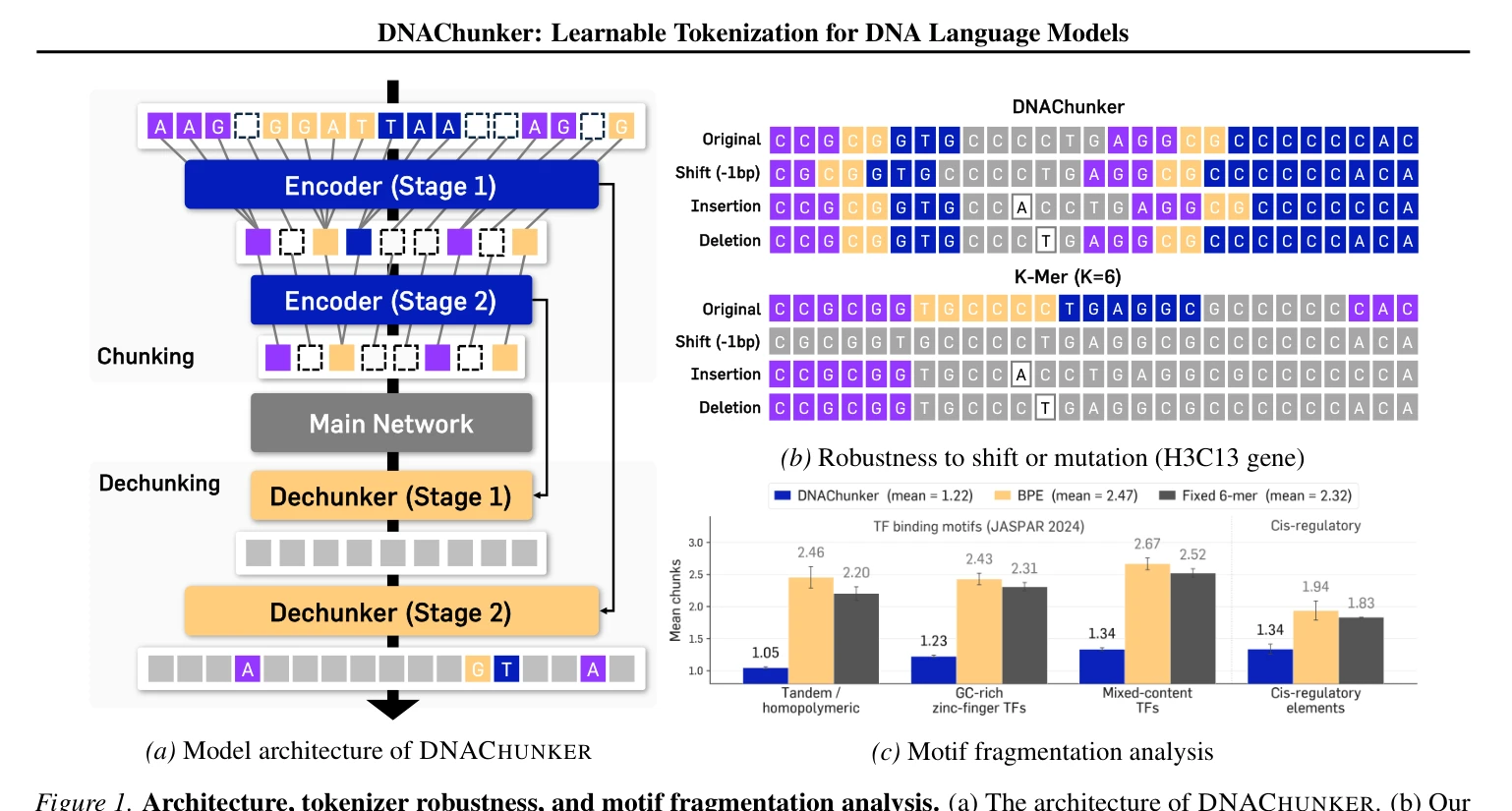
Figure 1. Architecture, tokenizer robustness, and motif fragmentation analysis. (a) The architecture of DNACHUNKER. (b)
DNAChunker는 masked DNA language model에 학습 가능한 adaptive segmentation 모듈을 결합하여, 고정된 tokenization(단일 nucleotide, k-mer, BPE) 대신 context-dependent하고 variable-length인 chunk 단위로 DNA를 분절하는 방법을 제안한다.
Motivation
Known: 기존 DNA language model들은 single nucleotide, fixed-size k-mer, 혹은 BPE 기반 tokenization을 사용해왔으며, Nucleotide Transformer, DNABERT-2, GROVER, Caduceus, HyenaDNA, Evo 등 다양한 아키텍처가 이러한 고정 tokenization 위에서 학습되어 왔다.
Gap: DNA는 자연어와 달리 canonical한 word 경계가 없기 때문에, 고정 tokenization은 shift, indel, local repeat 등 미세한 변이에 취약하고, k-mer는 사소한 mutation에도 tokenized output이 완전히 달라지며, BPE 같은 frequency 기반 방법은 반복적이고 비기능적인 서열을 우선시해 TF-binding motif나 cis-regulatory motif 같은 실제 기능적 substring을 조각내는 문제가 있다.
Why: DNA 서열의 기능적 요소(promoter, enhancer 등)를 의미 있는 token으로 묶는 tokenization 전략은 장거리 상호작용을 포착하는 DNA language model의 표현력과 downstream 성능에 직접적인 영향을 미치므로, mutation-resilient하고 생물학적으로 유의미한 tokenizer 설계는 genomic sequence modeling 전반의 신뢰성과 효율성을 높이는 데 중요하다.
Approach: 두 단계 hierarchical encoder 구조로, 먼저 lightweight bidirectional Mamba layer로 base-pair 임베딩을 처리한 후 cosine-similarity 기반 boundary decision으로 인접 위치를 chunk로 병합하고, 압축된 시퀀스를 더 expressive한 main network로 모델링한 뒤 bidirectional dechunking module로 다시 base-pair 해상도로 upsampling하는 masked DNA language model인 DNAChunker를 제안한다.
Achievement
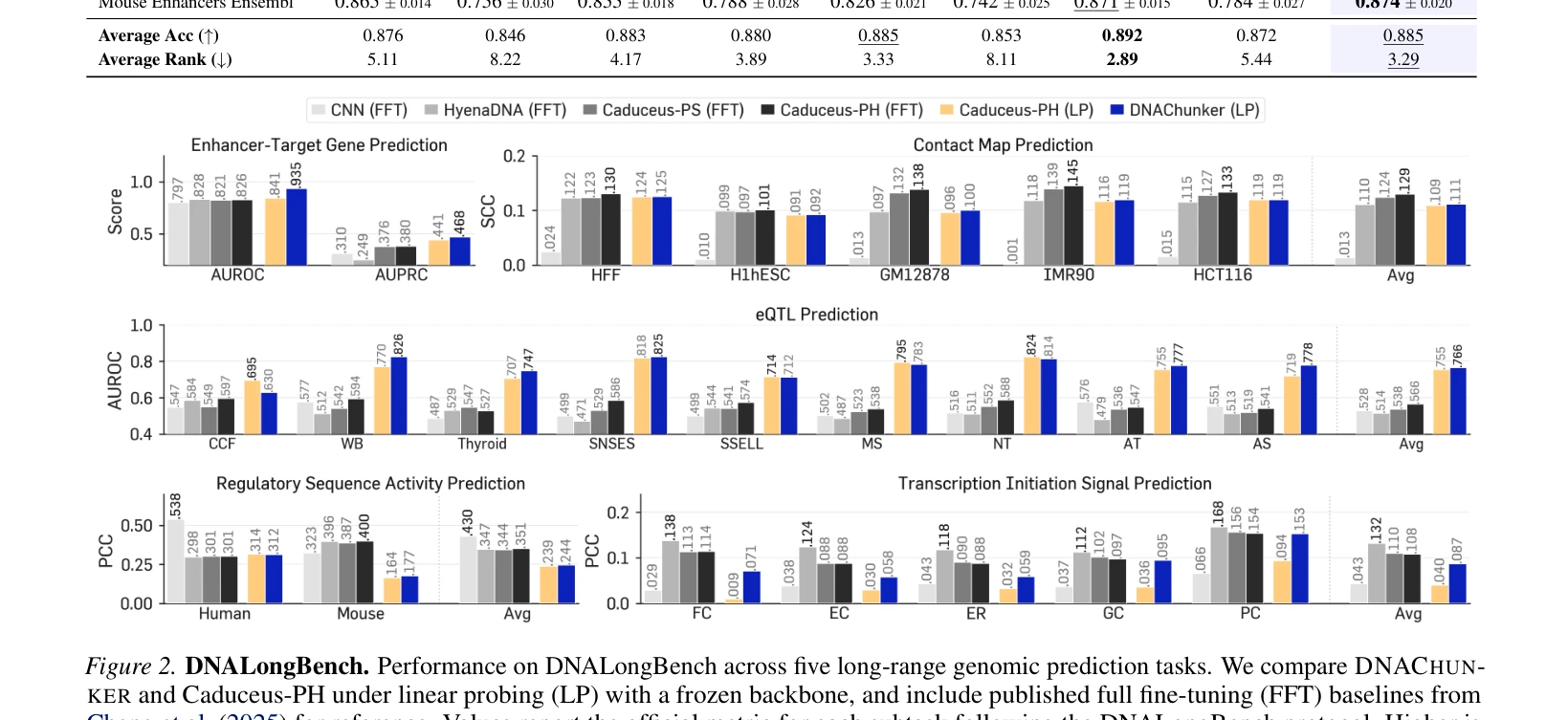
Figure 2. DNALongBench. Performance on DNALongBench across five long-range genomic prediction tasks. We compare DNACHUN-
다섯 개 벤치마크에서 일관된 성능 향상: NT benchmark(및 revised version), Genomic Benchmarks, BEND, DNALongBench에 걸쳐 DNAChunker가 strong fixed-tokenization baseline 대비 일관되게 우수한 성능을 보였으며, multi-species pretraining을 사용한 더 큰 baseline(Nucleotide Transformer 등)보다도 뛰어난 결과를 달성했다.
생물학적으로 유의미하고 mutation-resilient한 segmentation 학습: 학습된 tokenizer가 TF-binding motif, cis-regulatory motif 등 기능적 motif를 단일 chunk로 보존하고, SNV, InDel, structural variant 등 다양한 변이 하에서도 안정적인 boundary를 유지함을 확인했다.
긴 context에서의 효율성 개선: adaptive segmentation이 유효 시퀀스 길이를 줄여 FLOPs 분석 결과 long-context 처리 효율을 향상시켰다.
각 구성 요소의 기여 검증: controlled ablation을 통해 제안된 chunking, dechunking 등 각 모듈이 성능 향상에 기여함을 확인했다.
How
Figure 1. Architecture, tokenizer robustness, and motif fragmentation analysis. (a) The architecture of DNACHUNKER. (b)
Human reference genome(GRCh38/hg38)만을 사용해 사전학습을 수행하며, multi-species pretraining 없이도 경쟁력 있는 성능을 목표로 함.
Chunking 모듈이 cosine-similarity 기반 boundary decision을 통해 인접 위치의 표현이 충분히 유사하면 하나의 token으로 병합, dynamic segmentation procedure를 학습.
압축된(chunked) 시퀀스는 더 expressive한 main network(Stage 2 encoder)에서 처리되어 장거리 의존성(long-range dependency)을 포착.
Dechunker(Stage 1, Stage 2)가 bidirectional dechunking module을 통해 압축된 표현을 다시 base-pair 해상도로 upsampling하며, encoder feature로부터의 residual connection을 활용해 세밀한 표현을 복원.
이 구조는 masked language modeling 목적함수로 학습되며, 기존 autoregressive 기반 dynamic chunking(H-Net 등)을 bidirectional masked DNA pretraining 세팅으로 확장.
다섯 개 벤치마크(NT benchmark, revised NT benchmark, Genomic Benchmarks, BEND, DNALongBench)에서 평가하며, motif fragmentation analysis, token size distribution per-chromosome, computation overhead(FLOPs) 분석 등 다양한 ablation과 분석을 수행.
Originality
Autoregressive language modeling에서 주로 연구되던 dynamic/learnable tokenization(H-Net 등)을 masked DNA pretraining 세팅에 최초로 적용하여 bidirectional한 token boundary 학습을 가능하게 함.
기존 non-autoregressive 모델들이 gradient-based pooling이나 word-level external chunking처럼 사전 정의된 boundary heuristic에 의존했던 것과 달리, DNAChunker는 representation 학습과 segmentation을 완전히 end-to-end로 jointly 학습.
Cosine-similarity 기반 boundary decision과 2단계 encoder-dechunker 구조를 결합해, DNA에 특화된 mutation-resilient하고 biologically-informed한 tokenization을 구현.
Limitation & Further Study
사전학습이 human reference genome(GRCh38/hg38)에 한정되어 있어, multi-species나 다양한 population variant를 포함하는 대규모 pretraining 대비 일반화 범위가 제한적일 수 있음.
Cosine-similarity 기반 boundary decision의 임계값 설정이나 chunk 크기 분포에 대한 이론적 정당화가 충분히 제시되지 않을 가능성이 있어, 다양한 genomic 맥락(예: 비인간 genome, 비coding 영역)에서의 강건성 추가 검증이 필요.
발췌된 내용만으로는 최종 chunk 개수/길이에 대한 hyperparameter 민감도, 그리고 Evo2와 같은 초대형 autoregressive 모델과의 직접 비교가 충분히 다뤄졌는지 확인하기 어려움.
후속 연구로 multi-species pretraining과의 결합, 혹은 다른 생물학적 서열(RNA, 단백질)로의 확장 가능성을 탐구할 필요가 있음.
기반 연구SPECTER2 유사도 0.93로 Computational Molecular Design와 AI-Driven Drug and Materials Discovery가 맞닿아, 'Effective gene expression prediction from sequence by integrating long-range interactions'가 이 ICML 2026 논문의 배경·대안·응용 맥락을 보완한다.
기반 연구SPECTER2 유사도 0.92로 Computational Molecular Design와 AI-Driven Drug and Materials Discovery가 맞닿아, 'Language Models for Controllable DNA Sequence Design'가 이 ICML 2026 논문의 배경·대안·응용 맥락을 보완한다.
기반 연구SPECTER2 유사도 0.91로 Computational Molecular Design와 LLMs for Molecular Biology & Chemistry가 맞닿아, 'Genome modeling and design across all domains of life with Evo 2'가 이 ICML 2026 논문의 배경·대안·응용 맥락을 보완한다.
기반 연구SPECTER2 유사도 0.92로 Computational Molecular Design와 AI-Driven Drug and Materials Discovery가 맞닿아, 'CLM-X: A multimodal single-cell foundation model with flexible multi-way Transformer for unified scRNA-seq and scATAC-seq analysis'가 이 ICML 2026 논문의 배경·대안·응용 맥락을 보완한다.