Essence
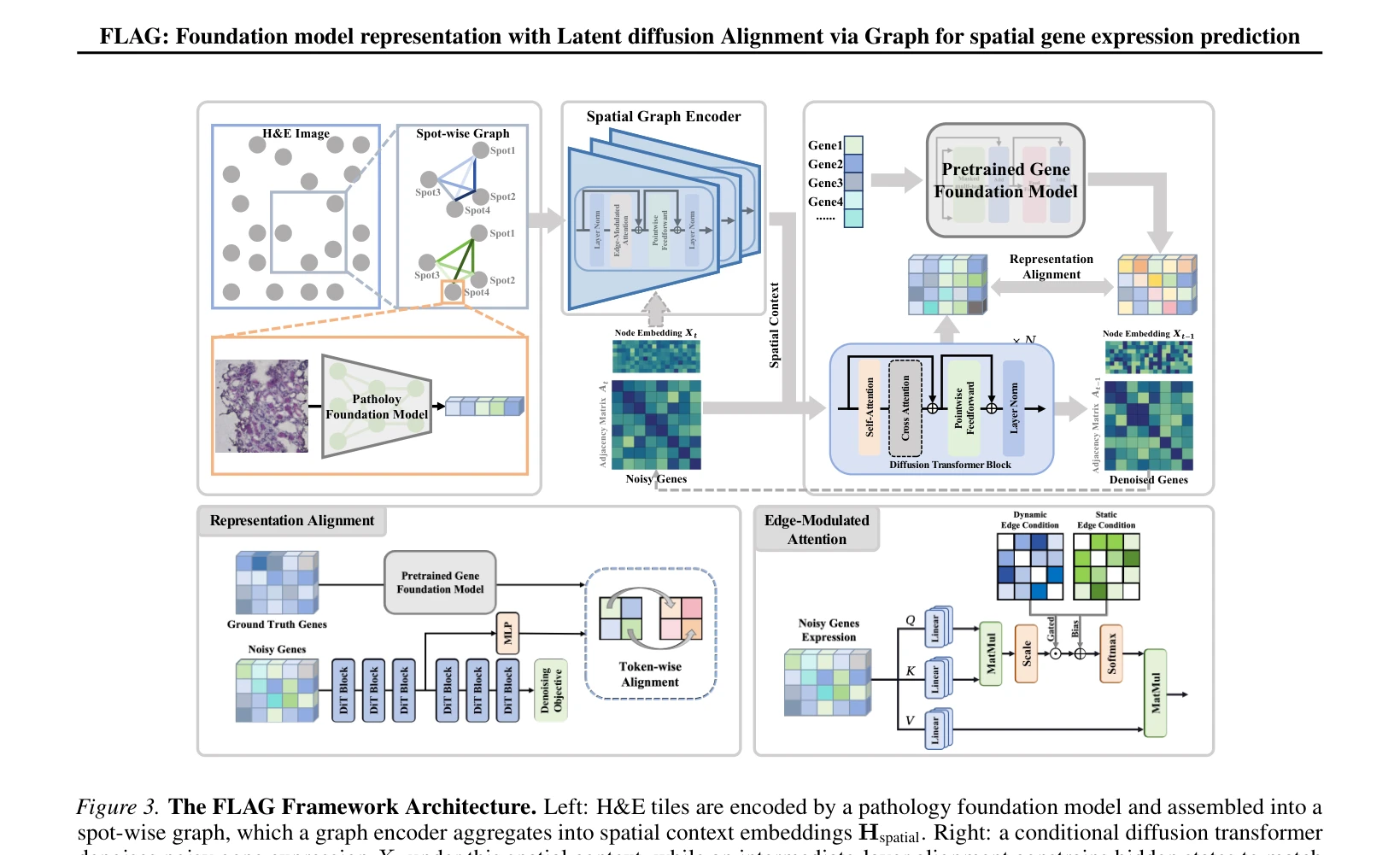
Figure 3. The FLAG Framework Architecture. Left: H&E tiles are encoded by a pathology foundation model and assembled int
FLAG는 H&E 이미지로부터 공간 유전자 발현을 예측하는 문제를 단순 pointwise 회귀가 아닌 구조화된 분포 모델링으로 재정의하고, spatial graph encoder와 Gene Foundation Model(GFM) alignment를 결합한 diffusion 기반 프레임워크를 제안한다.
Evaluation
Novelty: 4/5 Technical Soundness: 4/5 Significance: 4/5 Clarity: 4/5 Overall: 4/5
총평: 공간 유전자 발현 예측 문제를 구조적 분포 모델링으로 재구성하고 Gene Dimension Curse라는 새로운 문제를 규명하여 이를 spatial graph encoder와 GFM alignment로 해결한 참신하고 실용적인 접근으로, 새로운 평가지표(GSC/SSC) 제안까지 포함해 해당 분야에 의미 있는 기여를 한다고 평가된다.
같이 보면 좋은 논문
기반 연구SPECTER2 유사도 0.93로 Scientific Machine Learning for Dynamics와 AI-Driven Drug and Materials Discovery가 맞닿아, 'Learning to Discover Regulatory Elements for Gene Expression Prediction'가 이 ICML 2026 논문의 배경·대안·응용 맥락을 보완한다.
기반 연구SPECTER2 유사도 0.92로 Scientific Machine Learning for Dynamics와 LLMs for Molecular Biology & Chemistry가 맞닿아, 'PerTurboAgent: A Self-Planning Agent for Boosting Sequential Perturb-seq Experiments'가 이 ICML 2026 논문의 배경·대안·응용 맥락을 보완한다.
기반 연구flow matching을 유전자 발현 데이터에 적용한 유사한 응용 연구로 판단됨
다른 접근H&E 이미지로부터 공간 유전자 발현을 예측하는 동일 문제를 다른 모델링 방식으로 접근한다.
기반 연구spatial graph encoder를 활용한 기본적 방법론적 토대를 공유한다.
기반 연구latent diffusion 기법을 단일세포 유전자 발현 생성 문제에 적용한다.
다른 접근pointwise 회귀 대신 분포 모델링을 사용하는 다른 접근을 제시한다.
기반 연구spatial graph encoder 기반 유전자 발현 예측의 기초 방법론을 공유한다.
다른 접근mean collapse 문제 해결을 위한 다른 전략을 탐구한다.
기반 연구SPECTER2 유사도 0.92 기준으로 'FLAG: Foundation model representation with Latent diffusion Alignment via Graph for spatial gene expression prediction'의 AI4S 방법론을 'Extending the range of graph neural networks with global encodings'의 과학 생산·평가 맥락과 함께 보면 연구 자동화의 의미를 입체적으로 볼 수 있다.
기반 연구SPECTER2 유사도 0.92로 Scientific Machine Learning for Dynamics와 AI-Driven Drug and Materials Discovery가 맞닿아, 'Multi-Dimensional Spectral Geometry of Biological Knowledge in Single-Cell Transformer Representations'가 이 ICML 2026 논문의 배경·대안·응용 맥락을 보완한다.
기반 연구SPECTER2 유사도 0.93로 Scientific Machine Learning for Dynamics와 AI-Driven Drug and Materials Discovery가 맞닿아, 'Towards building a World Model to simulate perturbation responses in cellular biology'가 이 ICML 2026 논문의 배경·대안·응용 맥락을 보완한다.
다른 접근세포 계층 구조 모델링을 위한 다른 생성 모델 접근이다.
다른 접근정보 보존 통계 방법에 대한 다른 접근을 제시한다.
다른 접근diffusion 기반 분포 모델링이라는 유사 접근을 공유한다.
후속 연구latent space에서의 distribution-free generator 학습이라는 기초 방법론을 공유한다.
후속 연구Gaussian graphical model 추정을 위한 eigenspace 기반 이론적 기법을 공유한다.