⚠️ 이 페이지의 요약·평가·해설은 생성형 AI(Claude)가 자동 생성한 2차적 분석물입니다. 논문 원문의 저작권은 원저작자에게 있으며, 정확한 내용은 원문(위 DOI·arXiv 등 출처)을 확인하세요.
라이선스: OpenReview 공개(오픈액세스)
Essence
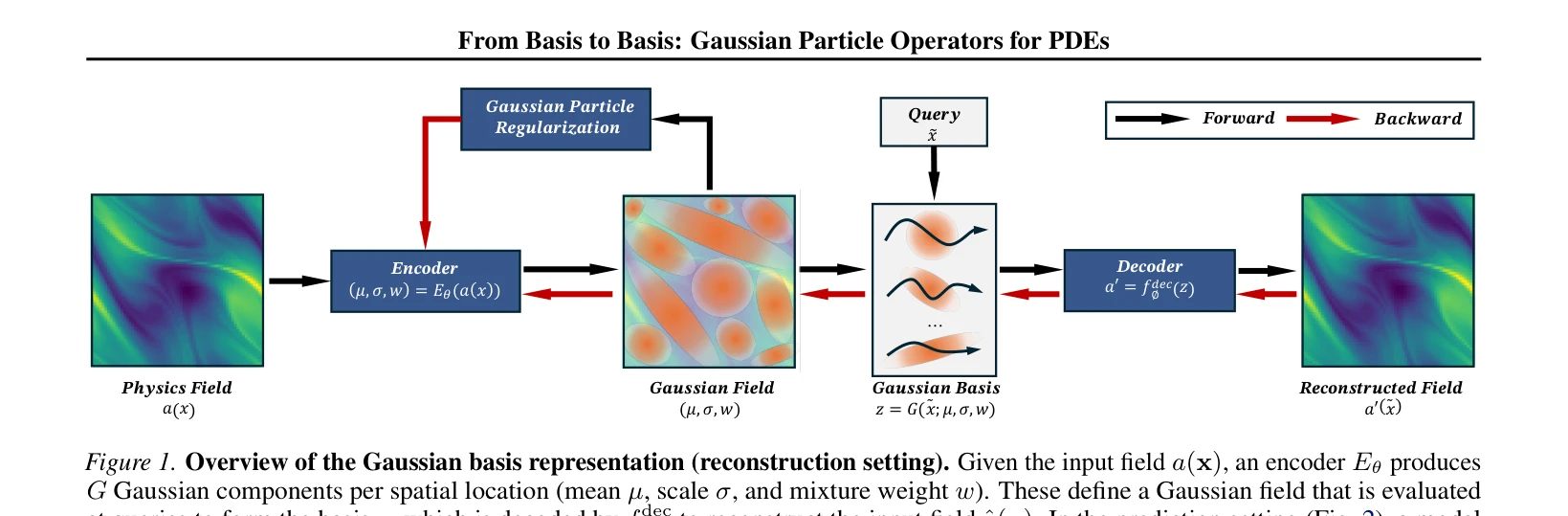
Figure 1. Overview of the Gaussian basis representation (reconstruction setting). Given the input field a(x), an encoder
GPO는 fluid PDE 필드를 학습된 Gaussian particle basis(중심, anisotropic scale, weight)로 표현하고, 이를 modal space에서 Petrov-Galerkin 방식의 Gaussian Attention으로 결합하여 basis-to-basis 방식의 resolution-agnostic neural operator를 제안한다.
Motivation
Known: 기존 neural operator(FNO 등)와 Transformer 기반 operator(Galerkin Transformer, GNOT, Transolver 등)는 함수 공간 간 매핑을 학습하여 resolution-agnostic한 surrogate를 제공하며 다양한 PDE task에서 강력한 성능을 보인다.
Gap: 그러나 이러한 모델들은 latent state와 attention weight가 explicit한 기하학적/모달 구조와 정렬되지 않아 representation-level 투명성이 부족하고, global self-attention이 low-frequency에 편향되어 sharp front나 vortical filament 같은 고주파 구조를 포착하기 어려우며, sample 수 N에 대해 O(N^2)의 비용이 든다는 한계가 있다.
Why: 해석 가능하면서도 효율적인 operator learning 프레임워크는 유체 PDE 대리모델의 신뢰성과 실용성을 높이는 데 중요하며, 특히 실제 기상/기후 재분석 데이터 같은 대규모 응용에 필수적이다.
Approach: field를 고정 grid나 hand-picked spectra 대신 학습된 anisotropic Gaussian particle basis로 표현하고, 이를 학습된 Gaussian modal window를 이용한 Petrov-Galerkin 측정과 modal 공간에서의 attention으로 결합하여 spatial domain으로 다시 scatter하는 구조를 제안한다.
Achievement
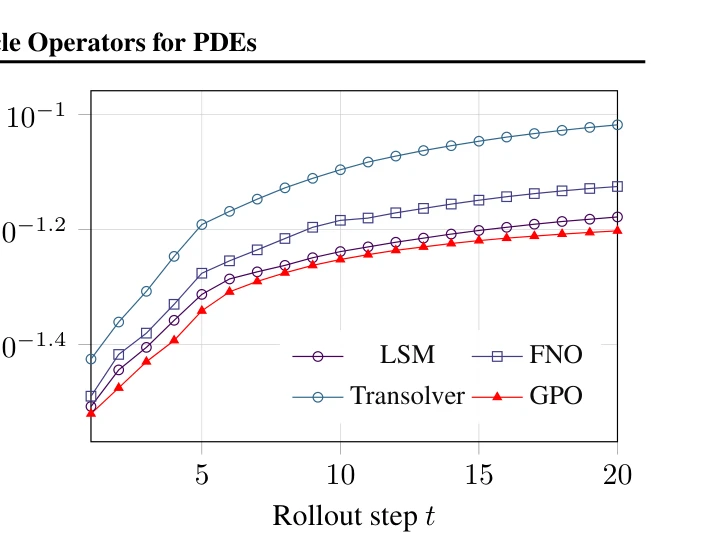
Figure 3. Multi-step prediction (rollout) on NS2D: relative L2
Gaussian Particle Representation: 인코더가 각 위치별로 (µ, σ, w)를 갖는 Gaussian particle을 학습하여, 임의의 query에서 평가 가능한 visualizable하고 mesh-agnostic한 basis Z를 생성하며 2D, 3D, irregular domain에 모두 적용 가능하다.
PG Gaussian Attention: 학습된 Gaussian modal window로 N→G의 Petrov-Galerkin 측정을 수행하고, G×G attention으로 modal coupling kernel을 파라미터화한 뒤 G→N으로 다시 scatter하여 window, modal token, coupling 등 중간 산출물을 모두 검사 가능하게 만든다.
Efficiency: 작은 modal budget G≪N을 사용해 spatial transfer는 O(N), modal attention은 N에 무관하게 동작하여 multi-step operator stacking에서도 해상도에 대해 near-linear한 확장성을 확보한다.
Empirical evaluation: NS2D/NS3D, PDEBench 등 synthetic 벤치마크와 ERA5, CARRA 같은 실제 reanalysis 데이터셋에서 GPO는 기존 neural-operator 및 Transformer baseline과 경쟁력 있는 정확도를 보이며 대부분의 task에서 최상위 성능을 기록하고, 나머지 task에서도 최상위에 근접한 성능을 보였다. 또한 particle 및 modal 시각화를 통한 representation-level 진단, 향상된 spectral retention, rollout 안정성을 제공한다.
How
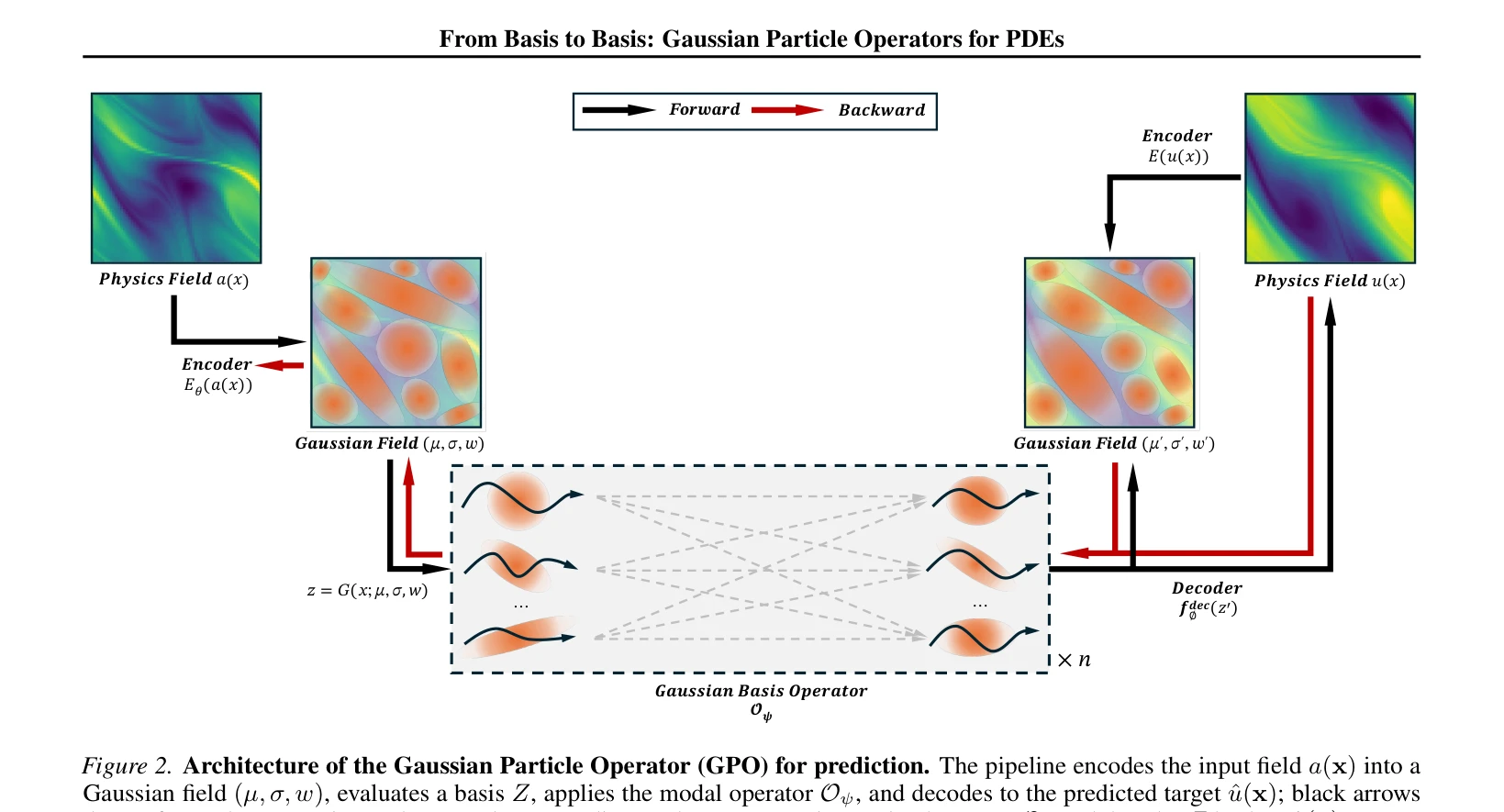
Figure 2. Architecture of the Gaussian Particle Operator (GPO) for prediction. The pipeline encodes the input field a(x)
Reconstruction 설정: 인코더 Eθ가 관측 필드 a(x)로부터 Gaussian particle (µ, σ, w)을 생성하고, 이를 query 위치에서 평가하여 basis z를 만든 후 decoder가 원래 필드를 복원하도록 학습하여 basis의 표현력을 검증한다.
Prediction 설정: 동일한 encoder로 입력 필드 a에서 particle을 생성한 뒤, PG Gaussian Attention operator가 basis에 작용하여 업데이트된 basis를 만들고, decoder가 target field u(one-step) 또는 rollout의 다음 필드(multi-step)로 매핑한다.
인코더는 좌표를 Fourier feature로 embedding하고 field feature와 fusion하여 ReLU/Softplus/Softmax 등을 통해 µ, σ, w를 산출한다 (수식 3-6).
PG Gaussian Attention 모듈은 학습된 Gaussian modal window로 N→G 측정(Petrov-Galerkin 방식)을 수행하고, G×G attention으로 modal coupling을 parameterize한 뒤 G→N으로 다시 scatter하여 spatial 표현으로 복원한다.
Originality
고정 grid, hand-picked spectra(Fourier/wavelet), 또는 monolithic implicit network(INR) 대신 학습된 particleized Gaussian basis를 field의 primary state로 사용하는 접근은 operator-learning 세팅에서 상대적으로 미개척된 영역이다.
3D Gaussian Splatting(3DGS)과 explicit-state라는 정신을 공유하지만, (i) basis가 static-scene renderer가 아닌 operator의 trial space로 사용되고, (ii) particle parameter (µ,σ,w)가 scene별로 fitting되는 것이 아니라 encoder에 의해 input field마다 예측되어 input-adaptive하며, (iii) cross-particle interaction이 image-space compositing이 아닌 학습된 modal space에서 PG-style attention으로 parameterize된다는 점에서 차별화된다.
Petrov-Galerkin 측정 개념을 Gaussian modal window와 결합해 N→G→N의 근사-선형 복잡도를 갖는 attention 메커니즘을 설계한 점이 novel하다.
Limitation & Further Study
발췌된 내용상 baseline 대비 성능 향상 폭이 일부 task에서 moderate하고 task-dependent하다고 저자들이 직접 인정하고 있어, 일관된 우위를 보이지 못하는 한계가 있다.
학습된 Gaussian particle이 물리적 구조(vortex, filament 등)와 정성적으로 align되는 것으로 보이나, 논문에서도 명시하듯 이는 one-to-one physical decomposition이 아니라 representation-level interpretability에 그쳐 정량적 해석 가능성 검증이 부족할 수 있다.
modal budget G의 선택, anisotropic scale의 초기화나 정규화(regularization) 전략이 성능에 미치는 민감도에 대한 심층 분석이 본문 발췌에서는 충분히 드러나지 않는다.
후속 연구로는 3D 및 매우 큰 스케일의 irregular geometry에서의 확장성 검증, 물리 법칙(예: 보존 법칙)과의 결합, 그리고 학습된 particle의 물리적 의미를 정량적으로 검증하는 방법론이 필요하다.
총평: 해석 가능성과 효율성이라는 neural operator의 두 난제를 explicit Gaussian particle basis와 Petrov-Galerkin attention으로 동시에 접근한 참신하고 실용적인 연구로, 다양한 벤치마크에서 경쟁력 있는 성능과 representation-level 시각화를 함께 제공하는 점이 인상적이다.
기반 연구SPECTER2 유사도 0.91로 Scientific Machine Learning for Dynamics와 Scientific AI for Physics and Environment가 맞닿아, 'Scientific discovery in the age of artificial intelligence'가 이 ICML 2026 논문의 배경·대안·응용 맥락을 보완한다.
기반 연구SPECTER2 유사도 0.91로 Scientific Machine Learning for Dynamics와 Scientific AI for Physics and Environment가 맞닿아, 'From Theory to Application: A Practical Introduction to Neural Operators in Scientific Computing'가 이 ICML 2026 논문의 배경·대안·응용 맥락을 보완한다.