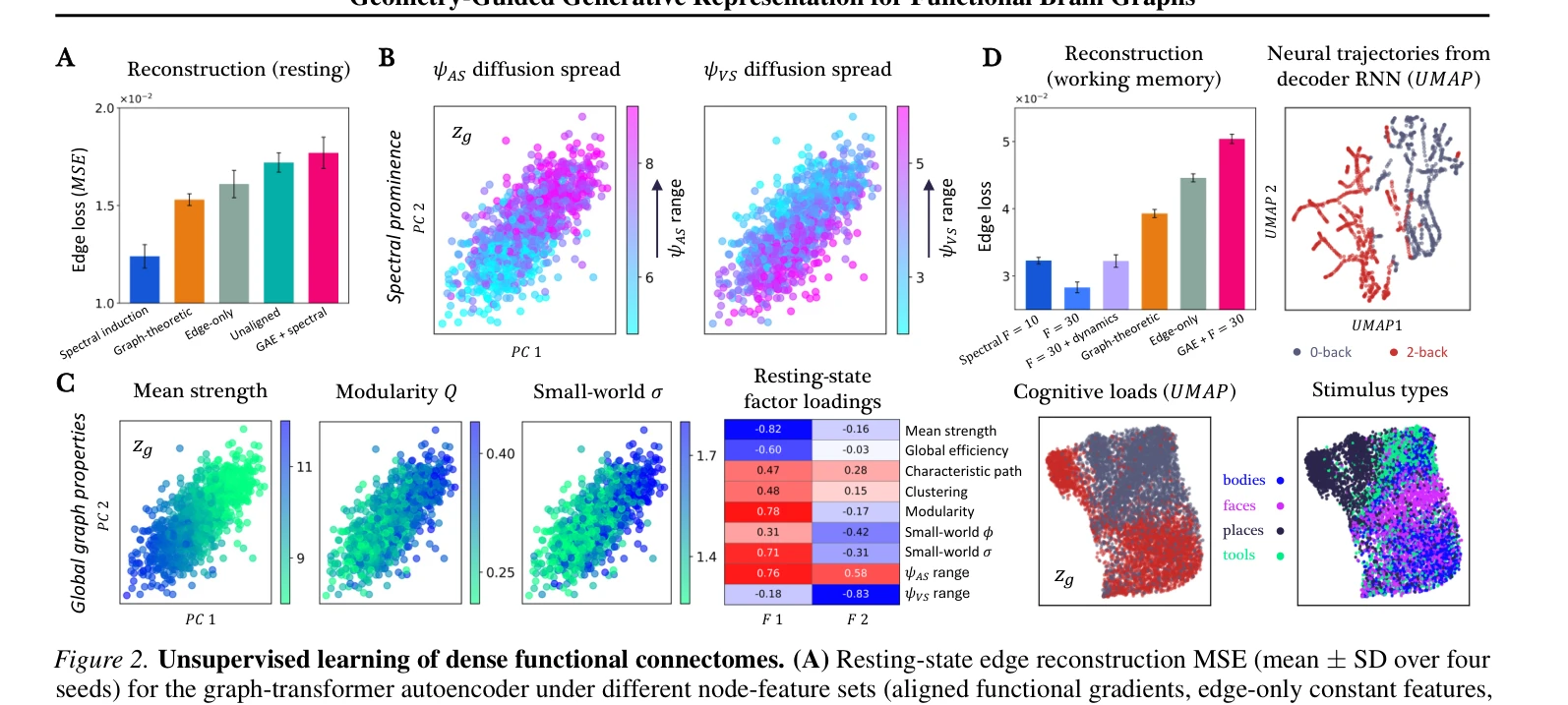
Known: Network neuroscience에서는 graph-theoretic 방법(small-world, modularity, hub 등)과 spectral 방법(functional gradients)을 통해 FC의 구조를 각각 분석해왔으며, 그래프 기반 딥러닝은 뇌 connectome 모델링에 유용한 도구로 활용되어 왔다.
Gap: 기존 방법들은 topological/spectral descriptor를 분리해서 다루어 이들이 population 수준에서 어떻게 공변하는지 간과하며, supervised graph learning은 라벨 부족 문제로 제약받고, 기존 unsupervised graph autoencoder는 주로 node-level embedding에 집중하여 dense FC 정보를 보존하는 compact graph-level representation을 얻기 어렵고, 대부분의 방법이 fixed-density thresholding을 적용해 global weight geometry를 훼손한다.
Why: Dense FC를 sparsification 없이 그대로 다루면서도 개별 subject 고유의 functional geometry를 활용해 비지도로 graph-level latent를 학습하면, 인지 상태 decoding과 synthetic connectome 생성 등 라벨이 부족한 신경영상 분야에서 폭넓게 활용 가능한 표현을 얻을 수 있어 중요하다.
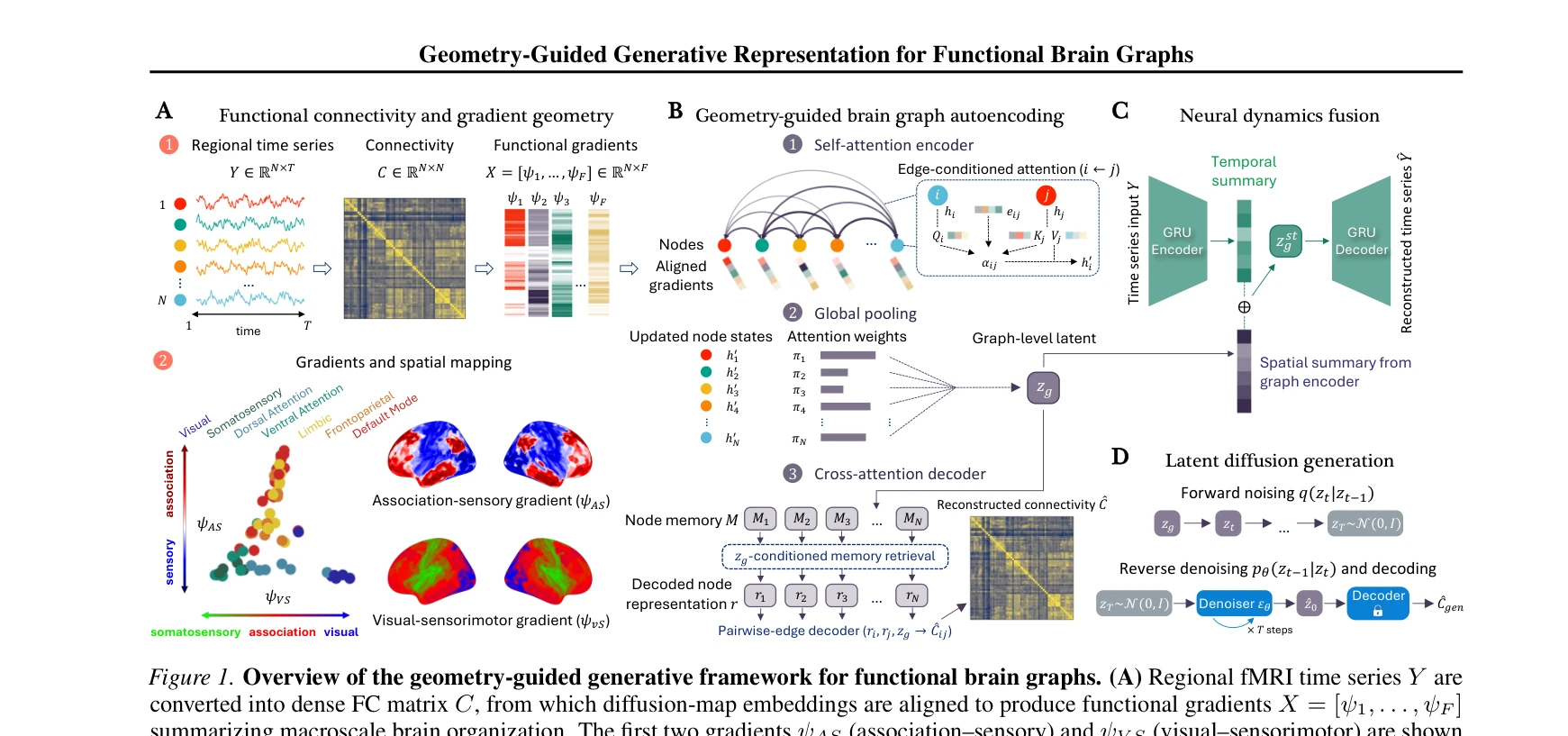
Approach: Edge-conditioned self-attention encoder와 aligned functional gradient를 node feature로 사용하는 graph transformer autoencoder를 통해 dense FC를 compact latent zg로 압축하고, memory 기반 cross-attention decoder로 dense connectome을 재구성하며, 이 latent 위에 diffusion model을 적합해 synthetic FC를 생성한다.
Achievement
완전히 비지도 방식으로 학습된 latent representation만으로도 인지 상태(cognitive state)를 의미 있게 분리하고 시각 자극(visual stimuli)을 decoding할 수 있음을 보였으며, neural dynamics를 결합하면 성능이 더욱 향상됨을 입증하였다. 또한 학습된 latent 위에 diffusion model을 적합하여 synthetic 뇌 connectome을 생성하고 latent space와 graph space 양쪽에서 검증하였다.
How
각 subject의 fMRI 시계열을 정규화한 뒤 Pearson correlation으로 dense, symmetric, unthresholded FC 행렬 C를 구성
diffusion-map embedding(normalized angle kernel, α-normalized kernel)을 이용해 각 subject의 functional gradient를 추출하고 subject 간 alignment 수행하여 node feature X로 사용
Edge-conditioned self-attention encoder가 FC weight로 attention을 modulate하여 node state h'_i를 업데이트
Global attention pooling으로 node state를 집계해 graph-level latent zg 생성
신경 동역학 통합을 위해 GRU 기반 encoder-decoder로 시계열을 압축하고 spatial summary와 결합(fusion)
학습된 latent 분포에 latent diffusion model을 적합시켜 forward noising/reverse denoising 과정을 통해 synthetic latent를 샘플링하고 decoder로 dense FC 재구성
Originality
기존 geometry-guided graph learning이 graph-structural encoding, 외부 spatial coordinate, non-Euclidean representation space를 사용한 것과 달리, subject별 FC로부터 직접 유도되고 subject 간 정렬된 connectome-specific functional geometry를 inductive bias로 도입
Sparsification 없이 dense, weighted FC를 그대로 다루면서 edge-conditioned attention으로 global interaction을 유지하는 접근
Node-level embedding에 치중된 기존 unsupervised graph autoencoding과 달리 memory 기반 cross-attention decoder를 통해 compact graph-level latent를 dense connectome으로 직접 복원
Raw graph가 아닌 학습된 latent representation 위에서 diffusion model을 적합하여 non-Gaussian edge distribution 문제와 edgewise generation 부담을 완화
Limitation & Further Study
완전 비지도 학습이라는 강점이 있으나 다운스트림 인지 상태 decoding 및 시각 자극 decoding 성능이 기존 supervised 방법 대비 얼마나 경쟁력 있는지에 대한 폭넓은 비교가 제한적일 수 있음
특정 parcellation과 fixed node ordering에 의존하므로 다른 parcellation이나 imaging modality로의 일반화 가능성 검증이 추가로 필요
Diffusion model이 생성한 synthetic connectome의 생물학적 타당성(예: 실제 병리적 변이와의 관계)에 대한 심층 검증이 더 요구됨
후속 연구로는 다양한 임상군(질환) 데이터에 대한 적용, 더 많은 modality(구조적 connectome 등) 통합, 그리고 latent geometry의 해석 가능성을 높이는 방법론 개발이 필요
총평: Dense functional connectome을 sparsification 없이 다루면서 subject-specific functional gradient geometry를 inductive bias로 활용한 graph transformer autoencoder와 latent diffusion 결합은 network neuroscience에서 신선한 접근이며, 비지도 학습만으로도 의미 있는 인지 상태 분리 및 생성 능력을 보여준 점에서 실용적 가치가 크다.
기반 연구SPECTER2 유사도 0.92 기준으로 'Geometry-Guided Generative Representation for Functional Brain Graphs'의 AI4S 방법론을 'The Empowerment of Science of Science by Large Language Models: New Tools and Methods'의 과학 생산·평가 맥락과 함께 보면 연구 자동화의 의미를 입체적으로 볼 수 있다.
기반 연구SPECTER2 유사도 0.91로 Multimodal Biomedical Data Fusion와 AI-Driven Drug and Materials Discovery가 맞닿아, 'An equivariant pretrained transformer for unified 3D molecular representation learning'가 이 ICML 2026 논문의 배경·대안·응용 맥락을 보완한다.
기반 연구SPECTER2 유사도 0.91로 Multimodal Biomedical Data Fusion와 AI-Driven Drug and Materials Discovery가 맞닿아, 'MolX: A Geometric Foundation Model for Protein–Ligand Modelling'가 이 ICML 2026 논문의 배경·대안·응용 맥락을 보완한다.