Learning Biophysical Models of Large-Scale Multineuronal Data To Enable Precise Neurostimulation
저자: Amrith Lotlikar, Ian Christopher Tanoh, Praful K. Vasireddy, Andrew Lanpouthakoun, Ramandeep Vilkhu, Michael A. Sommeling, A.J. Phillips, Alexander Sher, Alan Litke, Scott Linderman, EJ Chichilnisky, Subhasish Mitra | 날짜: 2026 | URL: https://openreview.net/forum?id=4hoiRJsmpp📄 PDF
⚠️ 이 페이지의 요약·평가·해설은 생성형 AI(Claude)가 자동 생성한 2차적 분석물입니다. 논문 원문의 저작권은 원저작자에게 있으며, 정확한 내용은 원문(위 DOI·arXiv 등 출처)을 확인하세요.
라이선스: OpenReview 공개(오픈액세스)
Essence
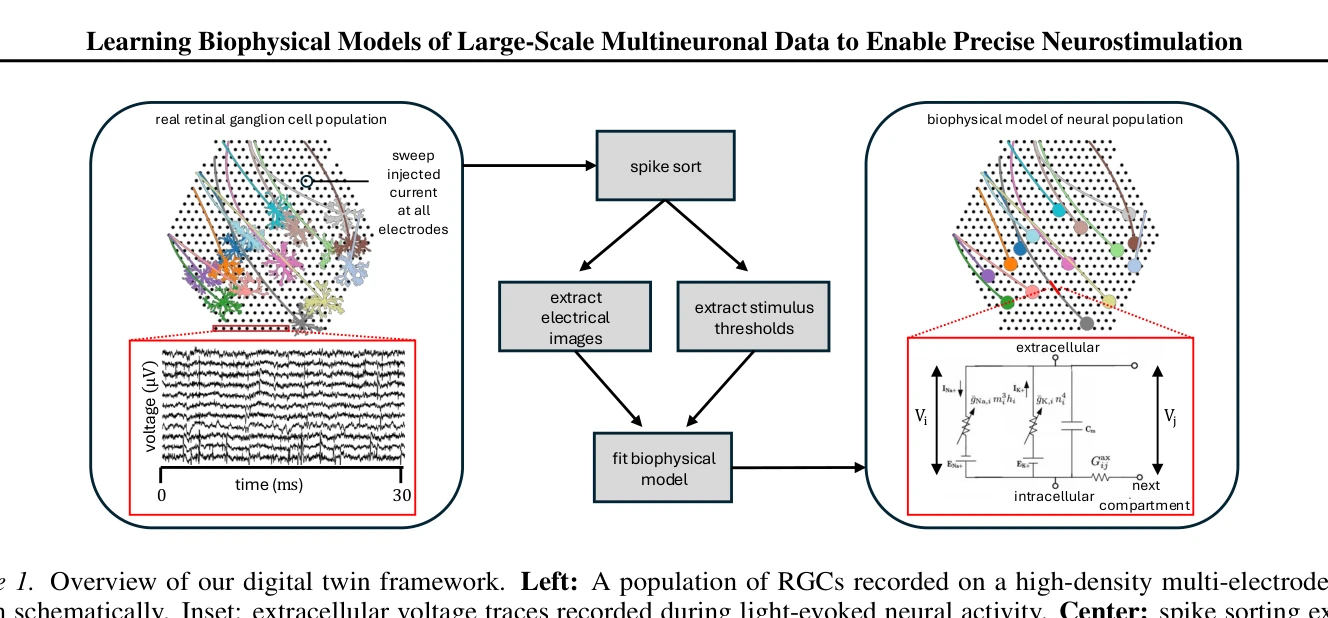
Figure 1. Overview of our digital twin framework. Left: A population of RGCs recorded on a high-density multi-electrode
고밀도 multi-electrode array(MEA)로부터 얻은 electrical image(EI) 및 자극 임계값 특징만으로, differentiable biophysical simulation(JAXLEY)과 simulation-based inference를 활용해 개별 신경세포의 multi-compartment Hodgkin-Huxley(HH) 파라미터를 신속히 추론하는 프레임워크를 제안한다.
Motivation
Known: Hodgkin-Huxley(HH) 모델은 세포 수준 신경 계산의 생물물리학적 근거를 제공하지만, 전통적으로 intracellular recording을 통해서만 파라미터를 정확히 추정할 수 있어 침습적이고 처리량이 낮다. Multi-electrode array(MEA)는 대규모 신경 집단의 extracellular 신호를 동시에 기록할 수 있지만, 이 신호는 여러 뉴런의 활동이 중첩되어 있고 conductance, morphology, electrode position 사이의 parameter degeneracy 문제로 인해 HH 모델 fitting이 어려웠다.
Gap: 대규모 신경 회로의 모든 뉴런에 대해 세포별 HH 모델을 extracellular MEA 데이터만으로 신뢰성 있게 추론하는 방법이 부재했으며, 이로 인해 신경보철 등 신경공학 응용에서 정밀한 neurostimulation pattern 설계에 필요한 세포 수준 생물물리 모델을 실용적 시간 내에 얻을 수 없었다.
Why: 임상 환경에서 candidate neurostimulation pattern에 대한 신경 반응을 직접 측정하려면 수시간이 소요되는데, 소수의 기록만으로 정확한 HH 모델을 얻을 수 있다면 이 과정을 대체하여 망막 임플란트 등 신경 인터페이스의 자극 설계를 대폭 가속화할 수 있다는 점에서 중요하다.
Approach: Kilosort2로 spike sorting하여 얻은 각 뉴런의 electrical image(EI)와 단일 전극 자극 임계값이라는 생물물리학적으로 해석 가능한 특징들을 설계하고, 이를 JAXLEY 기반 differentiable HH 시뮬레이션과 simulation-based inference에 결합하여 parameter degeneracy 문제를 완화하며 세포별 HH 파라미터(θ={ḡNa, ḡK, r, x})를 추론한다.
Achievement
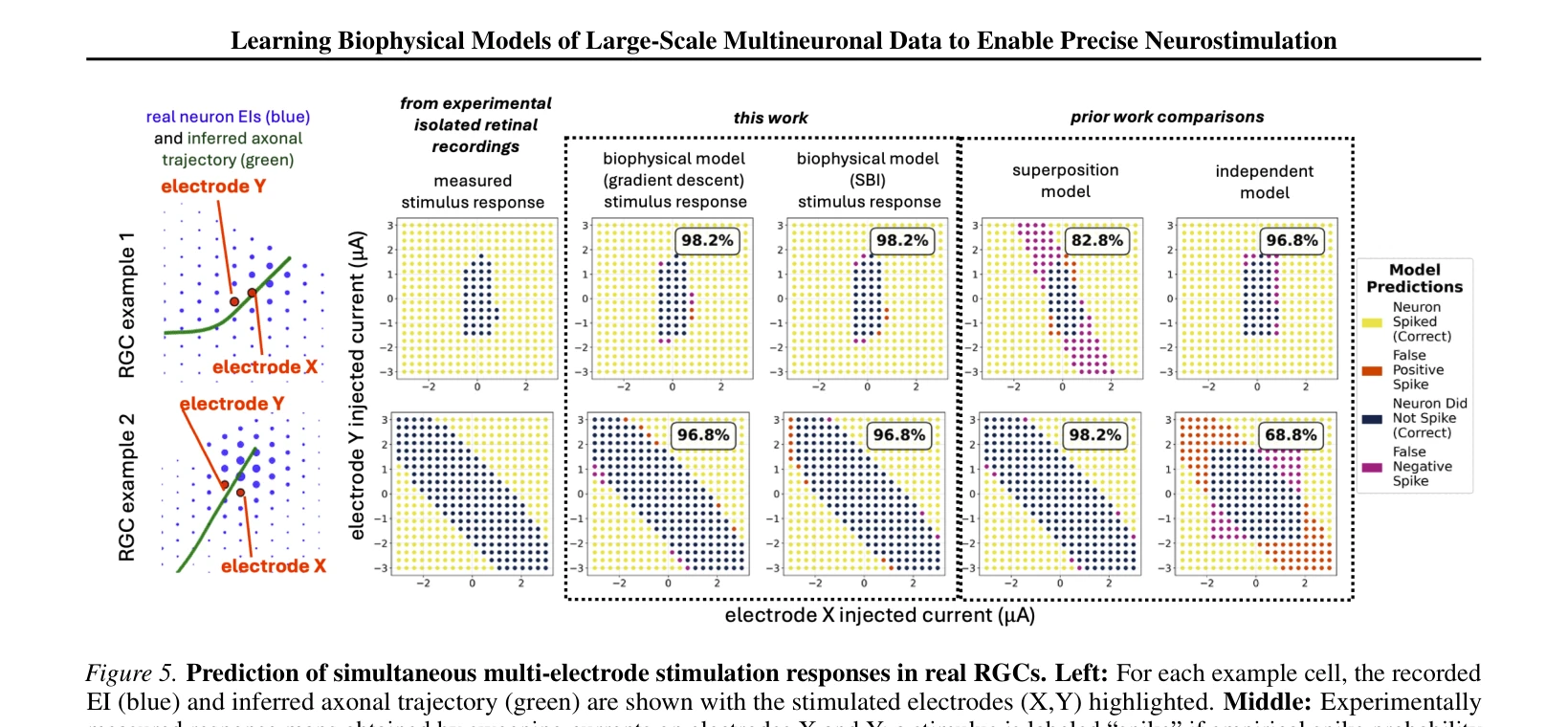
Figure 5. Prediction of simultaneous multi-electrode stimulation responses in real RGCs. Left: For each example cell, th
디지털 트윈 프레임워크 제시: 대규모 MEA 기록으로부터 세포별 multi-compartment HH 모델을 빠르게 추론하는 end-to-end 파이프라인(spike sorting → EI/threshold 특징 추출 → biophysical model fitting)을 구축했다.
정량적 검증: isolated macaque retina에서 30 µm-pitch 512-electrode array로 수백 시간의 자극·기록 데이터를 수집하여, 단 몇 분의 기록만으로 fitting한 HH 모델이 이전에 보지 못한 multi-electrode stimulation 반응을 90.4% 정확도로 예측함을 보였다.
시간 단축: 기존에 수 시간이 소요되던 임상적 자극 테스트를 몇 분의 기록으로 대체할 수 있음을 입증하여 신경자극 패턴 설계의 실용적 가속화 가능성을 제시했다.
How
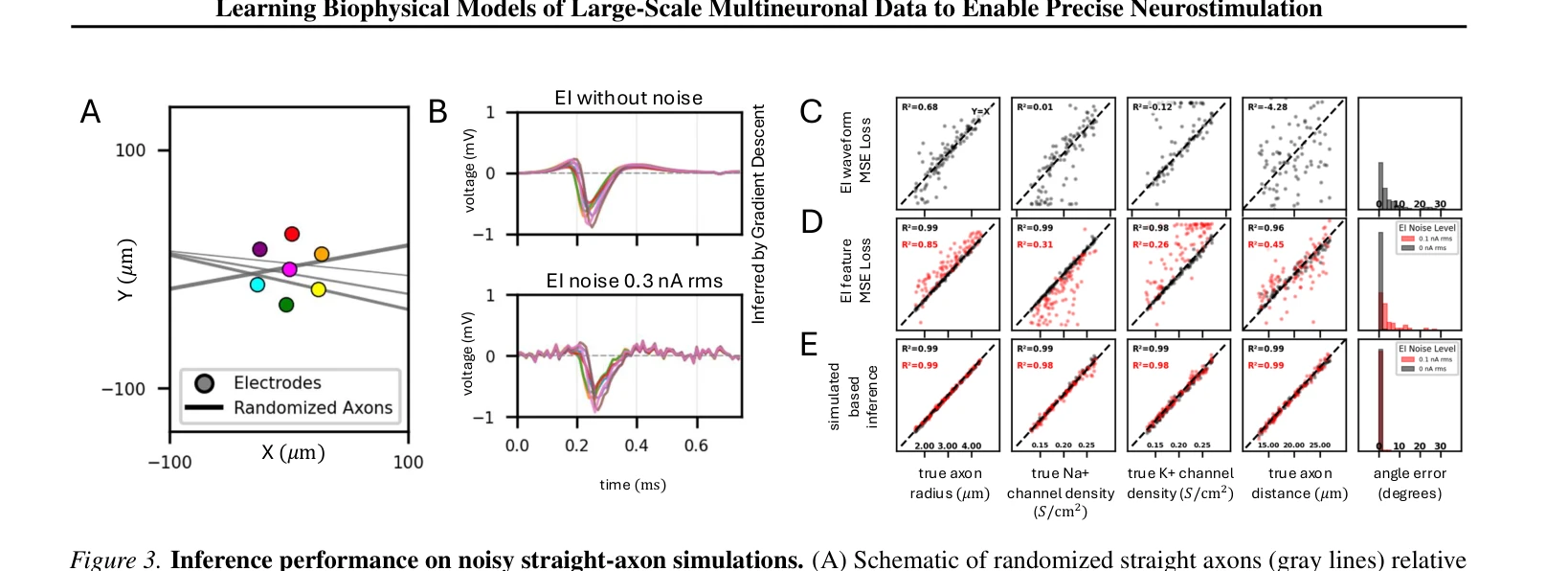
Figure 3. Inference performance on noisy straight-axon simulations. (A) Schematic of randomized straight axons (gray lin
Electrical image(EI) 추출: light-evoked retinal activity를 Kilosort2로 spike sorting하여 각 뉴런의 multielectrode voltage waveform(EI)을 얻음 (capacitive, sodium, potassium 3-phase 특징).
Forward Model 1 (EI): JAXLEY로 multi-compartment HH dynamics를 적분하고, line-source approximation을 통해 각 전극에서의 extracellular potential Φm(t)을 계산하여 시뮬레이션된 EI를 생성.
Forward Model 2 (Stimulation): 전극을 통한 전류 주입에 따른 신경 반응(발화 여부)을 시뮬레이션하는 stimulation forward model을 구성.
파라미터 추론: 생물물리학적으로 해석 가능한 EI 특징(spike duration, propagation velocity 등)과 소수의 single-electrode threshold 측정치를 결합하여, gradient-based optimization과 simulation-based inference(Cranmer et al., 2020)로 θ={ḡNa,i, ḡK,i, ri, xi}를 추정.
검증: noisy straight-axon 시뮬레이션(Figure 3)과 실제 RGC 기록(Figure 4, 5)에 대해 fitting 정확도 및 unseen multi-electrode stimulation response 예측 정확도를 평가.
Originality
Intracellular recording 없이 extracellular MEA 데이터만으로 multi-compartment HH 모델의 세포별 파라미터를 추론하는 최초의 시도로 보이며, 이를 통해 대규모 신경집단 전체에 대한 biophysical model 구축이 가능해짐.
기반 연구SPECTER2 유사도 0.91로 Scientific Machine Learning for Dynamics와 Scientific AI for Physics and Environment가 맞닿아, 'The frontier of simulation-based inference'가 이 ICML 2026 논문의 배경·대안·응용 맥락을 보완한다.
기반 연구SPECTER2 유사도 0.90로 Scientific Machine Learning for Dynamics와 Scientific AI for Physics and Environment가 맞닿아, 'A multimodal generative AI copilot for human pathology'가 이 ICML 2026 논문의 배경·대안·응용 맥락을 보완한다.
기반 연구SPECTER2 유사도 0.90 기준으로 'Learning Biophysical Models of Large-Scale Multineuronal Data To Enable Precise Neurostimulation'의 AI4S 방법론을 'After science'의 과학 생산·평가 맥락과 함께 보면 연구 자동화의 의미를 입체적으로 볼 수 있다.
기반 연구SPECTER2 유사도 0.91로 Scientific Machine Learning for Dynamics와 AI-Driven Drug and Materials Discovery가 맞닿아, 'stVCR: spatiotemporal dynamics of single cells from time-series spatial transcriptomics'가 이 ICML 2026 논문의 배경·대안·응용 맥락을 보완한다.