⚠️ 이 페이지의 요약·평가·해설은 생성형 AI(Claude)가 자동 생성한 2차적 분석물입니다. 논문 원문의 저작권은 원저작자에게 있으며, 정확한 내용은 원문(위 DOI·arXiv 등 출처)을 확인하세요.
라이선스: OpenReview 공개(오픈액세스)
Essence
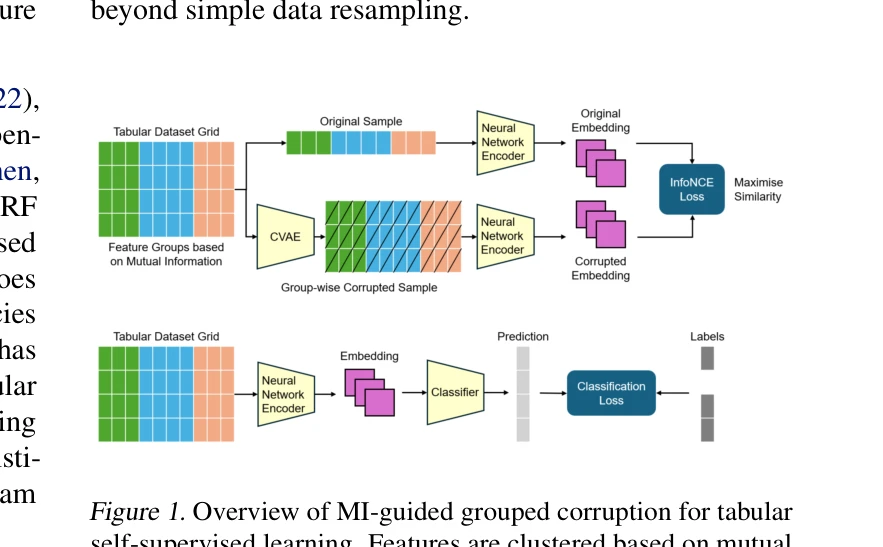
Figure 1. Overview of MI-guided grouped corruption for tabular
Mutual information 기반으로 tabular 데이터의 feature 간 통계적 의존성을 자동 탐지하여 feature group을 구성하고, 이를 conditional VAE로 사실적인 corruption을 생성함으로써 self-supervised contrastive learning의 pretraining 품질을 개선하는 프레임워크를 제안한다.
Motivation
Known: SimCLR, MoCo와 같은 contrastive self-supervised learning이 vision 분야에서 성공을 거두었고, tabular 데이터에서도 VIME, SubTab, TabPFN, SCARF 등의 방법이 제안되어 random feature corruption 기반 pretraining을 수행해왔다.
Gap: 기존 방법들(특히 SCARF)은 feature를 독립적인 개체로 취급하여 랜덤하게 corruption을 가하기 때문에, tabular 데이터에 내재된 feature 간 통계적 의존성(예: 생체지표들의 공변 관계)을 무시하며, 이는 비현실적인 샘플을 생성해 학습된 표현의 품질을 저하시킬 수 있다.
Why: 의료, 금융 등 라벨링 비용이 높은 도메인에서 tabular self-supervised learning의 label efficiency를 개선하는 것은 실용적 가치가 크며, feature 의존성을 명시적으로 모델링하는 것이 표현 학습의 질을 근본적으로 높일 수 있는 방법론적 방향을 제시한다.
Approach: Mutual information 행렬을 기반으로 hierarchical agglomerative clustering을 수행해 feature group을 구성하고, 각 group에 대해 conditional variational autoencoder(CVAE)를 학습시켜 나머지 feature에 조건화된 사실적인 corruption 값을 생성한 뒤, SCARF와 동일한 InfoNCE contrastive loss로 encoder를 pretraining한다.
Achievement
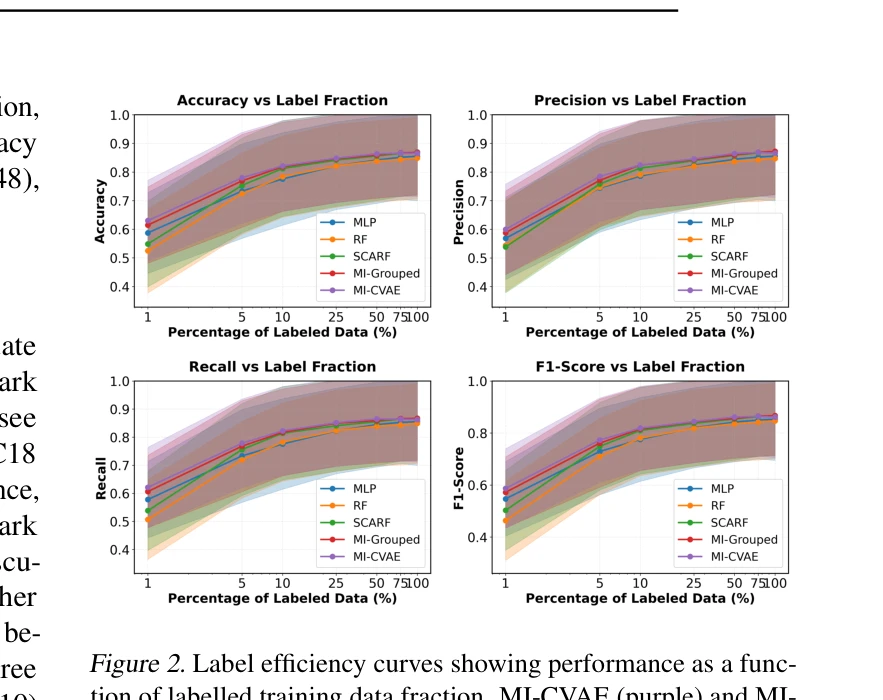
Figure 2. Label efficiency curves showing performance as a func-
MI 기반 feature grouping: k-nearest neighbours 방식으로 pairwise mutual information을 추정하고 정규화하여 dissimilarity matrix를 구성, hierarchical clustering으로 통계적으로 의존적인 feature group을 자동 발견함.
CVAE 기반 구조적 corruption: 각 feature group에 대해 CVAE를 학습하여 marginal pool에서 샘플링한 counterfactual 조건 벡터를 기반으로 사실적이고 다양한 corruption 값을 생성, 단순 permutation보다 novel한 값 생성이 가능함.
광범위한 실험적 검증: UK Biobank pretraining 후 plaque 예측 데이터로의 전이학습, 6개 오픈소스 의료 데이터셋, 66개(초록에는 69개로 표기된 불일치 있음) OpenML-CC18 벤치마크 태스크에서 SCARF, MLP, random forest 대비 우수한 label efficiency를 입증함.
How
Figure 1. Overview of MI-guided grouped corruption for tabular
Mutual information 행렬 M(Mij = I(Xi;Xj))을 k-NN 방법으로 추정하고 [0,1]로 정규화하여 M̃ 획득
Dij = 1 - M̃ij로 dissimilarity 행렬 구성 후 average linkage로 hierarchical agglomerative clustering 수행, 거리 임계값 σ=1-θ(θ=0.3)로 cluster 결정, 최소/최대 cluster 크기 제약 부여
각 cluster Cj에 대해 latent z∈R16, p(z)=N(0,I)인 CVAE를 학습, encoder qψ(z|xCj,x−Cj)와 decoder pϕ(xCj|z,x−Cj)를 MLP+BatchNorm+ReLU로 구현
기반 연구SPECTER2 유사도 0.91 기준으로 'Mutual Information-Guided Corruption for Improved Self-Supervised Representation Learning in Tabular Data'의 AI4S 방법론을 'Don't Stop Pretraining: Adapt Language Models to Domains and Tasks'의 과학 생산·평가 맥락과 함께 보면 연구 자동화의 의미를 입체적으로 볼 수 있다.
기반 연구SPECTER2 유사도 0.91로 Multimodal Biomedical Data Fusion와 AI-Driven Drug and Materials Discovery가 맞닿아, 'CLM-X: A multimodal single-cell foundation model with flexible multi-way Transformer for unified scRNA-seq and scATAC-seq analysis'가 이 ICML 2026 논문의 배경·대안·응용 맥락을 보완한다.
기반 연구SPECTER2 유사도 0.91로 Multimodal Biomedical Data Fusion와 AI-Driven Drug and Materials Discovery가 맞닿아, 'Few-Shot Continual Learning for 3D Brain MRI with Frozen Foundation Models'가 이 ICML 2026 논문의 배경·대안·응용 맥락을 보완한다.
기반 연구SPECTER2 유사도 0.92로 Multimodal Biomedical Data Fusion와 AI-Driven Drug and Materials Discovery가 맞닿아, 'Knowing when to trust machine-learned interatomic potentials'가 이 ICML 2026 논문의 배경·대안·응용 맥락을 보완한다.