저자: Zekuan Shang, Xiaosong Han, Liupu Wang, Wei Du, Peng Zhao, Yuanshu Li, Yubin Xiao, Xuan Wu, You Zhou | 날짜: 2026 | URL: https://openreview.net/forum?id=QO1uZg4fj4 📄 PDF
Essence
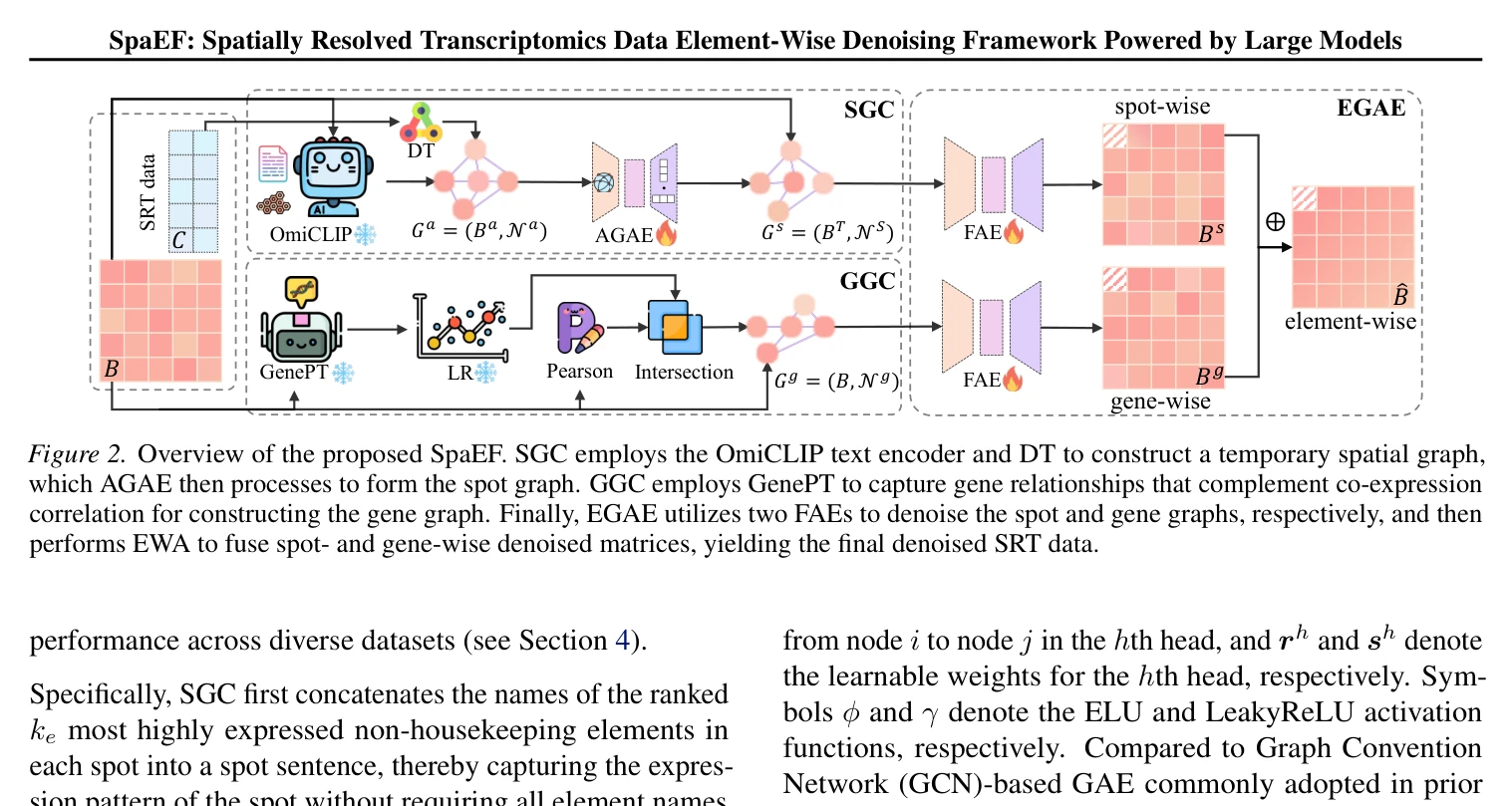
Figure 2. Overview of the proposed SpaEF. SGC employs the OmiCLIP text encoder and DT to construct a temporary spatial g
SpaEF는 두 개의 사전학습된 Large Model(OmiCLIP, GenePT)을 활용해 spot graph와 gene graph를 각각 구성하고, element-wise graph autoencoder(EGAE)로 이를 융합함으로써 Spatially Resolved Transcriptomics(SRT) 데이터의 노이즈를 제거하는 프레임워크이다.
Evaluation
Novelty: 4/5 Technical Soundness: 4/5 Significance: 4/5 Clarity: 4/5 Overall: 4/5
총평: 사전학습된 두 Large Model을 활용해 spot과 gene graph 구성의 근본적 한계를 해결하고 element-wise fusion으로 SRT denoising 성능을 향상시킨 독창적이고 실용적인 연구로, LM을 SRT 도메인에 창의적으로 접목한 점이 돋보인다.
같이 보면 좋은 논문
기반 연구SPECTER2 유사도 0.90로 Multimodal Biomedical Data Fusion와 LLMs for Molecular Biology & Chemistry가 맞닿아, 'Effective gene expression prediction from sequence by integrating long-range interactions'가 이 ICML 2026 논문의 배경·대안·응용 맥락을 보완한다.
기반 연구conditional VAE 기반 데이터 증강을 self-supervised contrastive learning으로 확장함
기반 연구graph autoencoder 기반 융합 기법의 방법론적 기반을 제공한다.
기반 연구SPECTER2 유사도 0.90 기준으로 'SpaEF: Spatially Resolved Transcriptomics Data Element-Wise Denoising Framework Powered by Large Models'의 AI4S 방법론을 'Extending the range of graph neural networks with global encodings'의 과학 생산·평가 맥락과 함께 보면 연구 자동화의 의미를 입체적으로 볼 수 있다.
기반 연구SPECTER2 유사도 0.91로 Multimodal Biomedical Data Fusion와 AI-Driven Drug and Materials Discovery가 맞닿아, 'Towards building a World Model to simulate perturbation responses in cellular biology'가 이 ICML 2026 논문의 배경·대안·응용 맥락을 보완한다.
기반 연구SPECTER2 유사도 0.91로 Multimodal Biomedical Data Fusion와 LLM Benchmarking and Agent Evaluation가 맞닿아, 'Generative machine learning unlocks the first proteome-wide image of human cells'가 이 ICML 2026 논문의 배경·대안·응용 맥락을 보완한다.
기반 연구SPECTER2 유사도 0.92로 Multimodal Biomedical Data Fusion와 Molecular Simulation and Generative Modeling가 맞닿아, 'SR-CGCNN: Shared Recurrent Convolution in Crystal Graph Neural Networks for Materials Property Prediction'가 이 ICML 2026 논문의 배경·대안·응용 맥락을 보완한다.
다른 접근그래프 학습에서 고주파 정보 보존 문제를 다른 방식으로 접근함.
다른 접근동일하게 그래프 기반 오토인코더 구조를 사용하지만 적용 도메인(PDE 동역학 vs 공간전사체)이 다른 대안적 접근이다.
반론/비판그래프 오토인코더의 smoothing 효과에 대해 상반된 관점(과도한 보존 vs 유용한 융합)을 제시한다.
다른 접근spatially resolved transcriptomics 데이터 처리를 위한 다른 그래프 융합 접근이다.
후속 연구spot-gene graph 결합 방식을 확장한 후속 연구로 볼 수 있다.