⚠️ 이 페이지의 요약·평가·해설은 생성형 AI(Claude)가 자동 생성한 2차적 분석물입니다. 논문 원문의 저작권은 원저작자에게 있으며, 정확한 내용은 원문(위 DOI·arXiv 등 출처)을 확인하세요.
라이선스: OpenReview 공개(오픈액세스)
Essence
공간 데이터에서 처치 간 간섭(interference)과 관측되지 않은 공간적 교란(spatial confounding)이 사실은 서로 연결되어 있다는 통찰을 바탕으로, 이웃 처치 벡터를 multi-cause 신호로 활용해 잠재 교란변수를 복원하는 두 단계(C-VAE + 유연한 outcome model) 프레임워크인 Spatial Deconfounder를 제안한다.
Motivation
Known: 기존 연구는 spatial interference(exposure mapping, spatial autoregressive 모델)와 spatial confounding(spline, matching, IV, 잠재장 사전분포 기반 방법)을 각각 별도로 다뤄왔으며, deconfounder framework(Wang & Blei, 2019)는 i.i.d. 다중 동시 처치 상황에서 잠재 교란변수를 복원할 수 있음이 알려져 있다.
Gap: 기존 방법들은 interference를 다루기 위해 confounding이 없다고 가정하거나, confounding을 다루기 위해 interference를 배제하는 방식으로 한쪽 문제를 무시해왔고, deconfounder 계열 방법은 다중 처치 유형이나 명시적 잠재장 모델(latent-field model)을 요구하여 spatial 도메인에는 직접 적용이 어렵다는 근본적 공백이 있다.
Why: 공기질-건강 연구처럼 정책적으로 중요한 공간 인과추론 문제에서 interference와 confounding을 동시에 무시하면 편향된 결론을 낳아 규제·공중보건 의사결정을 오도할 수 있으므로, 두 문제를 통합적으로 해결하는 방법론은 실질적 파급력이 크다.
Approach: interference가 오히려 동일한 잠재 공간장(latent spatial field)에 의해 형성된 자신과 이웃의 처치 벡터라는 multi-cause 구조를 드러낸다는 핵심 통찰을 활용해, 지역 처치 벡터로부터 spatial prior를 갖는 C-VAE로 substitute confounder를 복원한 뒤 유연한 outcome model로 direct/spillover effect를 추정하는 2단계 방법을 제안한다.
Achievement
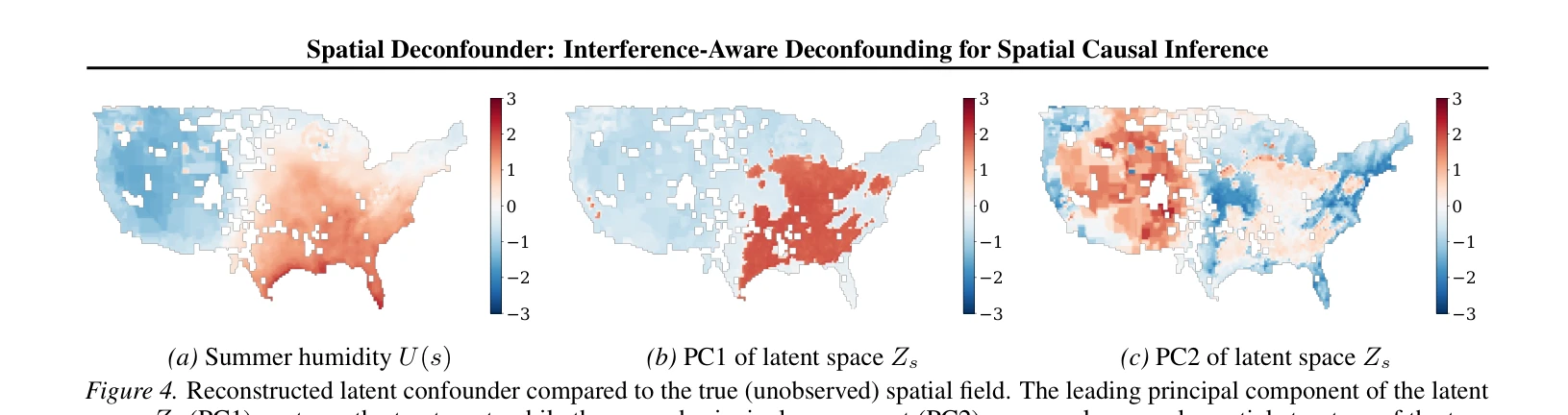
Figure 4. Reconstructed latent confounder compared to the true (unobserved) spatial field. The leading principal compone
Spatial Deconfounder 제안: 이웃 처치 노출(neighborhood treatment exposures)을 multi-cause 신호로 활용해 spatial interference와 unmeasured confounding을 동시에 다루는 최초의 nonparametric·model-agnostic 프레임워크를 제시했다.
식별 이론 증명: 다중 처치 유형이나 잠재장에 대한 파라메트릭 모델 없이도, localized interference와 약한 latent-field sufficiency 가정 하에서 direct 및 spillover effect의 nonparametric identification을 증명했다.
벤치마크 확장 및 실증적 개선: SpaCE 벤치마크를 structured interference를 포함하도록 확장하고, 기후·건강·사회과학 데이터셋 전반에서 spatial autoregressive, matching, spline 기반 baseline 대비 일관되게 편향을 줄임을 보였다.
How
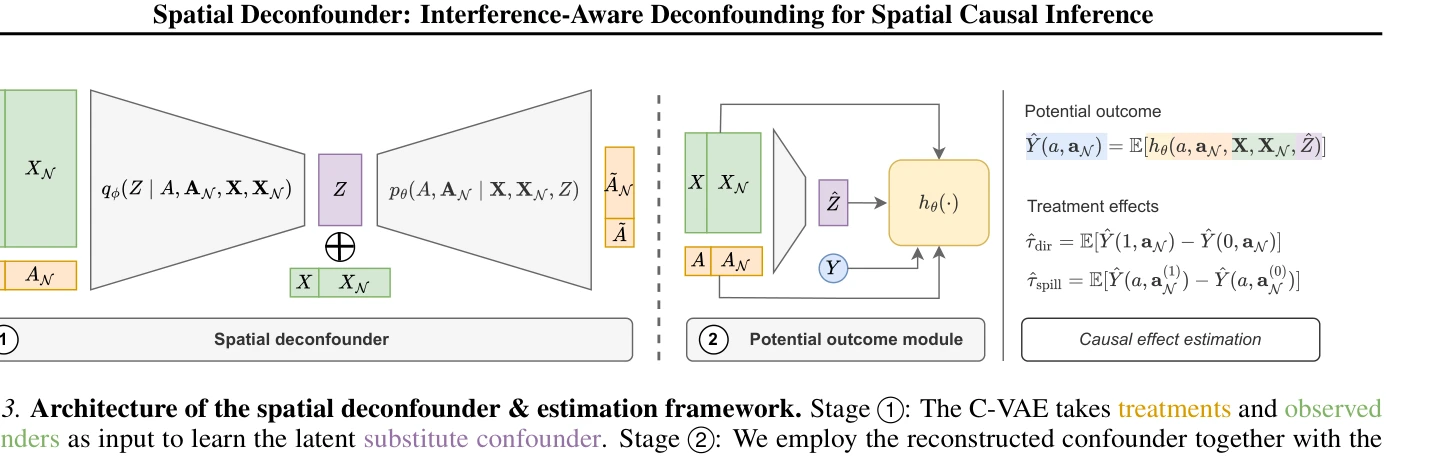
Figure 3. Architecture of the spatial deconfounder & estimation framework. Stage 1 : The C-VAE takes treatments and obse
공간 격자(spatial grid)에서 각 site s와 이웃 Ns의 처치 벡터를 결합해 multi-cause 구조를 구성
Stage 1: spatial prior가 부여된 conditional variational autoencoder (C-VAE)를 사용해 지역 처치 벡터로부터 substitute confounder(잠재 공간 교란변수)를 nonparametric하게 복원
Stage 2: 복원된 substitute confounder를 관측 covariate와 함께 U-Net, GNN 등 임의의 유연한 outcome model에 투입해 direct effect와 spillover effect를 추정
약한 latent-field sufficiency 가정 하에서 identification 결과를 이론적으로 증명(명시적 잠재장 모델이나 다중 동시 처치 불필요)
SpaCE 벤치마크를 treatment interference를 포함하도록 확장하여 환경보건·사회과학 실제 데이터셋에서 검증
Originality
interference와 spatial confounding을 별개 문제로 다루던 기존 연구와 달리, interference가 잠재 교란변수 복원에 필요한 multi-cause 구조를 오히려 제공한다는 참신한 연결고리를 제시
단일 처치 유형만 존재하는 상황에서도 이웃 처치 벡터를 활용해 deconfounder framework(Wang & Blei, 2019)를 spatial 도메인으로 확장
명시적 latent-field 모델이나 파라메트릭 outcome model 없이 nonparametric identification을 달성한 이론적 기여
SpaCE 벤치마크에 treatment interference를 도입한 새로운 평가 체계 구축
Limitation & Further Study
weak latent-field sufficiency 가정이 실제 응용에서 얼마나 검증 가능한지, 위반 시 견고성(robustness)에 대한 분석이 제한적일 수 있음
C-VAE 기반 substitute confounder 복원의 품질이 spatial prior 설계 및 이웃 크기(neighborhood size) 정의에 민감할 가능성이 있어 이에 대한 sensitivity analysis가 추가로 필요
실제 데이터셋에서의 검증이 SpaCE 확장 벤치마크에 국한되어 있어, 더 다양한 도메인(예: 시계열적 spatiotemporal 데이터)으로의 일반화 가능성에 대한 추가 검증이 필요
이웃 정의(Ns)가 잘못 지정되거나 간섭 범위가 알려지지 않은 경우의 식별 실패 가능성에 대한 논의가 부족
기반 연구SPECTER2 유사도 0.90로 Statistical Causal Inference Methods와 Agentic AI for Scientific Automation가 맞닿아, 'A deep subgrouping framework for precision drug repurposing via emulating clinical trials on real-world patient data'가 이 ICML 2026 논문의 배경·대안·응용 맥락을 보완한다.
기반 연구SPECTER2 유사도 0.90 기준으로 'Spatial Deconfounder: Interference-Aware Deconfounding for Spatial Causal Inference'의 AI4S 방법론을 'REFORMS: Consensus-based Recommendations for Machine-learning-based Science'의 과학 생산·평가 맥락과 함께 보면 연구 자동화의 의미를 입체적으로 볼 수 있다.
기반 연구SPECTER2 유사도 0.90로 Statistical Causal Inference Methods와 Scientific Information Extraction and QA가 맞닿아, 'Large language models for zero-shot inference of causal structures in biology'가 이 ICML 2026 논문의 배경·대안·응용 맥락을 보완한다.