SynLaD: Latent Diffusion for Generating Synthesizable Molecules Conditioned on 3D Pharmacophore Profiles
저자: Miruna Cretu, John Bradshaw, Patricia Suriana, Saeed Saremi, Omar Mahmood, Kirill Shmilovich, Kangway V. Chuang, Vishnu Sresht, Colin A Grambow | 날짜: 2026 | URL: https://openreview.net/forum?id=xn9Jxl54r3📄 PDF
⚠️ 이 페이지의 요약·평가·해설은 생성형 AI(Claude)가 자동 생성한 2차적 분석물입니다. 논문 원문의 저작권은 원저작자에게 있으며, 정확한 내용은 원문(위 DOI·arXiv 등 출처)을 확인하세요.
라이선스: OpenReview 공개(오픈액세스)
Essence
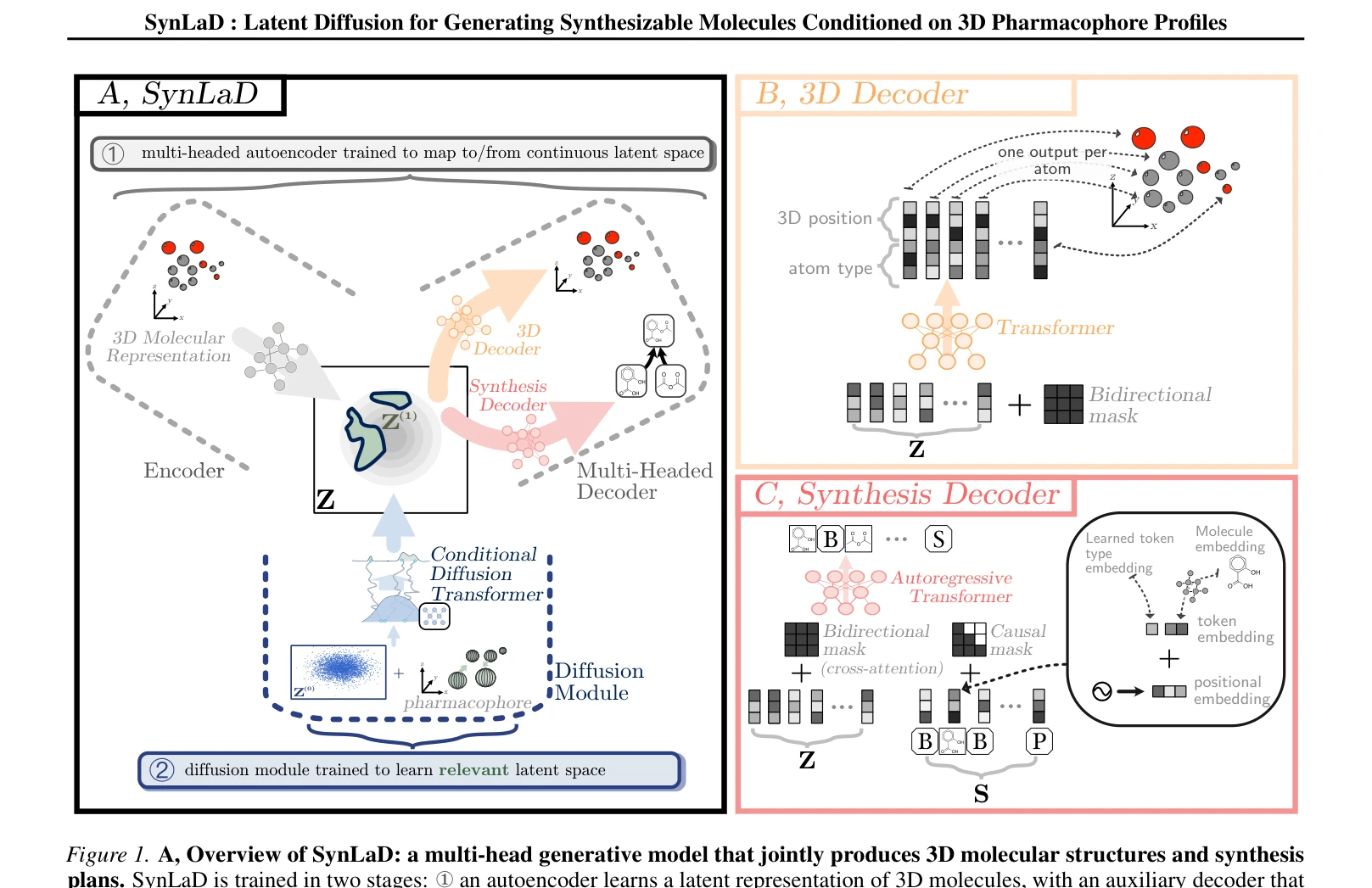
Figure 1. A, Overview of SynLaD: a multi-head generative model that jointly produces 3D molecular structures and synthes
SynLaD은 3D pharmacophore profile에 조건화된 latent diffusion을 통해 3D 구조 생성과 합성 경로(synthesis pathway) 생성을 하나의 latent space에서 동시에 수행하는 프레임워크이다. 단일 encoder-latent 표현을 두 개의 decoder head(3D geometric head, autoregressive synthesis head)가 공유하여 shape-aligned하면서도 synthesizable한 분자를 생성한다.
Motivation
Known: 기존 ligand-based drug design(LBDD) 방법들은 pharmacophore 기반 virtual screening이나 autoregressive/diffusion/flow matching/VAE 기반 3D 조건부 생성 모델을 통해 원하는 3D 형상과 물리화학적 특성을 갖는 분자를 생성해왔다. 한편 synthesis-aware 생성 모델들은 reaction template이나 pathway 기반 생성을 통해 합성가능성을 확보해왔다.
Gap: 현재 모델들은 두 목표 중 하나만 최적화하는 경향이 있다: 3D 형상/pharmacophore 조건부 생성 모델은 합성 불가능한 분자를 생성하는 경우가 많고, 반대로 synthesis-aware 모델들은 3D 화학적 특징(단백질-리간드 결합에 핵심적인)에 조건화되지 않는다는 한계가 있다. 또한 기존 synthesis-constrained 모델들은 고정된 reaction template에 의존하여 탐색 가능한 화학 공간이 좁게 제한된다.
Why: 신약 개발 초기 단계(hit discovery, hit diversification)에서 생성된 분자가 목표 결합 특성을 만족하면서도 실제로 합성 가능해야 실용적 가치가 있으므로, 두 목표를 하나의 모델로 통합하는 것은 계산 창약(computational drug design)의 실질적 병목을 해소하는 데 중요하다.
Approach: SynLaD은 3D 분자를 latent space로 매핑하는 encoder와, 이 latent에서 원자 유형·좌표를 복원하는 geometric decoder 및 직렬화된 reaction 기반 표기로 합성 경로를 생성하는 autoregressive synthesis decoder를 함께 학습하는 dual-decoder autoencoder를 구성하고, 이 latent space 위에서 pharmacophore profile에 조건화된 Diffusion Transformer(DiT)로 새로운 latent를 생성한다.
Achievement
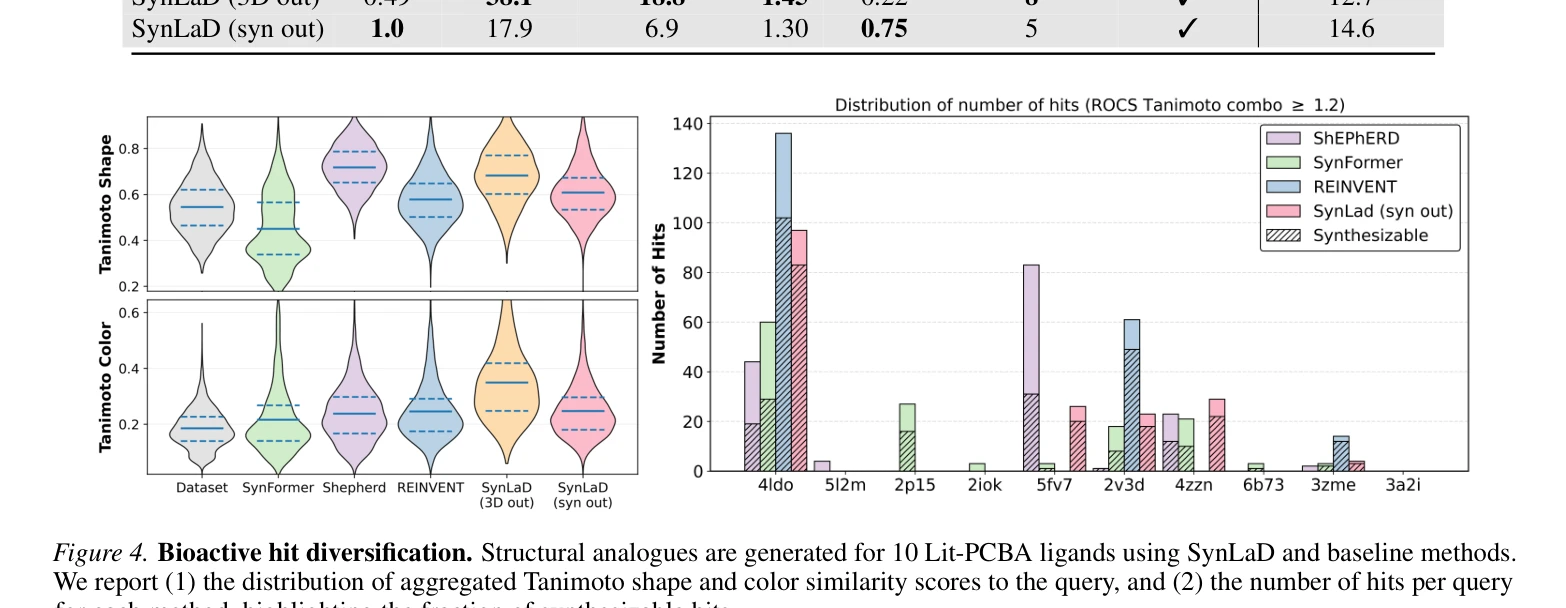
Figure 4. Bioactive hit diversification. Structural analogues are generated for 10 Lit-PCBA ligands using SynLaD and bas
통합 latent space 구축: 3D 구조와 synthesis pathway를 동시에 디코딩할 수 있는 dual-constrained latent 표현을 학습하여, 하나의 latent가 유효한 geometry와 실행 가능한 route로 동시에 디코딩되도록 함.
pharmacophore 조건부 latent diffusion: DiT를 이용해 학습된 latent space에서 pharmacophore profile에 조건화된 novel latent를 샘플링, 3D-aware 설계를 가능케 함.
template-free 합성 제약: 고정된 reaction template 대신 다양한 화학 변환에 대해 학습된 reaction prediction model을 사용하여 template bottleneck을 완화하고 더 넓은 화학 공간 탐색을 지원.
성능 검증: Lit-PCBA benchmark 기반 bioactive analogue 생성 과제에서 SynLaD가 기존 baseline 대비 synthesizable하고 diverse한 hit 생성에서 우수한 성능을 보이며, 분자 품질(pose validity 등)은 개별적으로 학습된 대응 모델 수준을 유지하면서 synthesizable route를 갖는 샘플 비율을 일관되게 향상시킴.
How
Figure 1. A, Overview of SynLaD: a multi-head generative model that jointly produces 3D molecular structures and synthes
1단계: molecular variational autoencoder 학습 — 단일 encoder가 3D 분자를 continuous latent로 매핑, (i) bidirectional mask 기반 transformer로 원자 유형·3D 좌표를 재구성하는 3D decoder, (ii) causal mask 기반 autoregressive transformer로 직렬화된 reaction 기반 synthesis plan을 생성하는 synthesis decoder를 joint training.
2단계: 학습된 latent space 위에서 pharmacophore-conditioned Diffusion Transformer(DiT)를 학습시켜 원하는 pharmacophore를 포함하는 분자로 디코딩되는 latent를 샘플링.
추론 시 synthesis decoder는 cross-attention을 통해 3D-informed latent에 조건화되어, pharmacophore-aware 구조 정보를 반영하면서도 synthesizable route에 직접 연결된 출력을 생성.
reaction 표현은 고정 template이 아닌, 다양하고 상보적인 화학 변환에 대해 학습된 reaction prediction model을 사용해 product를 추론함으로써 template bottleneck 완화.
평가: unconditional/pharmacophore-conditioned 생성에서 pose validity, synthesizability 등 표준 지표 측정, Lit-PCBA 벤치마크 리간드 기반 bioactive analogue 생성 과제로 실용성 평가, diversity·synthesizability·target-conditioned hit discovery trade-off를 함께 보고하는 end-to-end 평가 프로토콜 적용.
Originality
3D 구조 재구성과 synthesis pathway 생성을 하나의 latent space에서 dual-decoder로 결합한 최초 시도로, 두 상충되는 목표(what to make vs. how to make it)를 단일 프레임워크에서 통합.
pharmacophore 조건부 3D 설계와 synthesis-constrained 생성을 동시에 다루는 점에서, 기존 pharmacophore 조건부 방법(MolSnapper, ShEPhERD 등)이나 synthesis-aware 방법(template 기반 reaction pathway 생성)과 차별화됨.
고정 reaction template 대신 학습된 reaction prediction model을 사용해 template bottleneck을 제거하는 접근은 기존 synthesis-constrained 생성 모델들과 구별되는 방법론적 참신성.
MolSnapper 대비 제한적인 pharmacophore 유형 지원 문제는 논문에서 다른 방법의 한계로 언급되나, SynLaD 자체가 지원하는 pharmacophore feature의 다양성과 실제 결합 포켓 정보(단백질 구조)를 활용하지 않는 점에서 SBDD 대비 정보 손실 가능성이 존재.
reaction prediction model에 기반한 synthesis pathway 생성이 실제 실험실에서의 합성 가능성(reagent 가용성, 반응 조건, 수율 등)을 완전히 보장하지 않을 수 있으며, 실제 wet-lab 검증이 부재함.
Lit-PCBA 벤치마크 등 in silico 평가에 국한되어 있어 실제 활성/독성 실험 데이터를 통한 검증이 추가로 필요.
두 decoder 간의 trade-off(예: geometry fidelity와 synthesis plan 정확도 간의 균형)에 대한 심층 분석과, 더 다양한 표적/화학 공간으로의 일반화 검증이 후속 연구로 필요.
총평: 3D pharmacophore 조건부 설계와 합성가능성을 하나의 latent diffusion 프레임워크로 통합한 참신하고 실용적 기여가 돋보이는 연구로, 신약 초기 발굴 단계에서의 실질적 병목을 해소할 잠재력이 크다. 다만 실제 wet-lab 검증과 더 넓은 화학 공간·표적에 대한 일반화 검증이 향후 보완되어야 할 지점이다.
기반 연구SPECTER2 유사도 0.93 기준으로 'SynLaD: Latent Diffusion for Generating Synthesizable Molecules Conditioned on 3D Pharmacophore Profiles'의 AI4S 방법론을 'Molgan: An implicit generative model for small molecular graphs'의 과학 생산·평가 맥락과 함께 보면 연구 자동화의 의미를 입체적으로 볼 수 있다.
기반 연구SPECTER2 유사도 0.94로 Computational Molecular Design와 AI-Driven Drug and Materials Discovery가 맞닿아, 'Retrieval-Augmented Foundation Models for Matched Molecular Pair Transformations to Recapitulate Medicinal Chemistry Intuition'가 이 ICML 2026 논문의 배경·대안·응용 맥락을 보완한다.
기반 연구SPECTER2 유사도 0.94로 Computational Molecular Design와 Molecular Simulation and Generative Modeling가 맞닿아, 'A collaborative constrained graph diffusion model for the generation of realistic synthetic molecules'가 이 ICML 2026 논문의 배경·대안·응용 맥락을 보완한다.