⚠️ 이 페이지의 요약·평가·해설은 생성형 AI(Claude)가 자동 생성한 2차적 분석물입니다. 논문 원문의 저작권은 원저작자에게 있으며, 정확한 내용은 원문(위 DOI·arXiv 등 출처)을 확인하세요.
라이선스: OpenReview 공개(오픈액세스)
Essence
DBMol은 AlphaFold-3, Boltz-2와 같은 structure prediction model을 differentiable guidance 신호로 활용하여, 타겟 단백질 포켓에 특이적으로 결합하는 소분자를 de novo로 설계하는 optimization-projection 프레임워크이다. gradient 기반 최적화와 flow-matching 기반 이산 분자 투영을 번갈아 수행하여 유효하고 결합 친화도가 높은 분자를 생성한다.
Motivation
Known: AlphaFold-3와 Boltz-2 같은 structure prediction model이 단백질-리간드 상호작용과 binding affinity를 정확히 예측할 수 있음이 알려져 있으며, 이를 downstream task의 foundation model로 활용할 가능성이 제시되어 왔다. 기존 ligand 설계 방법은 DiffSBDD, FLOWR, Pocket2Mol 같은 structure-based pocket-aware generator와 docking 목적함수나 reference ligand에 의존하는 ligand-centric 모델로 나뉜다.
Gap: pocket-aware generator는 curated protein-ligand complex 데이터의 커버리지에 제약되고, ligand-centric 방법은 known ligand나 task-specific retraining에 의존하여 새로운 단백질과 결합 부위에 대한 일반화가 어렵다. 또한 protein-protein/protein-nucleic acid interface에는 differentiable structure predictor 기반 gradient 최적화가 적용되었으나, 소분자 설계를 위한 유사한 differentiable structure-predictor-guided 프레임워크는 아직 거의 탐구되지 않았다.
Why: curated dataset이나 known ligand 없이도 최신 structure prediction model의 differentiable 신호만으로 target-specific 소분자를 설계할 수 있다면, 새로운 단백질 포켓에 대한 de novo 약물 설계의 일반화 가능성과 실용성이 크게 확장될 수 있다.
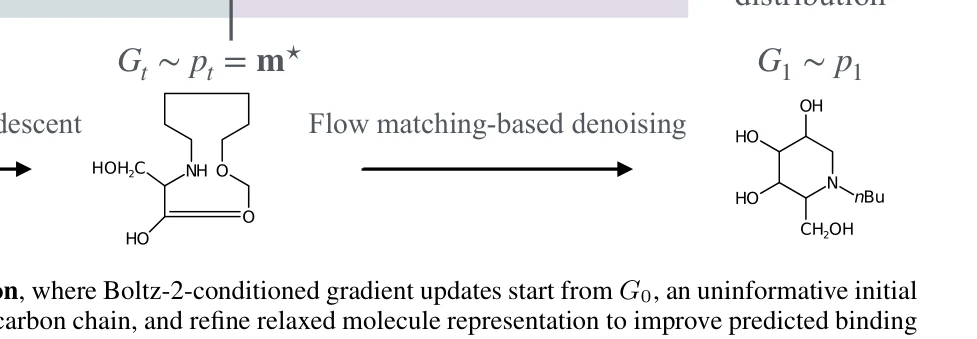
Approach: DBMol은 초기 분자에서 시작해 Boltz-2 기반 gradient descent로 pocket-specific interaction과 predicted binding affinity를 최적화하는 optimization 단계와, flow-matching 기반 분자 완성 모델(DeFoG)로 최적화된 표현을 이산적이고 화학적으로 유효한 분자 그래프로 투영하는 projection 단계를 번갈아 수행한다.
Achievement
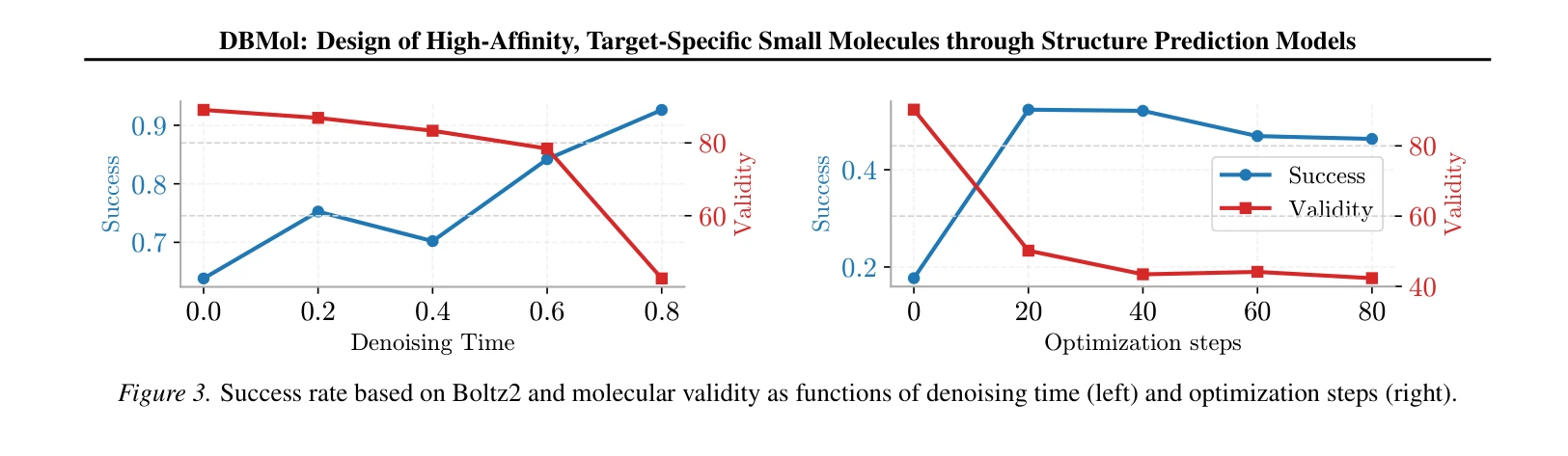
Boltz-2 proxy 최적화 성공: DBMol은 Boltz-2 affinity proxy를 효과적으로 최적화하여 Boltz-2 평가 기준에서 강한 predicted affinity와 specificity를 갖는 분자를 생성했다.
self-confirmation bias 완화를 위한 held-out 평가: AF3 기반의 held-out metric으로 추가 평가하여 최적화에 사용된 proxy 자체를 정답으로 취급하지 않고 독립적으로 검증했다.
pocket coverage와 diversity 동시 개선: unconditional generation 대비 pocket coverage를 크게 향상시키면서도 분자 다양성을 유지했다.
경쟁력 있는 held-out 성능: reference-ligand supervision, curated pocket-ligand pair, task-specific retraining 없이도 RL 기반 및 conditional generative baseline과 견줄 만한 성능을 held-out metric에서 달성했다.
새로운 포켓에 대한 적용 가능성 시연: LIT-PCBA 벤치마크를 넘어 known ligand가 없는 새로운 단백질 포켓에도 적용 가능함을 보여주었다.
How
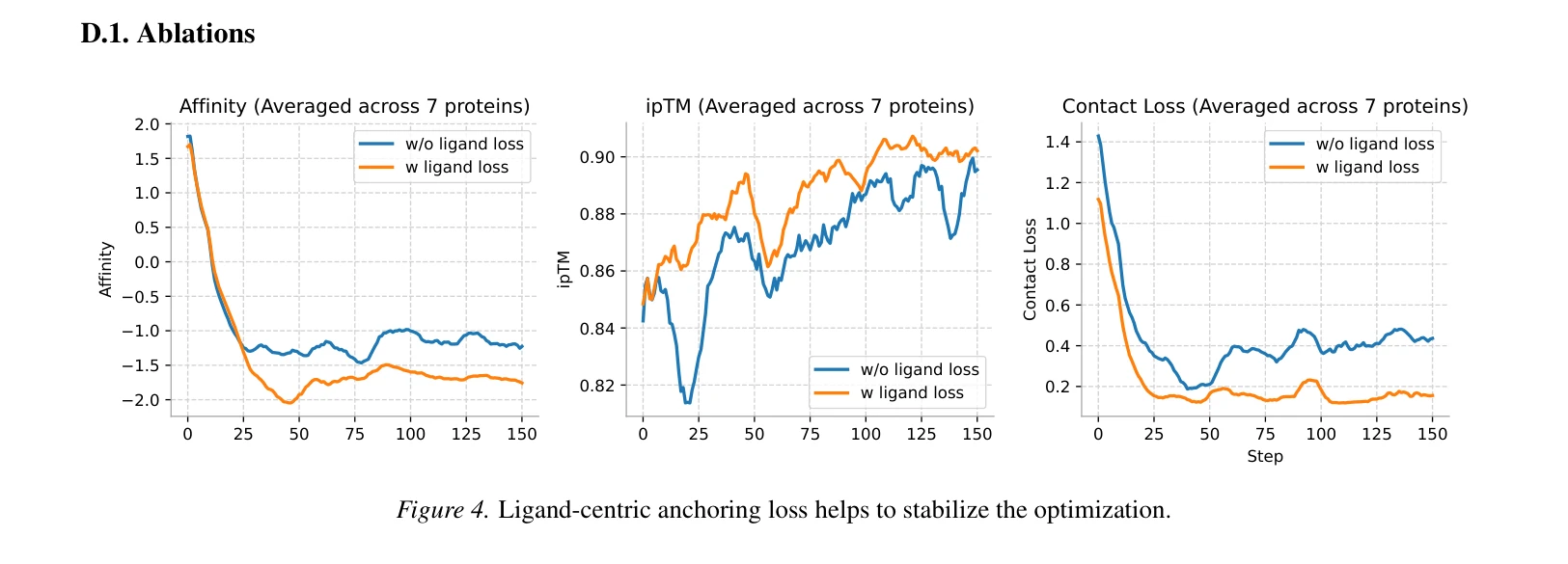
Optimization 단계: 초기(uninformative) 분자 그래프 G0에서 시작하여, Boltz-2와 같은 structure prediction model에서 유도된 differentiable interaction objective(predicted binding affinity, pocket specificity, complex confidence 반영)를 gradient-based로 최적화해 relaxed molecule representation을 개선.
Projection 단계: gradient 업데이트로 인해 발생할 수 있는 화학적으로 invalid한 구조 문제를 해결하기 위해, DeFoG 기반 flow-matching(diffusion 유사) molecule completion model을 사용해 noisy/optimized representation m⋆을 discrete하고 chemically valid한 2D molecule graph G1으로 투영.
Synthesizability 처리: 생성된 각 분자를 구조적으로 유사하면서 합성 가능한(synthetically accessible) 화합물로 매핑하여 실용성을 확보.
평가: LIT-PCBA 벤치마크에서 Boltz-2 기반 지표와 AF3 기반 held-out 지표를 모두 사용해 self-confirmation bias를 줄이면서 성능을 검증.
Originality
structure prediction model(Boltz-2, AF3)을 curated protein-ligand dataset이나 known ligand 없이 소분자 설계의 general-purpose differentiable optimization 신호로 활용한 최초의 시도 중 하나.
gradient 기반 optimization과 discrete flow-matching 기반 projection을 alternating하는 새로운 파이프라인 설계로, differentiable guidance의 chemical validity 문제를 명시적으로 해결.
self-confirmation bias를 인지하고 AF3 기반 held-out metric으로 별도 검증하는 평가 프로토콜 도입.
Limitation & Further Study
논문은 Boltz-2 proxy에 크게 의존하며, 이 proxy 자체가 실제 실험적 binding affinity와 얼마나 일치하는지에 대한 in-vitro/실험적 검증이 부재하다.
발췌된 내용상 synthesizability 매핑 절차나 flow-matching projection의 이론적 보장(예: convergence, 최적화-투영 간 상호작용의 안정성)에 대한 구체적 분석이 제한적으로 보인다.
LIT-PCBA 외 다양한 타겟군(특히 GPCR과 같이 다양한 conformational pocket을 가진 경우)에 대한 광범위한 벤치마크가 추가로 필요하다.
후속 연구로 구조 예측 모델의 발전(정확도, 속도 개선)에 따른 DBMol 성능의 스케일링 분석, 그리고 실제 wet-lab 검증을 통한 실용성 입증이 요구된다.
총평: 구조 예측 모델을 differentiable 신호로 삼아 curated 데이터 없이도 target-specific 소분자를 de novo 설계하는 새롭고 실용적인 접근으로, self-confirmation bias를 인지한 held-out 평가까지 포함한 신중한 실험 설계가 돋보인다. 다만 실험적 검증과 광범위한 타겟에 대한 추가 검증이 향후 신뢰성 확보에 중요할 것이다.
기반 연구SPECTER2 유사도 0.93로 Computational Molecular Design와 AI-Driven Drug and Materials Discovery가 맞닿아, 'Fragment and Geometry Aware Tokenization of Molecules for Structure-Based Drug Design Using Language Models'가 이 ICML 2026 논문의 배경·대안·응용 맥락을 보완한다.
기반 연구SPECTER2 유사도 0.94로 Computational Molecular Design와 AI-Driven Drug and Materials Discovery가 맞닿아, 'Zero-shot design of drug-binding proteins via neural iterative selection−expansion'가 이 ICML 2026 논문의 배경·대안·응용 맥락을 보완한다.