⚠️ 이 페이지의 요약·평가·해설은 생성형 AI(Claude)가 자동 생성한 2차적 분석물입니다. 논문 원문의 저작권은 원저작자에게 있으며, 정확한 내용은 원문(위 DOI·arXiv 등 출처)을 확인하세요.
라이선스: OpenReview 공개(오픈액세스)
Essence
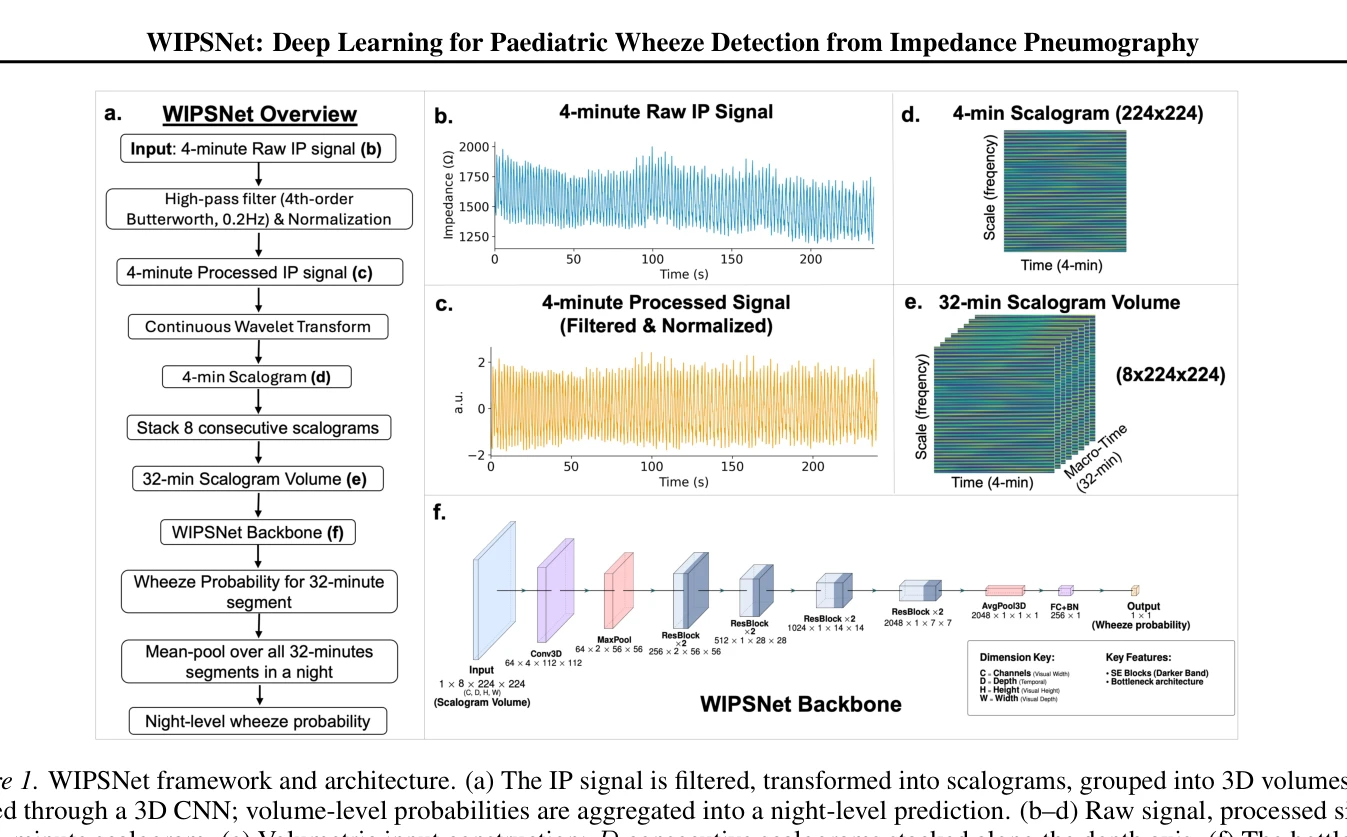
Figure 1. WIPSNet framework and architecture. (a) The IP signal is filtered, transformed into scalograms, grouped into 3
WIPSNet은 overnight impedance pneumography(IP) 신호를 continuous wavelet transform(CWT) scalogram으로 변환해 3D volume으로 쌓고 3D ResNet으로 처리하여 소아 야간 wheeze를 탐지하는 딥러닝 파이프라인으로, 기존 임상 지표인 EVI 대비 AUC를 0.633에서 0.783으로 크게 향상시켰다.
Motivation
Known: Overnight IP는 소아 호흡기 건강 모니터링에 사용되며, 현재 임상 readout인 Expiratory Variability Index(EVI)는 각 recording을 하나의 scalar로 압축해 night-level wheeze classification에서 AUC 0.633을 달성한다. 또한 recurrent neural network, transformer, Mamba와 같은 state-space model은 극도로 길고 불규칙한 physiological time series를 다루는 데 각각 vanishing gradient, quadratic scaling, 제한된 long-context 능력 등의 한계를 가진다.
Gap: EVI는 단일 scalar로 정보를 과도하게 압축해 inter-individual variability가 크고 wheeze 진단보다는 종단적 airway function 모니터링에 더 적합하다는 한계가 있으며, IP recording의 극단적 길이(~10^7 samples)와 motion artefact로 인한 irregularity를 효과적으로 다룰 수 있는 딥러닝 아키텍처가 부재했다.
Why: 소아 wheeze의 조기 탐지는 천식 위험 예측과 재택 모니터링에 중요하지만 기존 acoustic device는 능동적 협조가 필요해 야간 연속 모니터링에 부적합하고, IP 기반 자동 wheeze 진단 방법이 확립되면 원격 소아 호흡기 모니터링의 실질적 임상 도구가 될 수 있다.
Approach: Raw IP 신호를 high-pass filtering 후 4분 단위로 분할하고 각 window를 complex Morlet wavelet 기반 CWT로 224×224 scalogram으로 변환한 뒤, 8개의 연속 scalogram(32분)을 3D volume으로 쌓아 3D ResNet(Bottleneck3D)으로 처리해 wheeze 확률을 예측하고 segment-level 예측을 mean-pooling해 night-level 예측을 얻는다.
Achievement
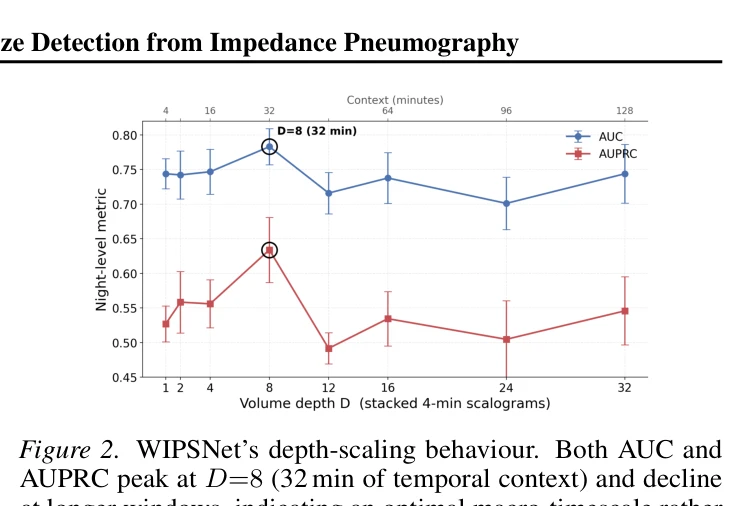
Figure 2. WIPSNet’s depth-scaling behaviour. Both AUC and
AUC 성능 향상: 15-patient cohort(60 nights, 281시간)에서 WIPSNet은 AUC 0.783±0.026을 달성하여 EVI(+0.15) 및 Mamba(+0.094)를 포함한 모든 baseline을 능가했다.
시간적 context의 중요성 규명: volumetric depth(D)에 대한 ablation을 통해 32분(D=8)의 temporal context에서 성능이 최고조에 이르는 것을 확인하여, multi-scale temporal aggregation이 야간 호흡 역학 모델링에 중요함을 시사했다.
다양한 baseline 대비 우위 입증: 최신 sleep-staging architecture인 AttnSleep, SleePyCo, 그리고 state-space model인 Mamba, 그리고 XGBoost(spectral), catch22와 같은 classical ML baseline들을 모두 능가하여 구조화된 time-frequency representation과 3D convolutional architecture의 결합이 효과적임을 입증했다.
How
Figure 1. WIPSNet framework and architecture. (a) The IP signal is filtered, transformed into scalograms, grouped into 3
데이터 수집 및 라벨링: Ventica® 시스템으로 15명의 미취학 아동(60 nights, 281.3시간, 250Hz)의 overnight IP를 수집하고, WheezeScan®(음향 기반 검증 장치)의 wheeze 탐지 여부에 따라 night 단위로 wheezy/non-wheezy 라벨을 부여(21 wheezy, 39 non-wheezy nights).
Scalogram 및 volume 구성: complex Morlet wavelet 기반 CWT로 224×224 scalogram 생성, 8개 연속 scalogram을 stacking해 32분에 해당하는 3D volume 구성(D=8은 hyperparameter optimisation으로 선택).
모델 아키텍처: Bottleneck3D 기반 3D ResNet([2,2,2,2] layers, expansion 4), global-average-pooling과 linear head로 wheeze logit 산출. Optuna 기반 50 trial HPO 수행.
Baseline 비교: Mamba(raw 1D 및 scalogram 입력 두 버전), AttnSleep, SleePyCo(published default configuration에 binary classification head 적용), EVI, XGBoost(spectral features), catch22(raw 1D 22개 domain-agnostic time-series features)와 비교.
평가: patient-level leave-one-out cross-validation(LOOCV, 15 folds)을 5개 random seed에 걸쳐 반복하고, AUC와 AUPRC를 threshold-independent metric으로 보고.
Originality
EVI처럼 단일 scalar로 압축하는 기존 clinical readout과 달리, IP 신호 전체 waveform을 활용하는 최초의 딥러닝 기반 wheeze detection 접근을 제시.
CWT 기반 scalogram을 시간축으로 쌓아 3D volume을 구성함으로써 short-term spectral 정보와 longer-term temporal evolution을 동시에 인코딩하는 two-timescale 설계를 도입.
Mamba와 같은 최신 state-space model, 그리고 sleep-staging에 특화된 AttnSleep/SleePyCo 등 폭넓은 baseline과 체계적으로 비교하여 구조화된 time-frequency representation + 3D convolutional inductive bias의 효과를 실증적으로 검증.
Volumetric depth sweep을 통해 physiological time series 모델링에서 optimal temporal context의 크기(32분)를 정량적으로 규명.
Limitation & Further Study
15명 환자, 60 nights라는 매우 작은 cohort 크기로 인해 일반화 가능성과 통계적 검정력에 한계가 있으며, 외부 검증 코호트에서의 재현이 필요함.
라벨이 WheezeScan이라는 acoustic device의 판정에 의존하므로, night 내 wheeze의 정확한 시점이나 세부 유형을 반영하지 못하는 coarse binary label의 한계가 있음.
Mamba 및 sleep-staging baseline들에 대한 hyperparameter tuning이 WIPSNet만큼 충분히 이루어졌는지 불확실하며, 이는 비교의 공정성에 영향을 줄 수 있음.
향후 연구로는 더 큰 규모의 multi-center cohort 확보, wheeze의 세부 위치·강도까지 예측하는 fine-grained labeling, 그리고 실시간 임상 적용을 위한 모델 경량화 및 해석 가능성 향상이 필요함.
기반 연구SPECTER2 유사도 0.91로 Multimodal Biomedical Data Fusion와 AI-Driven Drug and Materials Discovery가 맞닿아, 'WaveFormer: Wavelet Embedding Transformer for Biomedical Signals'가 이 ICML 2026 논문의 배경·대안·응용 맥락을 보완한다.
기반 연구SPECTER2 유사도 0.88로 Multimodal Biomedical Data Fusion와 Scientific AI for Physics and Environment가 맞닿아, 'Incorporating Continuous Dependence Qualifies Physics-Informed Neural Networks for Operator Learning'가 이 ICML 2026 논문의 배경·대안·응용 맥락을 보완한다.
기반 연구SPECTER2 유사도 0.88로 Multimodal Biomedical Data Fusion와 Applied Bibliometrics Across Domains가 맞닿아, 'Weaning from mechanical ventilation in ICU patients: research hotspots and trends in the past decade—a bibliometric analysis'가 이 ICML 2026 논문의 배경·대안·응용 맥락을 보완한다.
기반 연구SPECTER2 유사도 0.89로 Multimodal Biomedical Data Fusion와 Scientific AI for Physics and Environment가 맞닿아, 'Physics-Informed Neural Learning for State Reconstruction and Parameter Identification in Coupled Greenhouse Climate Dynamics'가 이 ICML 2026 논문의 배경·대안·응용 맥락을 보완한다.