Essence
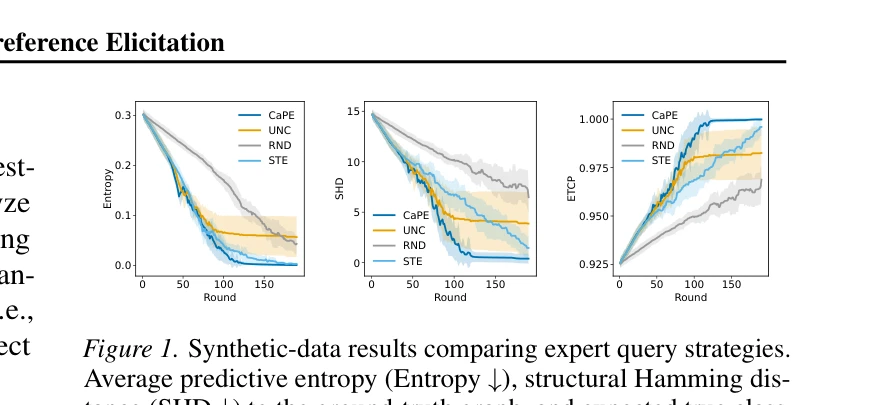
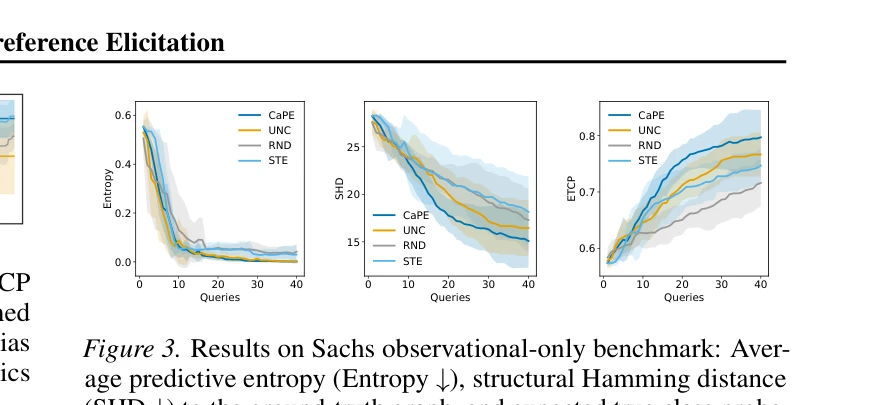
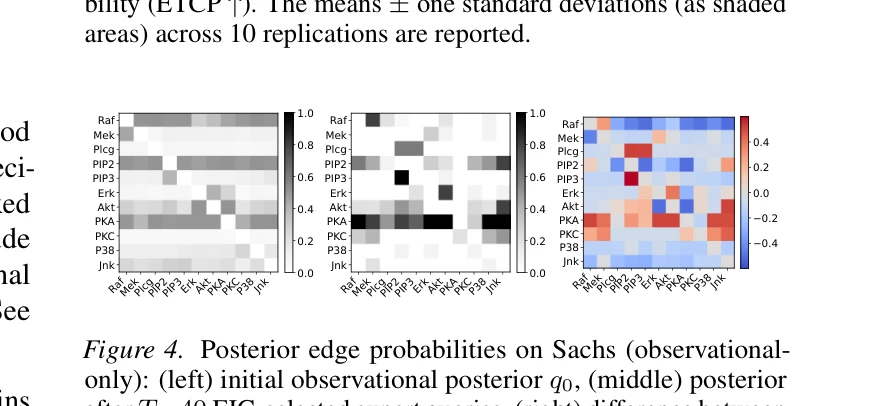
observational posterior over DAG를 초기값으로 두고, 전문가에게 국소적인 edge existence/direction 질문을 순차적으로 던져 posterior를 빠르게 concentrate시키는 Bayesian active learning 프레임워크인 CaPE를 제안한다. 전문가 응답은 3-way categorical likelihood로 모델링되고, particle 기반 posterior update와 BALD 기반 expected information gain(EIG) query selection이 결합된다.
Evaluation
Novelty: 4/5 Technical Soundness: 4/5 Significance: 4/5 Clarity: 4/5 Overall: 4/5
총평: 전문가 지식을 노이즈가 있는 확률적 신호로 취급하고 능동적으로 질의를 선택하는 causal preference elicitation이라는 문제를 명확히 정식화하고, 이를 위한 실용적이고 이론적으로 근거 있는 particle 기반 Bayesian 프레임워크(CaPE)를 제시한 완성도 높은 연구로, expert-in-the-loop causal discovery 분야에 의미 있는 기여를 한다.
같이 보면 좋은 논문
기반 연구SPECTER2 유사도 0.93로 Statistical Causal Inference Methods와 AI-Assisted Academic Scholarly Communication가 맞닿아, 'Exploiting LLMs for Automatic Hypothesis Assessment via a Logit-Based Calibrated Prior'가 이 ICML 2026 논문의 배경·대안·응용 맥락을 보완한다.
기반 연구SPECTER2 유사도 0.93로 Statistical Causal Inference Methods와 Scientific Information Extraction and QA가 맞닿아, 'Large language models for zero-shot inference of causal structures in biology'가 이 ICML 2026 논문의 배경·대안·응용 맥락을 보완한다.
기반 연구SPECTER2 유사도 0.92로 Statistical Causal Inference Methods와 Formal Methods and Computational Reasoning가 맞닿아, 'Piflow: Principle-aware scientific discovery with multi-agent collaboration'가 이 ICML 2026 논문의 배경·대안·응용 맥락을 보완한다.
기반 연구인과 구조 학습의 확장으로서 선호도 유도 문제에 적용된다.
후속 연구대규모 그래프로의 인과 발견 확장 연구이다.
기반 연구observational posterior 기반 DAG 추론이라는 유사한 이론적 기반을 공유
기반 연구LLM을 인과 추론 문제에 적용해 평가하는 관련 사례이다.
다른 접근인과관계 발견을 위한 다른 DAG 파라미터화 방법 제시
다른 접근causal inference라는 공통 주제 하에 preference elicitation과 high-dimensional treatment effect 추정이라는 다른 하위 문제를 다룸
후속 연구hidden confounder 등 causal reasoning의 핵심 개념을 공유하는 이론적 기반
응용 사례causal discovery 능력을 LLM agent의 causal thinking 평가라는 응용 벤치마크로 확장 가능
후속 연구Bayesian inference 기반 위험 요인 발견의 이론적 기초를 제공한다.
후속 연구Bayesian low-rank adaptation의 이론적 기초를 공유한다.