Essence
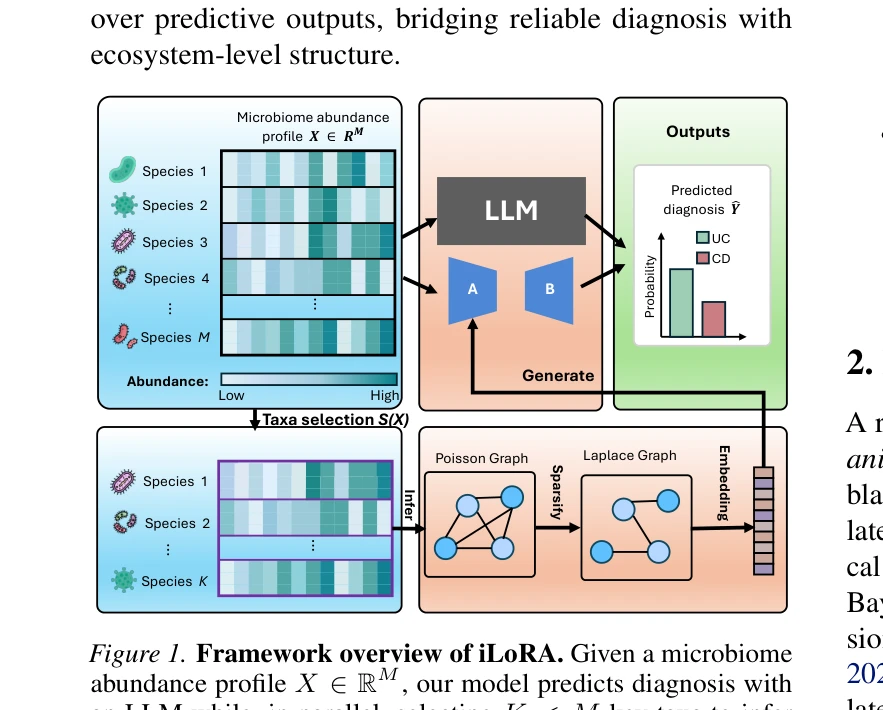
Figure 1. Framework overview of iLoRA. Given a microbiome
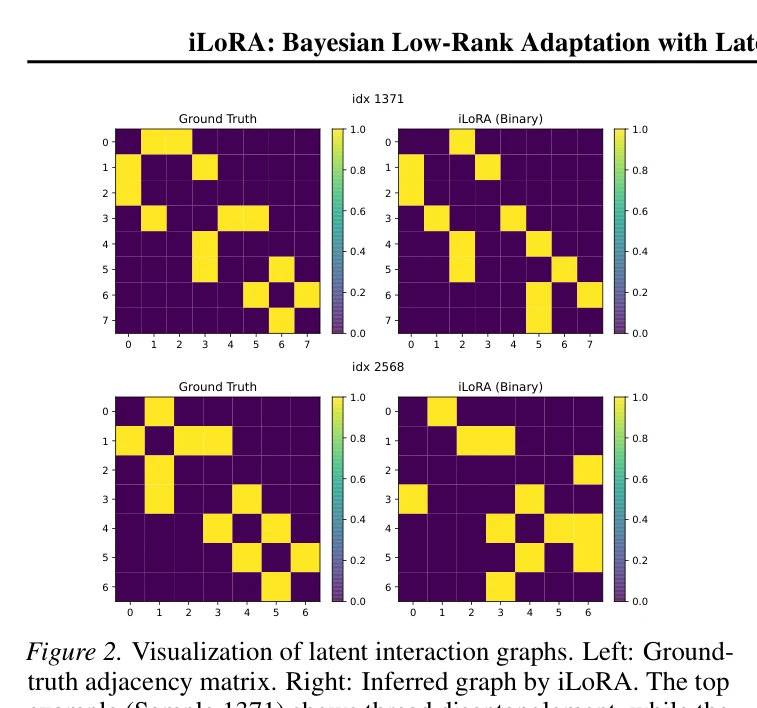
iLoRA는 입력으로부터 latent interaction graph를 추론하고 이를 조건으로 input-conditioned LoRA 업데이트를 생성하는 최초의 Bayesian graph-conditioned LoRA 프레임워크로, microbiome diagnosis에서 예측과 잠재 상호작용 구조를 하나의 end-to-end Bayesian objective로 공동 학습한다.
Evaluation
Novelty: 4/5 Technical Soundness: 4/5 Significance: 4/5 Clarity: 4/5 Overall: 4/5
총평: LoRA의 정적 저랭크 업데이트를 latent interaction graph로 조건화하여 예측과 기전 발견을 통합한 시도는 방법론적으로 참신하고 microbiome 진단이라는 실질적 응용에서 의미 있는 성과를 보였으나, 확장성과 인과적 해석에 대한 추가 검증이 뒷받침되면 임팩트가 더욱 커질 것이다.
같이 보면 좋은 논문
기반 연구SPECTER2 유사도 0.91로 Computational Molecular Design와 LLMs for Molecular Biology & Chemistry가 맞닿아, 'LLM4GRN: Discovering causal gene regulatory networks with llms–evaluation through synthetic data generation'가 이 ICML 2026 논문의 배경·대안·응용 맥락을 보완한다.
기반 연구SPECTER2 유사도 0.92로 Computational Molecular Design와 Agentic AI for Scientific Automation가 맞닿아, 'MRAgent: an LLM-based automated agent for causal knowledge discovery in disease via Mendelian randomization'가 이 ICML 2026 논문의 배경·대안·응용 맥락을 보완한다.
기반 연구Bayesian low-rank adaptation의 이론적 기초를 공유한다.
기반 연구set-aggregation 기법을 확장하여 다른 생물학적 문제에 적용한다.
후속 연구latent interaction graph를 활용한 적응 기법을 확장한다.
기반 연구SPECTER2 유사도 0.92로 Computational Molecular Design와 LLMs for Molecular Biology & Chemistry가 맞닿아, 'CrossLLM-Mamba: Multimodal State Space Fusion of LLMs for RNA Interaction Prediction'가 이 ICML 2026 논문의 배경·대안·응용 맥락을 보완한다.
기반 연구SPECTER2 유사도 0.92로 Computational Molecular Design와 LLMs for Molecular Biology & Chemistry가 맞닿아, 'Partially shared multi-modal embedding learns holistic representation of cell state (APOLLO)'가 이 ICML 2026 논문의 배경·대안·응용 맥락을 보완한다.
기반 연구SPECTER2 유사도 0.92로 Computational Molecular Design와 AI-Driven Drug and Materials Discovery가 맞닿아, 'BioReason-Pro: Advancing Protein Function Prediction with Multimodal Biological Reasoning'가 이 ICML 2026 논문의 배경·대안·응용 맥락을 보완한다.
기반 연구SPECTER2 유사도 0.92로 Computational Molecular Design와 AI-Driven Drug and Materials Discovery가 맞닿아, 'ViraHinter: A Dual-Modal Artificial Intelligence Framework for Predicting Virus-Host Interactions'가 이 ICML 2026 논문의 배경·대안·응용 맥락을 보완한다.
다른 접근posterior uncertainty 정량화를 위한 다른 접근 방식
다른 접근LLM을 이용한 인과추론 및 통계적 추정이라는 유사한 문제를 다른 접근으로 다룬다.
다른 접근LoRA 기반 적응 기법에 대한 다른 조건화 방식을 제안한다.
후속 연구GPT 스타일 causal language model 사전학습의 방법론적 토대를 공유한다.
후속 연구latent interaction graph 기반 LoRA 방법을 확장한 연구이다.
응용 사례유사한 프레임워크를 다른 진단 도메인에 적용한 사례이다.