⚠️ 이 페이지의 요약·평가·해설은 생성형 AI(Claude)가 자동 생성한 2차적 분석물입니다. 논문 원문의 저작권은 원저작자에게 있으며, 정확한 내용은 원문(위 DOI·arXiv 등 출처)을 확인하세요.
라이선스: OpenReview 공개(오픈액세스)
Essence
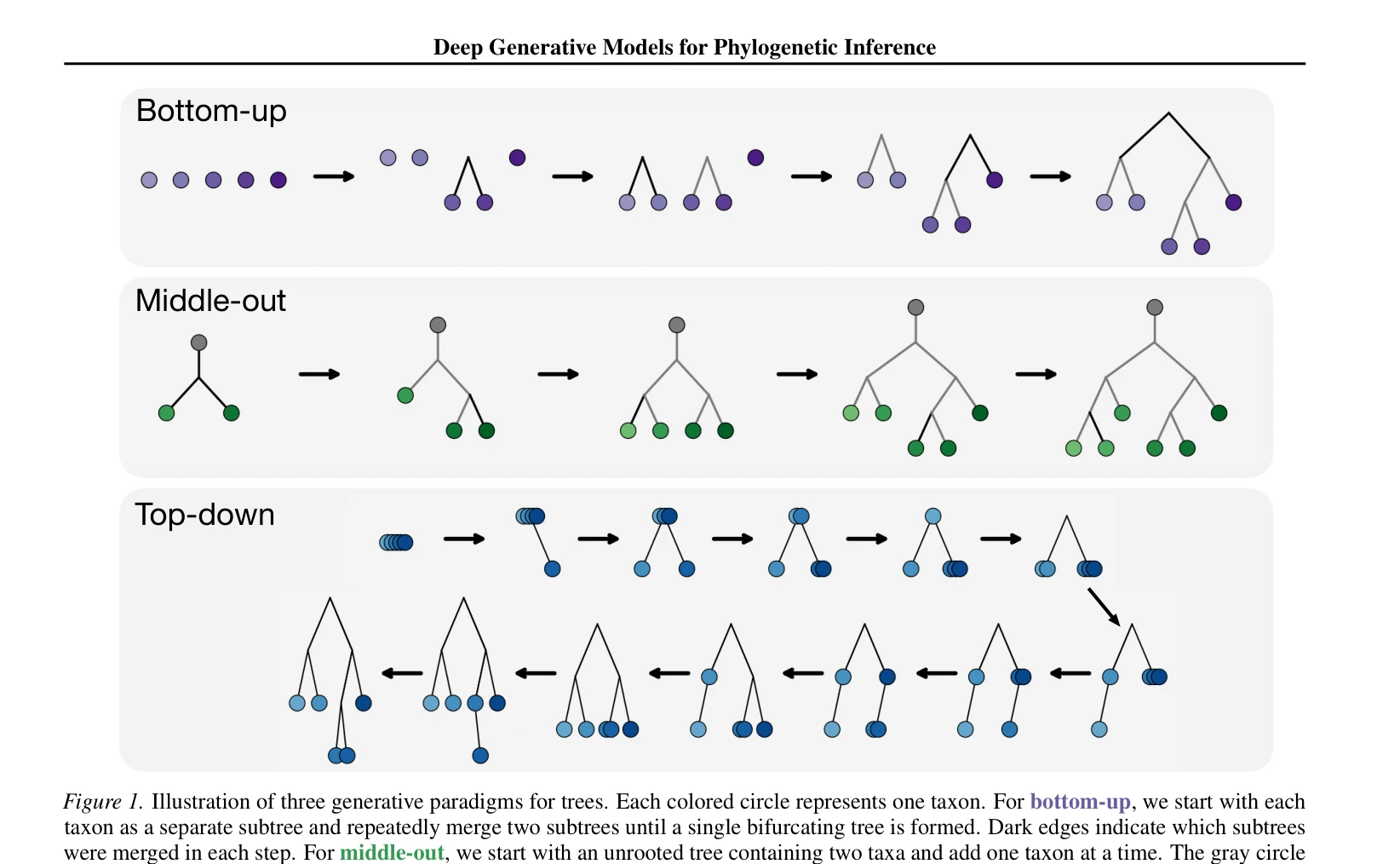
Figure 1. Illustration of three generative paradigms for trees. Each colored circle represents one taxon. For bottom-up,
계통수(phylogenetic tree) 위상에 대한 posterior를 MCMC 없이 simulation-based inference로 학습하기 위해, top-down·middle-out·bottom-up 세 가지 패러다임의 iterative generative model을 discrete diffusion framework로 학습하는 방법을 제안한다.
Motivation
Known: 기존에는 Jukes-Cantor 같은 단순 evolutionary model에서 Felsenstein's pruning algorithm으로 likelihood를 계산하고 MCMC로 posterior를 샘플링해왔으며, Phyloformer 2와 같은 simulation-based 방법도 존재한다.
Gap: 복잡하고 현실적인 evolutionary model(부위 간 상관관계, insertion/deletion, context-dependent mutation 등)에서는 likelihood 계산이 비용이 크거나 완전히 intractable하여 MCMC 기반 방법이 부정확하거나 아예 불가능하며, 기존 simulation-based 방법들은 tree에 대한 parametric distribution만을 매핑하여 표현력이 제한적이다.
Why: DNA/단백질 서열로부터 병원체 확산 추적, 생명 역사 재구성, 면역계 기능 이해 등 다양한 응용에서 tree topology와 불확실성을 정확히 추론하는 것이 필수적이며, 이를 현실적인 진화 모델 하에서도 가능하게 하면 계통수 추론의 정확성과 신뢰도를 크게 높일 수 있다.
Approach: 시뮬레이션된 (X1:N, T) 쌍의 대규모 데이터셋으로 신경망을 학습시켜 서열 조건부로 tree topology의 posterior를 직접 예측하는 simulation-based inference 접근을 취하며, 복잡한 posterior를 표현하기 위해 top-down, middle-out, bottom-up의 세 가지 iterative tree 생성 패러다임과 discrete diffusion 학습 목표를 결합한다.
Achievement
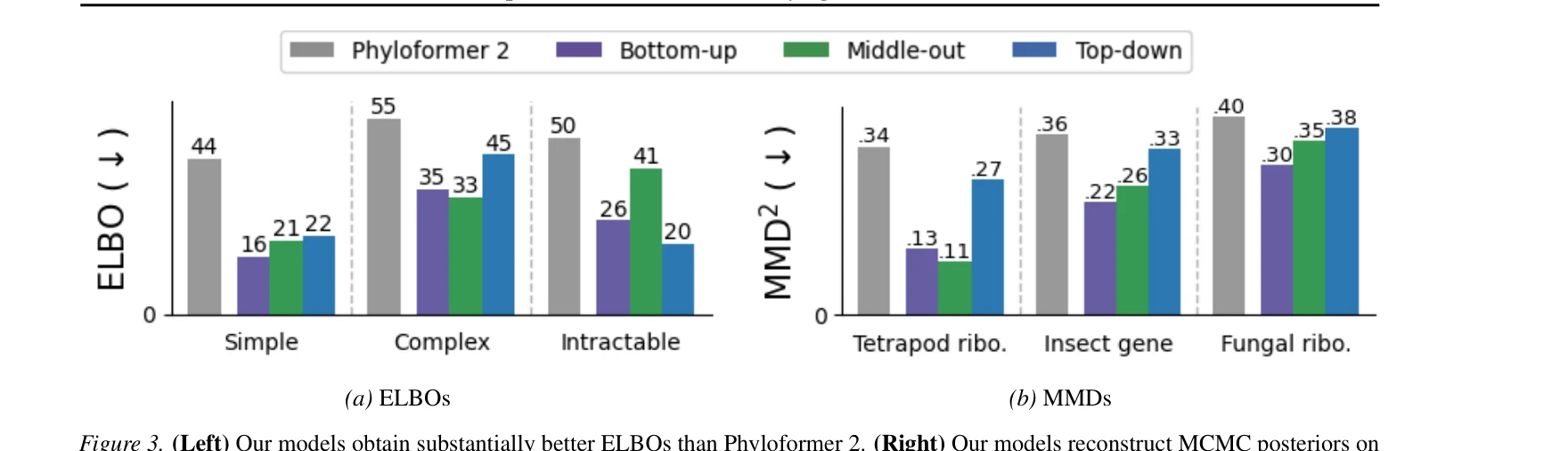
Figure 3. (Left) Our models obtain substantially better ELBOs than Phyloformer 2. (Right) Our models reconstruct MCMC po
세 가지 생성 패러다임 제시: top-down, middle-out, bottom-up 방식으로 tree topology를 iterative하게 생성하는 유연한 attention 기반 모델군을 설계했다.
discrete diffusion 기반 효율적 학습: 대규모 simulated phylogenetic tree 데이터셋에서 discrete diffusion framework를 활용해 세 패러다임 모두를 효율적으로 학습시켰다.
기존 SOTA 대비 우수한 fit: 세 패러다임 모두에서 이전 state-of-the-art simulation-based 방법인 Phyloformer 2보다 데이터에 훨씬 더 잘 fit하며, 실제 데이터셋에서도 더 정확한 posterior를 얻었다.
복잡한 진화 과정에서의 우수성 입증: 복잡한 evolutionary process를 따르는 데이터에서 misspecified된 기존 conventional 방법(IQ-Tree 등)을 능가하는 성능을 보였다.
How
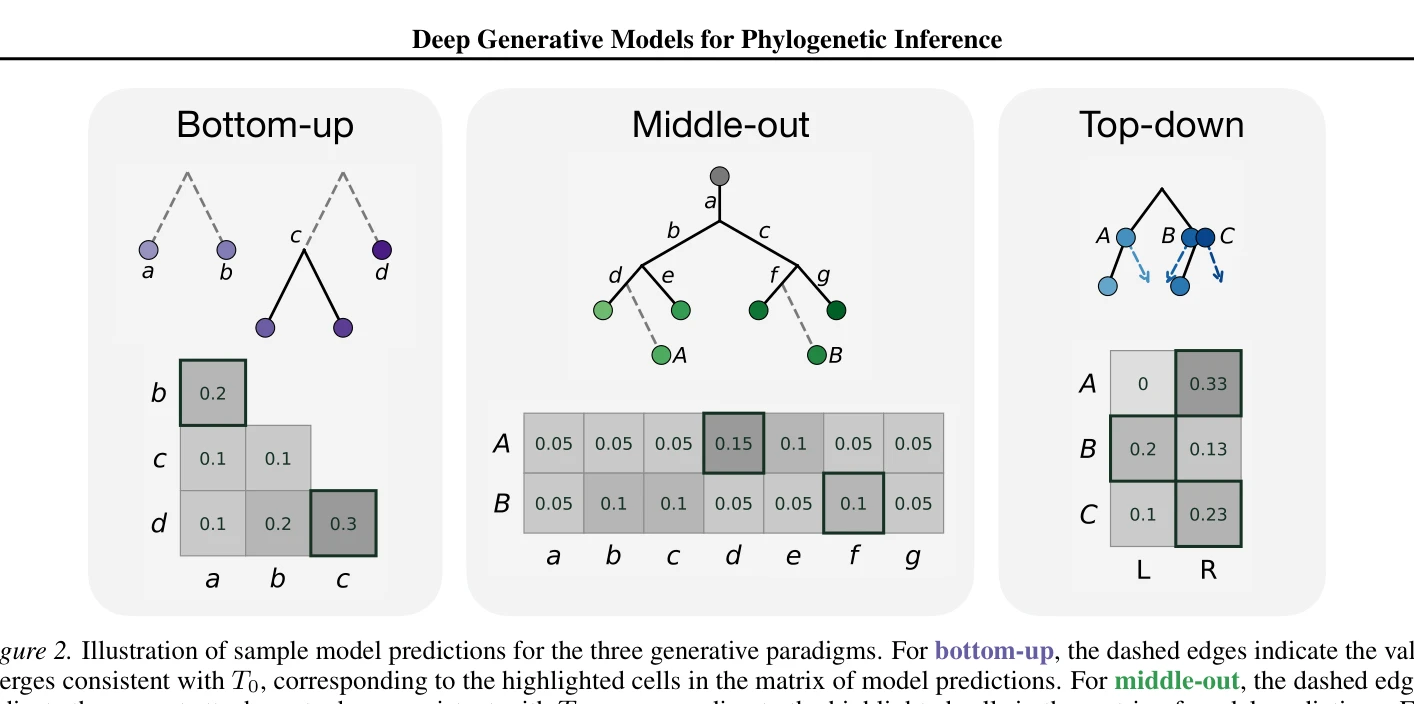
Figure 2. Illustration of sample model predictions for the three generative paradigms. For bottom-up, the dashed edges i
계통수 T와 서열 X1:N을 evolutionary model(prior p(T), likelihood p(X1:N|T))로부터 대량 시뮬레이션하여 학습 데이터로 사용
top-down, middle-out, bottom-up 세 가지 자연스러운 패러다임으로 tree를 반복적으로(iteratively) 생성하는 모델 구조 설계 (Figure 1 참고)
각 패러다임에 대해 attention 기반 아키텍처를 적용하고 discrete diffusion objective로 다중 forward pass를 통해 tree topology를 샘플링하도록 학습
PDA(uniform), Yule, Ford's alpha, Aldous' beta 등 다양한 tree topology prior와 Jukes-Cantor 및 더 복잡한 evolutionary model(사이트 간 상관관계, insertion/deletion 등)로 시뮬레이션 데이터 생성
ELBO 등을 통해 Phyloformer 2와 fit 비교, 실제 데이터셋 및 IQ-Tree와의 posterior 정확도 비교로 검증
Originality
MCMC 기반 likelihood 계산에 의존하지 않고, tree topology 생성 자체를 simulation-based inference 문제로 재정의하여 intractable likelihood를 가진 복잡한 evolutionary model에도 적용 가능하게 함
단일 forward pass로 parametric distribution의 파라미터만 예측하던 기존 방식(Phyloformer 2 등) 대신, iterative하게 tree를 생성하는 세 가지 새로운 패러다임(top-down, middle-out, bottom-up)을 제시하여 표현력을 향상
discrete diffusion을 조합형 combinatorial 구조인 tree topology 생성에 적용하여 효율적인 대규모 학습을 가능케 함
Limitation & Further Study
본 논문에서는 tree topology만을 추론 대상으로 하고 branch length 예측은 다루지 않아, 완전한 phylogenetic inference를 위해서는 추가 확장이 필요함
발췌된 내용상 세 패러다임 간의 성능 차이나 각각의 장단점에 대한 심층 분석이 충분히 제시되지 않았을 가능성이 있음
대규모 시뮬레이션 데이터 생성 및 학습에 따른 계산 비용, 그리고 taxa 수가 매우 커질 때의 확장성(scalability)에 대한 논의가 필요해 보임
실제 데이터(real datasets)에서의 검증이 제한적일 수 있어, 다양한 실제 생물학적 시나리오에 대한 추가 검증이 후속 연구로 필요함
총평: 복잡한 진화 과정 하에서 intractable한 phylogenetic posterior 추론이라는 중요하지만 어려운 문제에 대해, iterative generative model과 discrete diffusion을 결합한 참신하고 실용적인 해법을 제시하며 실증적으로도 기존 SOTA를 능가함을 보인 견실한 연구이다.
기반 연구SPECTER2 유사도 0.91로 Computational Molecular Design와 Scientific AI for Physics and Environment가 맞닿아, 'The frontier of simulation-based inference'가 이 ICML 2026 논문의 배경·대안·응용 맥락을 보완한다.
기반 연구SPECTER2 유사도 0.91로 Computational Molecular Design와 AI-Driven Drug and Materials Discovery가 맞닿아, 'General Multimodal Protein Design Enables DNA-Encoding of Chemistry'가 이 ICML 2026 논문의 배경·대안·응용 맥락을 보완한다.