⚠️ 이 페이지의 요약·평가·해설은 생성형 AI(Claude)가 자동 생성한 2차적 분석물입니다. 논문 원문의 저작권은 원저작자에게 있으며, 정확한 내용은 원문(위 DOI·arXiv 등 출처)을 확인하세요.
라이선스: OpenReview 공개(오픈액세스)
Essence
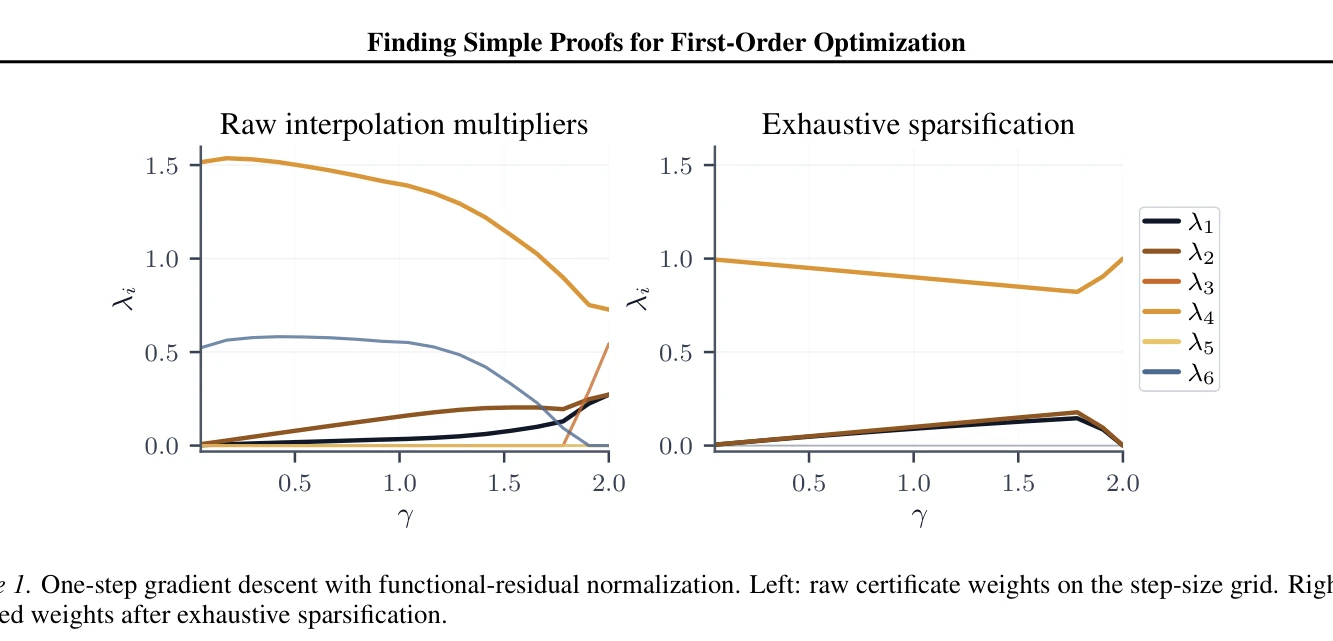
Figure 1. One-step gradient descent with functional-residual normalization. Left: raw certificate weights on the step-si
Performance Estimation Problem (PEP)에서 얻어지는 Lagrangian dual certificate(수렴 증명)를 sparse optimization 및 statistical learning 기법으로 후처리하여, 더 단순하고 해석 가능한 증명 구조(intermediate lemma 포함)로 압축하는 workflow를 제안한다.
Motivation
Known: PEP framework는 first-order optimization method의 worst-case convergence rate를 SDP로 정식화하고, 그 Lagrangian dual solution을 통해 수치적 증명 certificate를 자동으로 발견할 수 있음이 알려져 있다.
Gap: 그러나 이렇게 얻어진 dual certificate는 numerical, parameter-specific, dense하며 유일하지 않아, 어떤 inequality와 residual term이 실제로 증명을 이끄는지 파악하기 어렵고 인간이 해석·재사용·formalization하기 힘들다는 문제가 있다.
Why: LLM 및 solver 기반 agentic workflow가 수학 연구에 활용되려면, dense한 machine-generated proof를 사람이 이해·검증·재사용 가능한 compact 구조로 자동 정제하는 절차가 필요하며, 이는 AI-assisted mathematical discovery를 더 체계적이고 검증 가능하게 만드는 핵심 단계이다.
Approach: 이 논문은 증명 단순화를 dual certificate 위에서의 2단계 optimization 문제로 재정의하고, active hypothesis 수와 residual 구조 등 complexity 척도를 도입한 뒤, (weighted) ℓ1-heuristics와 intermediate lemma 탐색을 위한 SDP 기반 절차를 개발한다.
Achievement
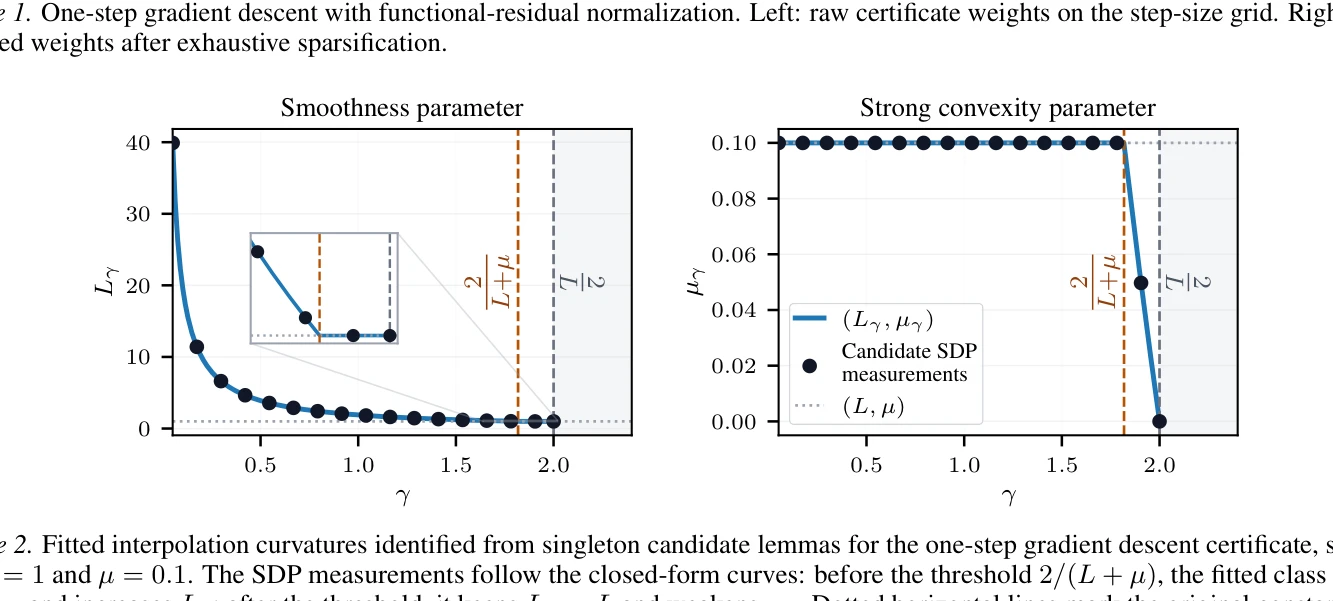
Figure 2. Fitted interpolation curvatures identified from singleton candidate lemmas for the one-step gradient descent c
Certificate-complexity criteria 정의: 표준 interpolation 기반 PEP의 SDP 정식화를 바탕으로 active inequalities와 residual term을 이용한 증명 복잡도 척도를 제안했다.
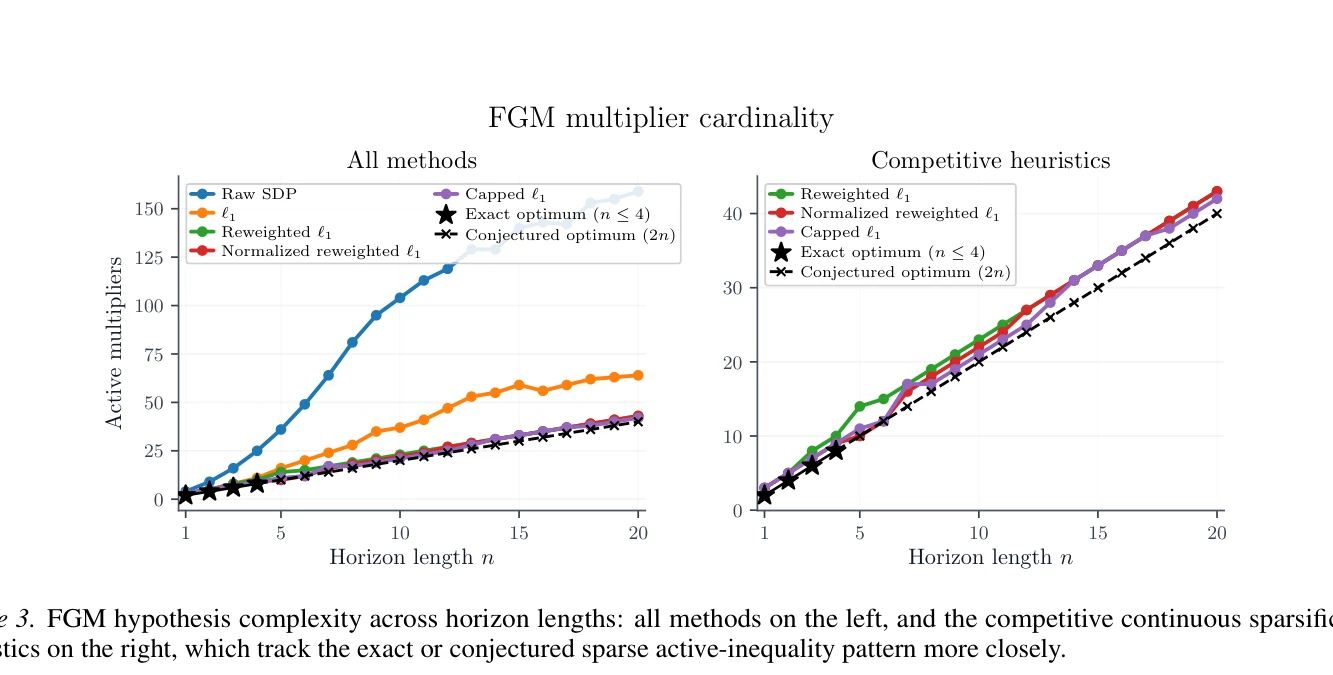
Sparsification 절차 개발: 소규모 인스턴스에 대한 exhaustive search부터 대규모 문제를 위한 weighted ℓ1-type surrogate까지 exact/heuristic sparsification 기법을 개발했다.
Intermediate lemma 탐색: 기존 PEP formulation에 있는 부등식들로부터 새로운 valid inequality(candidate intermediate lemma)를 도출하는 SDP 탐색법을 제안했다.
다양한 알고리즘에 적용: gradient descent(GD), fast-gradient methods(FGM), proximal methods에 대해 실험하여, redundant inequality 자동 제거, 3-hypothesis GD proof, compact FGM multiplier pattern, proximal point residual bound 및 accelerated proximal point saddle-gap estimate에 대한 Lyapunov function 기반 compact proof 등을 복원했다.
How
Figure 3. FGM hypothesis complexity across horizon lengths: all methods on the left, and the competitive continuous spar
PEP를 함수 f, trajectory, performance metric Pf, initialization measure If를 이용한 infinite-dimensional worst-case maximization 문제로 정식화하고, exact finite-dimensional SDP reformulation의 Lagrangian dual certificate를 출발점으로 삼음
동일한 target bound를 증명하는 대안적(더 단순한) dual certificate를 찾는 2단계 search로 simplification을 정의
Active hypothesis 개수와 residual decomposition 구조를 복잡도 지표로 사용
(weighted) ℓ1-heuristic을 이용해 multiplier를 sparsify하고, 소규모 문제에는 exhaustive search 적용
기존 PEP formulation의 부등식들로부터 새로운 valid inequality를 도출하는 SDP 기반 candidate lemma 탐색 formulation 제안
GD, FGM, proximal methods(및 accelerated proximal point)에 대한 구체적 사례로 검증
Originality
PEP의 Lagrangian dual certificate를 "증명 자체"로 보고, 이를 sparse optimization/statistical learning 관점에서 후처리(post-processing)하는 새로운 문제 설정을 제시
증명 단순화를 별도의 2단계 optimization 문제로 정식화하여, active hypothesis 및 residual 구조 기반의 정량적 complexity 척도를 도입
Weighted ℓ1-heuristics를 dual certificate sparsification에 적용하고, intermediate lemma를 자동으로 발견하는 SDP 탐색을 결합한 독창적 workflow 제안
LLM 및 formal proof assistant(Lean 등)와 결합 가능한 pre-processing 단계로서 solver-guided proof simplification을 agentic workflow 관점에서 위치시킴
Limitation & Further Study
실험이 GD, FGM, proximal methods 등 비교적 단순하고 잘 알려진 알고리즘/함수 클래스에 국한되어 있어, 더 복잡한 composite/constrained 설정이나 stochastic 알고리즘으로의 일반화가 검증되지 않음
"simplicity"의 정의가 여전히 operational하고 다소 임의적(active hypothesis 수, residual 구조 등)이어서, 다른 복잡도 척도나 사람의 직관적 단순성과의 정합성에 대한 추가 검토가 필요함
Intermediate lemma 탐색이 미리 정해진 후보 부등식 공간 내에서 이루어지므로, 완전히 새로운 lemma나 proof pattern을 발견하는 능력에는 한계가 있을 수 있음
후속 연구로 실제 LLM 기반 agentic workflow와의 통합 실험, Lean 등 formal proof system으로의 자동 translation 검증이 필요함
총평: PEP 기반 dual certificate를 증명 단순화 관점에서 체계적으로 후처리하는 새로운 workflow를 제시하여, AI 보조 수학 연구를 더 검증 가능하고 재사용 가능하게 만드는 실질적 기여를 한다. 다만 적용 범위가 제한적이고 simplicity 척도의 일반성에 대한 추가 검증이 필요하다.
기반 연구SPECTER2 유사도 0.91로 LLM Reasoning and Safety Benchmarks와 Agentic AI for Scientific Automation가 맞닿아, 'A survey on large language model based autonomous agents'가 이 ICML 2026 논문의 배경·대안·응용 맥락을 보완한다.
기반 연구SPECTER2 유사도 0.90 기준으로 'Finding Simple Proofs for First-Order Optimization'의 AI4S 방법론을 'Towards a Science of Scaling Agent Systems'의 과학 생산·평가 맥락과 함께 보면 연구 자동화의 의미를 입체적으로 볼 수 있다.
기반 연구SPECTER2 유사도 0.90로 LLM Reasoning and Safety Benchmarks와 Agentic AI for Scientific Automation가 맞닿아, 'YC-Bench: Benchmarking AI Agents for Long-Term Planning and Consistent Execution'가 이 ICML 2026 논문의 배경·대안·응용 맥락을 보완한다.