Essence
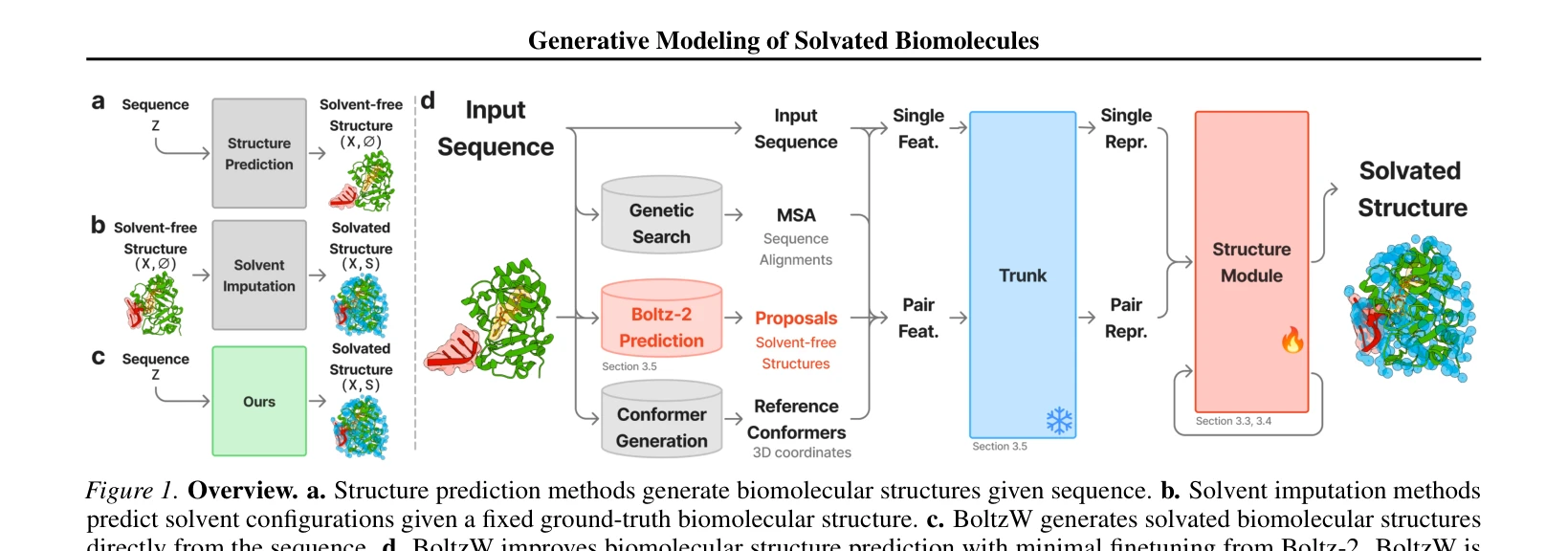
Figure 1. Overview. a. Structure prediction methods generate biomolecular structures given sequence. b. Solvent imputati
BoltzW는 단백질, 핵산, 소분자, water를 포함하는 solvated biomolecule의 joint distribution을 모델링하는 최초의 generative framework로, explicit solvent modeling의 여러 난제를 해결하며 structure prediction 성능과 water placement 정확도를 동시에 개선한다.
Evaluation
Novelty: 5/5 Technical Soundness: 4/5 Significance: 4/5 Clarity: 4/5 Overall: 4/5
총평: Solvated biomolecule에 대한 joint generative modeling이라는 새로운 문제를 정의하고 이를 permutation invariance와 cardinality 문제를 창의적으로 우회하는 기법으로 해결한 의미 있는 연구로, structure prediction과 solvent imputation 두 분야 모두에서 SOTA 성능을 보였다는 점에서 워크숍 논문 이상의 잠재력을 지닌다.
같이 보면 좋은 논문
기반 연구SPECTER2 유사도 0.94로 Computational Molecular Design와 AI-Driven Drug and Materials Discovery가 맞닿아, 'Boltz-1 Democratizing Biomolecular Interaction Modeling'가 이 ICML 2026 논문의 배경·대안·응용 맥락을 보완한다.
기반 연구in-context learning 기반 최적화 기법을 확장
기반 연구단백질 등 biomolecule의 generative modeling을 위한 핵심 구조 표현 기법을 공유한다.
기반 연구분광학적 데이터를 활용한 구조 예측이라는 실제 응용 사례를 다룸
기반 연구Boltz 계열 모델의 생성적 다양성 문제를 확장하여 다루는 후속 연구
기반 연구co-folding 모델의 생성적 다양성 부족 문제를 다루는 확장 연구
다른 접근생체분자 구조 생성이라는 동일 문제를 다른 프레임워크로 다룸
기반 연구전자 밀도 기반 분자 설계를 신약 개발에 적용한 사례이다.
기반 연구단백질 구조 예측 모델의 pair representation 분석을 확장한다.
기반 연구SPECTER2 유사도 0.94로 Computational Molecular Design와 Molecular Simulation and Generative Modeling가 맞닿아, 'MolCrystalFlow: Molecular Crystal Structure Prediction via Flow Matching'가 이 ICML 2026 논문의 배경·대안·응용 맥락을 보완한다.
기반 연구SPECTER2 유사도 0.94 기준으로 'Generative Modeling of Solvated Biomolecules'의 AI4S 방법론을 'OrgFlow: Generative Modeling of Organic Crystal Structures from Molecular Graphs'의 과학 생산·평가 맥락과 함께 보면 연구 자동화의 의미를 입체적으로 볼 수 있다.
후속 연구결정 구조 생성 모델링의 기초적 방법론을 제공한다.
기반 연구SPECTER2 유사도 0.94로 Computational Molecular Design와 AI-Driven Drug and Materials Discovery가 맞닿아, 'ConforNets: Latents-Based Conformational Control in OpenFold3'가 이 ICML 2026 논문의 배경·대안·응용 맥락을 보완한다.
다른 접근biomolecule diffusion 기반 생성모델의 대안적 아키텍처를 제시한다.
다른 접근단백질 구조 생성이라는 유사 도메인을 다른 물리 기반 생성모델로 접근함
후속 연구사전학습된 분자 인코더의 semantic embedding 활용에 대한 기초 방법론을 제공한다.
후속 연구물리적 대칭성을 커널 수준에서 보장하는 Gaussian process 이론적 기반을 제공한다.
후속 연구분자 descriptor 기반 물성 예측의 방법론적 기초를 제공한다.
후속 연구biomolecule generative modeling을 solvent 모델링으로 확장한 연구와 연결된다.
후속 연구solvated biomolecule 생성모델이 리간드 등 소분자 결합 문제로 확장될 수 있는 관계이다.
후속 연구GCMC/cDFT 시뮬레이션 기반 흡착 예측의 이론적 토대를 제공한다.