⚠️ 이 페이지의 요약·평가·해설은 생성형 AI(Claude)가 자동 생성한 2차적 분석물입니다. 논문 원문의 저작권은 원저작자에게 있으며, 정확한 내용은 원문(위 DOI·arXiv 등 출처)을 확인하세요.
라이선스: OpenReview 공개(오픈액세스)
Essence
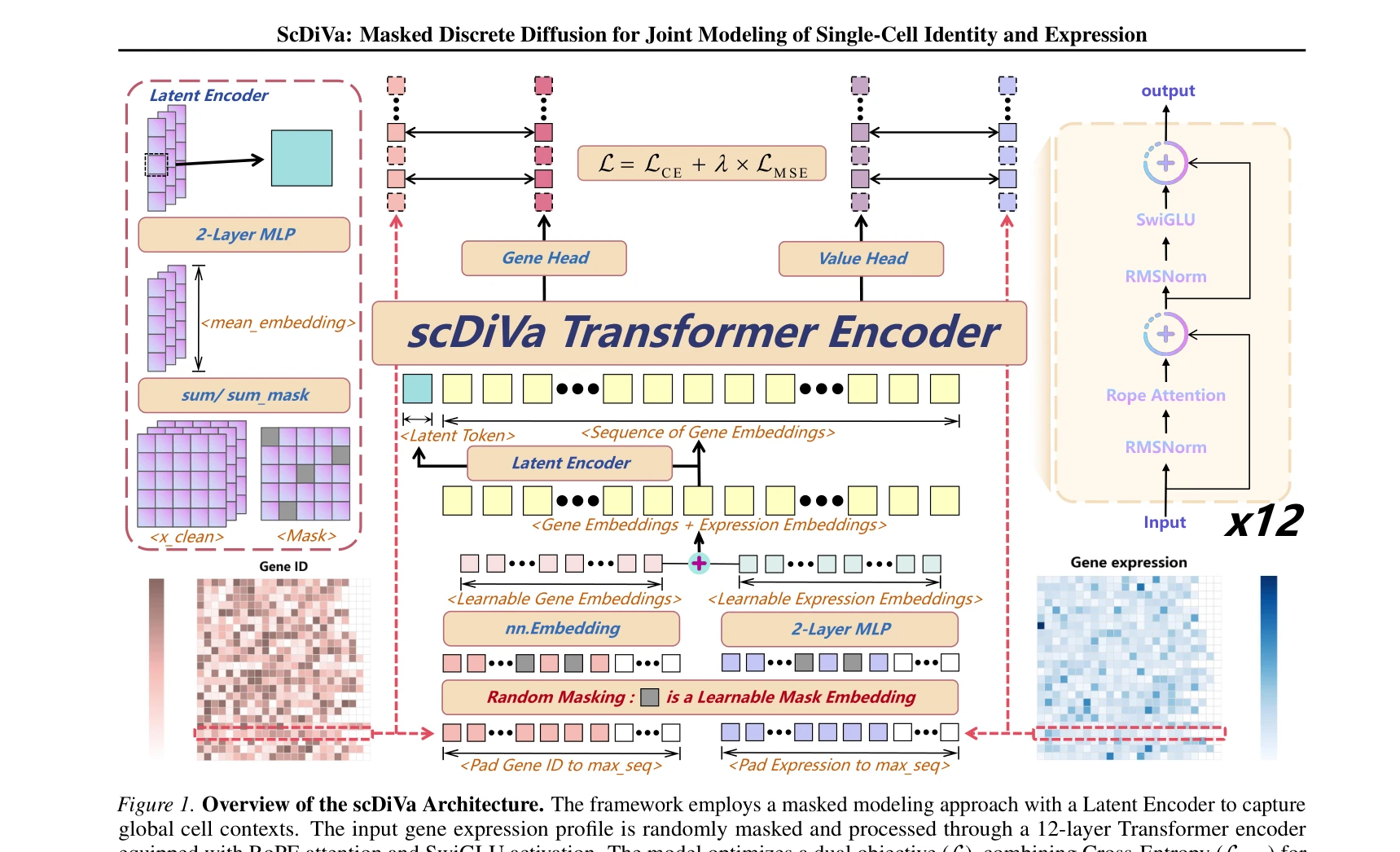
scDiVa는 single-cell RNA-seq 데이터의 순서 없는 희소성(sparse, unordered) 특성을 반영하기 위해 masked discrete diffusion 프레임워크를 도입하여, autoregressive 방식의 인위적 순서 편향과 오류 누적 문제를 해결하고 gene identity와 continuous expression value를 하나의 확률적 프레임워크에서 공동 모델링하는 foundation model이다.
Motivation
Known: scBERT, Geneformer, scGPT, scFoundation 등 LLM 기반 single-cell foundation model들은 gene을 discrete token으로 취급해 self-supervised 방식으로 transferable representation을 학습해왔으며, scVI, totalVI 같은 continuous probabilistic model은 VAE 기반으로 batch effect와 노이즈를 통합적으로 다루어왔다.
Gap: 기존 autoregressive 기반 single-cell foundation model은 유전자 발현 프로파일의 순서 없는(unordered) 특성에 인위적 순서(ordering bias)를 강제하고 오류가 누적되는 문제가 있으며, continuous diffusion/VAE 계열 모델은 Gaussian noise 가정에 의존해 discrete dropout 이벤트를 제대로 모델링하지 못하고 over-smoothing되는 한계가 있다.
Why: 단일 세포 유전체 데이터의 discrete-continuous 이중 구조와 sequence-set 불일치 문제를 동시에 해결하는 생물학적으로 타당한 생성 패러다임을 제시함으로써, batch integration, cell type annotation, perturbation response prediction 등 다양한 downstream task에 강건하게 transfer 가능한 foundation model 설계 방향을 제시하기 때문에 중요하다.
Approach: continuous-time forward masking mechanism을 token space에서 정의하는 masked discrete diffusion을 기반으로, absorbing [MASK] state를 통한 dropout-like corruption과 bidirectional denoiser를 결합하여 gene identity와 expression value를 동시에 복원하는 접근을 취한다.
Achievement
masked discrete diffusion foundation model 제안: absorbing-state corruption과 dropout-like gene non-detection 간의 대응관계를 형식화하여 scDiVa라는 새로운 single-cell foundation model을 제시했다.
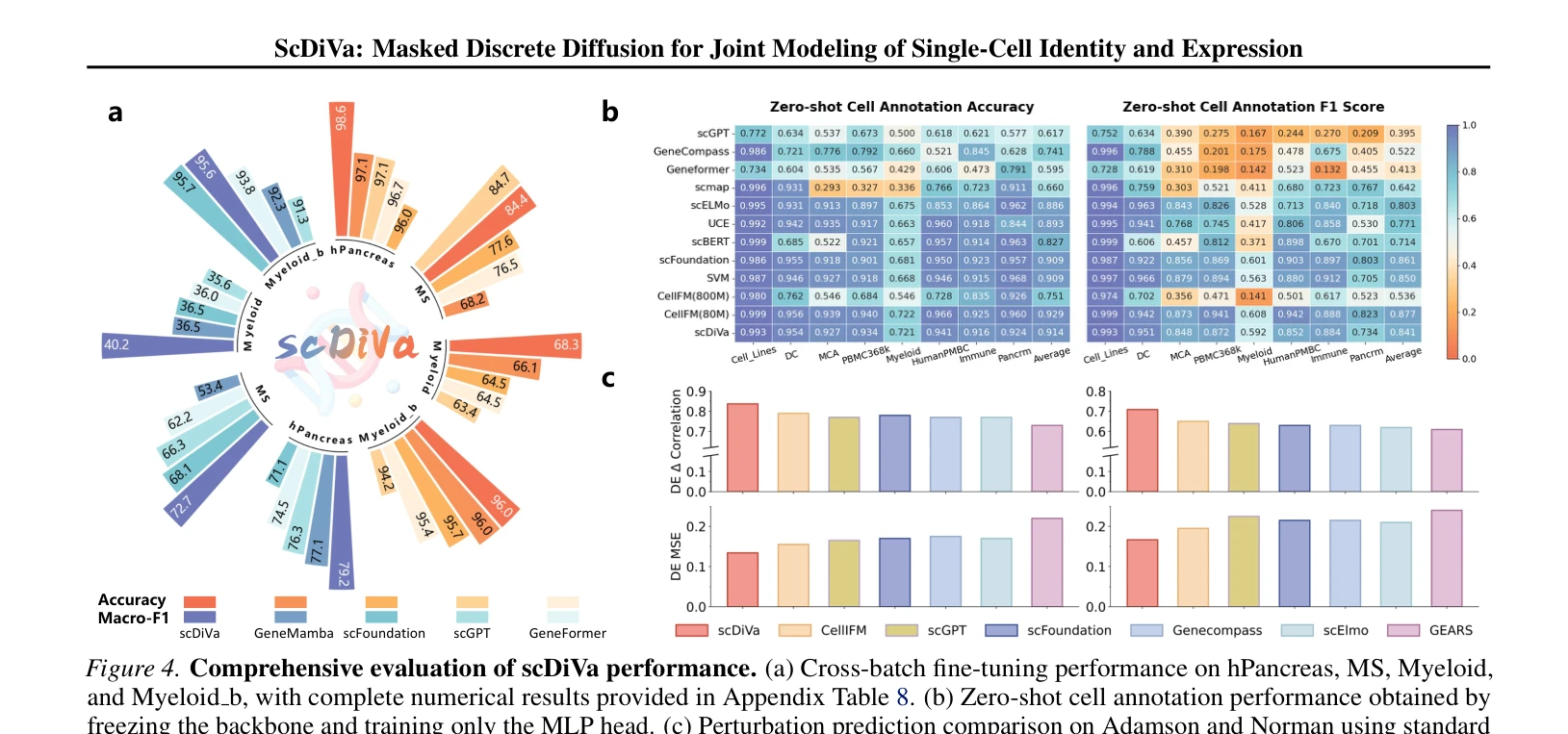
대규모 사전학습 및 전이 성능 검증: 59 million cells에 대한 pre-training을 통해 batch integration, cell type annotation, perturbation response prediction 등 주요 벤치마크에서 강력한 transfer 성능을 달성했다.
정보 효율적 직렬화 기법 도입: entropy-normalized serialization과 latent anchor token을 통해 고정된 token budget 하에서 informative gene에 자원을 효율적으로 배분하면서 global cell identity를 보존했다.
dual denoising objective 및 depth-robust time sampling 설계: gene identity(rank)와 expression magnitude(value)를 동시에 정밀 복원하도록 훈련 전략을 마련하여 다양한 sequencing depth에 대한 강건성을 확보했다.
How
유전자 서열 x0 = [x1, ..., xL]을 discrete token 시퀀스로 정의하고, continuous-time Markov process (t ∈ [0,1])를 통해 absorbing [MASK] state로 진행되는 forward diffusion을 설계함
Gaussian noise 기반 continuous diffusion 대신 global stochastic state-transition corruption을 채택하여 discrete gene token의 categorical 특성과 정합성을 맞춤
bidirectional non-causal denoiser를 통해 discrete gene identity(rank)와 continuous expression value(value)를 하나의 네트워크에서 공동 예측
entropy-normalized serialization으로 고정 token budget 하에서 sparse long-tail 관측 데이터의 정보 유실을 최소화하고, latent anchor token으로 global cell identity를 유지
Dual Denoising Loss(topological classification + dosage regression)를 결합하여 identity와 magnitude 모두를 정밀하게 복원하도록 학습
depth-robust time sampling 전략을 통해 다양한 sparse-observation regime을 모델에 노출시켜 sequencing depth 이질성에 대한 강건성 확보
59 million cells 규모의 대규모 corpus에서 사전학습 후 batch integration, cell type annotation, perturbation response prediction 등 다운스트림 태스크에 fine-tuning하여 평가
Originality
autoregressive 기반 single-cell foundation model의 인위적 순서 편향 문제를 masked discrete diffusion으로 근본적으로 재구성한 최초 시도 중 하나로 보임
absorbing-state corruption과 single-cell sequencing의 dropout-like missingness 간의 생물학적 대응관계를 명시적으로 형식화한 점이 독창적임
discrete gene identity와 continuous expression value를 단일 확률적 프레임워크에서 동시에 모델링하는 dual denoising 설계가 기존 discrete-only 또는 continuous-only 접근과 차별화됨
entropy-normalized serialization과 latent anchor token을 결합해 고정 token budget 하에서 정보 효율성과 global cell identity 보존을 동시에 추구하는 설계가 새로움
Limitation & Further Study
발췌된 본문에서 diffusion 수식 전개와 dual denoising loss의 구체적 정의, 학습 세부사항(하이퍼파라미터, 아키텍처 세부구조)이 충분히 제시되지 않아 재현성 및 이론적 엄밀성을 완전히 판단하기 어려움
59 million cells라는 대규모 사전학습 데이터의 출처와 batch/species 다양성에 대한 상세 설명이 부족하여 데이터 편향 가능성을 평가하기 어려움
비교 대상(scGPT, scFoundation, scVI, scDiffusion 등)과의 정량적 성능 비교표가 발췌본에 드러나지 않아 실제 성능 우위의 정도를 판단하기 어려움
후속 연구로는 multi-omics 확장, in-silico perturbation 예측의 인과적 타당성 검증, 더 다양한 조직·질환 데이터셋에 대한 일반화 평가가 필요해 보임
총평: autoregressive와 continuous diffusion 계열의 한계를 모두 짚고 masked discrete diffusion이라는 생물학적으로 타당한 대안을 제시한 점에서 개념적 기여가 뚜렷하나, 발췌본만으로는 실험적 검증의 엄밀성과 세부 구현을 완전히 평가하기 어렵다.
기반 연구SPECTER2 유사도 0.92로 Multimodal Biomedical Data Fusion와 Molecular Simulation and Generative Modeling가 맞닿아, 'Dynamic Search for Inference-Time Alignment in Diffusion Models'가 이 ICML 2026 논문의 배경·대안·응용 맥락을 보완한다.
기반 연구SPECTER2 유사도 0.92 기준으로 'ScDiVa: Masked Discrete Diffusion for Joint Modeling of Single-Cell Identity and Expression'의 AI4S 방법론을 'stVCR: spatiotemporal dynamics of single cells from time-series spatial transcriptomics'의 과학 생산·평가 맥락과 함께 보면 연구 자동화의 의미를 입체적으로 볼 수 있다.
기반 연구SPECTER2 유사도 0.92로 Multimodal Biomedical Data Fusion와 AI-Driven Drug and Materials Discovery가 맞닿아, 'Towards building a World Model to simulate perturbation responses in cellular biology'가 이 ICML 2026 논문의 배경·대안·응용 맥락을 보완한다.