Essence
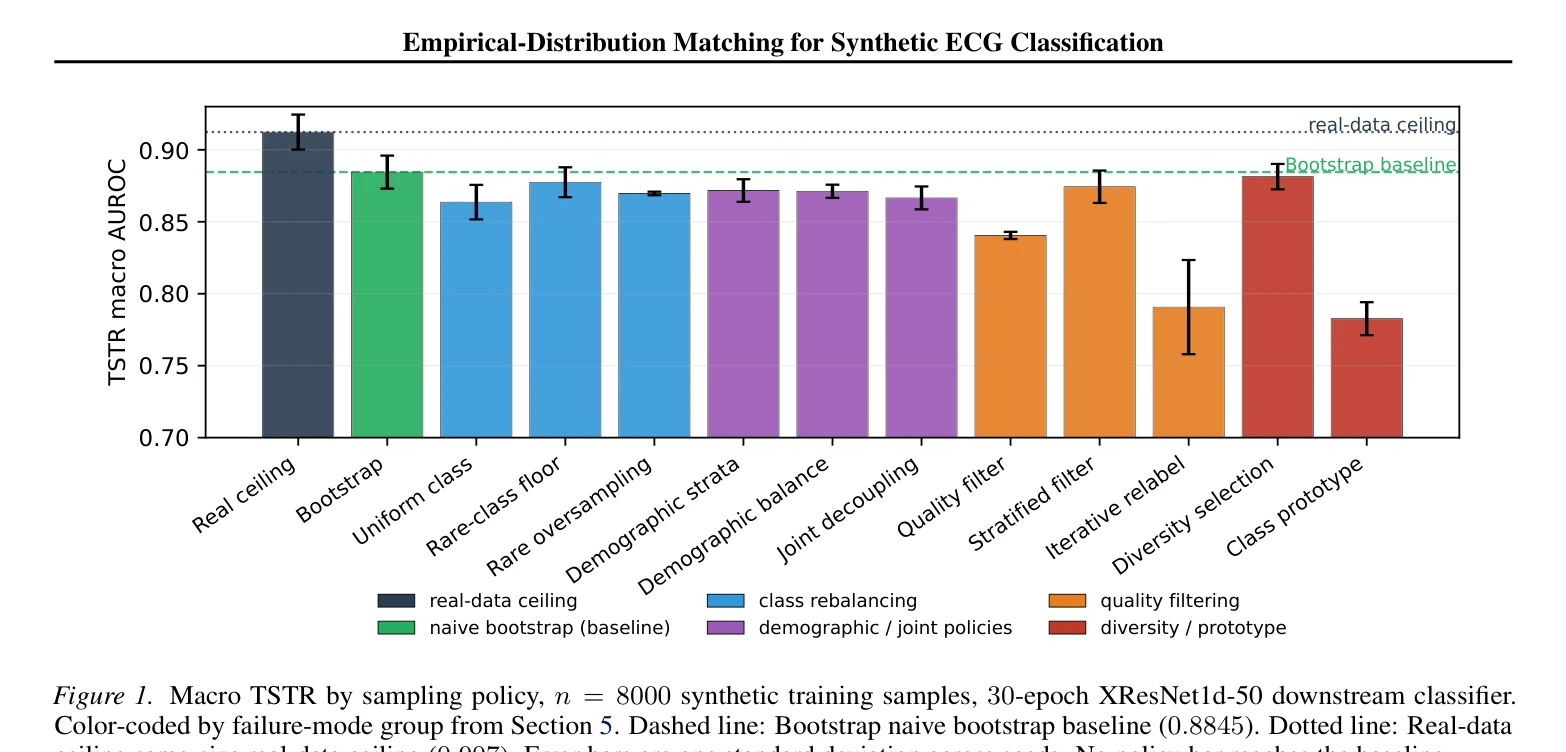
Figure 1. Macro TSTR by sampling policy, n = 8000 synthetic training samples, 30-epoch XResNet1d-50 downstream classifie
합성 ECG 데이터로만 학습하는 TSTR(train-on-synthetic-test-on-real) 환경에서, 13가지 샘플링 정책을 비교한 결과 CV/NLP에서 통용되는 클래스 재균형 기법들이 오히려 성능을 해치며, 단순히 실제 학습 분포를 그대로 재현하는 naive bootstrap이 가장 우수함을 보인다.
Evaluation
Novelty: 4/5 Technical Soundness: 4/5 Significance: 4/5 Clarity: 4/5 Overall: 4/5
총평: 단순하지만 실용적으로 중요한 질문(합성 의료 데이터를 어떻게 샘플링할 것인가)에 대해 명확한 통제 실험으로 반직관적이지만 설득력 있는 결론(rebalancing보다 empirical distribution matching이 우월함)을 제시한 견실한 워크숍 논문이다. 단일 데이터셋·생성기·분류기에 국한된 실험 범위는 한계이나, 실무자에게 즉각 적용 가능한 시사점을 제공한다는 점에서 의의가 크다.
같이 보면 좋은 논문
기반 연구SPECTER2 유사도 0.91로 Statistical Causal Inference Methods와 Molecular Simulation and Generative Modeling가 맞닿아, 'Derivative-Free Guidance in Continuous and Discrete Diffusion Models with Soft Value-Based Decoding'가 이 ICML 2026 논문의 배경·대안·응용 맥락을 보완한다.
기반 연구SPECTER2 유사도 0.90로 Statistical Causal Inference Methods와 Molecular Simulation and Generative Modeling가 맞닿아, 'Iterative Distillation for Reward-Guided Fine-Tuning of Diffusion Models in Biomolecular Design'가 이 ICML 2026 논문의 배경·대안·응용 맥락을 보완한다.
기반 연구SPECTER2 유사도 0.90 기준으로 'Empirical-Distribution Matching for Synthetic ECG Classification'의 AI4S 방법론을 'Reward-Guided Iterative Refinement in Diffusion Models at Test-Time with Applications to Protein and DNA Design'의 과학 생산·평가 맥락과 함께 보면 연구 자동화의 의미를 입체적으로 볼 수 있다.
기반 연구TSTR 평가 프레임워크의 방법론적 기초를 제공한다.
기반 연구SPECTER2 유사도 0.90로 Statistical Causal Inference Methods와 Molecular Simulation and Generative Modeling가 맞닿아, 'CAGenMol: Condition-Aware Diffusion Language Model for Goal-Directed Molecular Generation'가 이 ICML 2026 논문의 배경·대안·응용 맥락을 보완한다.
다른 접근클래스 재균형 문제에 대한 다른 샘플링 정책을 제시한다.
다른 접근합성 ECG 데이터 생성 및 평가에 대한 다른 접근 방식을 제안한다.
다른 접근perturbation-conditional 생성 모델의 유사한 설계 공간 탐색이다.
후속 연구TSTR 프레임워크의 클래스 재균형 문제를 확장하여 다룬 연구이다.
응용 사례합성 데이터를 활용한 실제 의료 분류 문제에 적용된 사례이다.