Essence
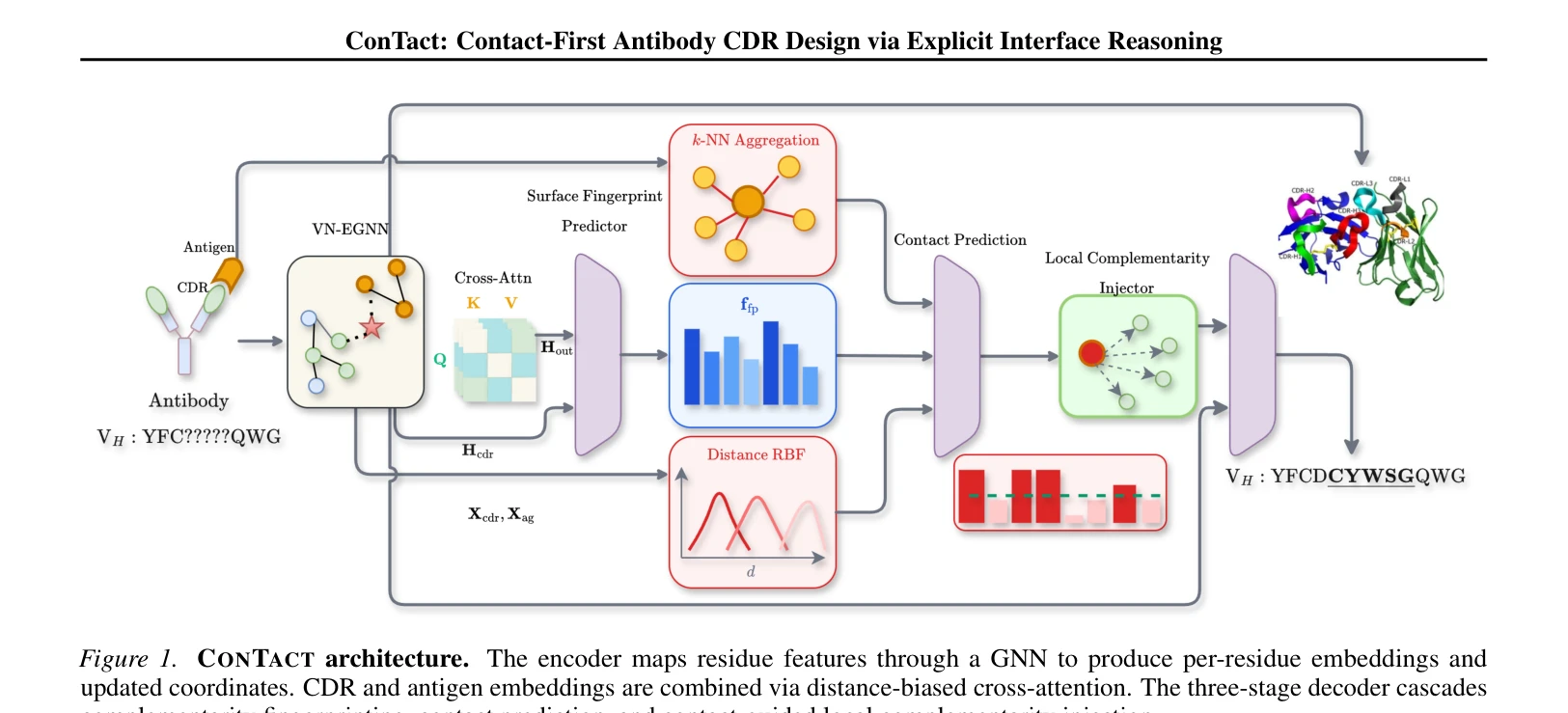
Figure 1. CONTACT architecture. The encoder maps residue features through a GNN to produce per-residue embeddings and
CDR 서열 및 구조 설계에서 항원 conditioning이 실제로는 거의 사용되지 않는다는 문제를, contact 식별과 amino acid 선택이라는 두 하위 문제를 명시적으로 분리하는 contact-then-act 아키텍처(ConTact)로 해결한다.
Evaluation
Novelty: 4/5 Technical Soundness: 4/5 Significance: 4/5 Clarity: 4/5 Overall: 4/5
총평: Antigen conditioning이 실제로 활용되지 않는다는 잘 알려진 문제에 대해 명확한 아키텍처적 원인 진단과 구체적이고 실행 가능한 해결책(contact-then-act 분해)을 제시했으며, CHIMERA-Bench에서 일관된 성능 향상을 보인 점에서 실용적 기여도가 높은 연구다.
같이 보면 좋은 논문
기반 연구SPECTER2 유사도 0.91 기준으로 'ConTact: Contact-First Antibody CDR Design via Explicit Interface Reasoning'의 AI4S 방법론을 'Accurate prediction of protein structures and interactions using a three-track neural network'의 과학 생산·평가 맥락과 함께 보면 연구 자동화의 의미를 입체적으로 볼 수 있다.
기반 연구SPECTER2 유사도 0.92 기준으로 'ConTact: Contact-First Antibody CDR Design via Explicit Interface Reasoning'의 AI4S 방법론을 'Boltz-1 Democratizing Biomolecular Interaction Modeling'의 과학 생산·평가 맥락과 함께 보면 연구 자동화의 의미를 입체적으로 볼 수 있다.
기반 연구구조 기반 전이학습을 데이터 제한적 생물학적 서열 문제에 적용한 사례이다.
후속 연구항원 conditioning을 명시적으로 활용하는 방법을 확장한다.
기반 연구구조 기반 분자/항체 표현 학습 기법이 ConTact의 contact 예측 모듈에 기초를 제공한다.
기반 연구SPECTER2 유사도 0.91 기준으로 'ConTact: Contact-First Antibody CDR Design via Explicit Interface Reasoning'의 AI4S 방법론을 'An equivariant pretrained transformer for unified 3D molecular representation learning'의 과학 생산·평가 맥락과 함께 보면 연구 자동화의 의미를 입체적으로 볼 수 있다.
기반 연구SPECTER2 유사도 0.93로 Computational Molecular Design와 AI-Driven Drug and Materials Discovery가 맞닿아, 'Linear-time prediction of proteome-scale microbial protein interactions'가 이 ICML 2026 논문의 배경·대안·응용 맥락을 보완한다.
기반 연구SPECTER2 유사도 0.93로 Computational Molecular Design와 AI-Driven Drug and Materials Discovery가 맞닿아, 'A deep learning predictor of bindable protein surfaces to guide generative synthetic biology (IARA)'가 이 ICML 2026 논문의 배경·대안·응용 맥락을 보완한다.
기반 연구SPECTER2 유사도 0.93로 Computational Molecular Design와 AI-Driven Drug and Materials Discovery가 맞닿아, 'ViraHinter: A Dual-Modal Artificial Intelligence Framework for Predicting Virus-Host Interactions'가 이 ICML 2026 논문의 배경·대안·응용 맥락을 보완한다.
다른 접근In-Context 학습 패러다임을 활용한 유사한 co-design 접근
다른 접근항체 CDR 설계에 다른 아키텍처 접근법을 사용한다.
후속 연구항체 CDR 서열-구조 공동설계 흐름을 확장한 후속 연구로 볼 수 있다.
후속 연구antigen conditioning을 명시적으로 다루는 확장된 설계 프레임워크이다.
응용 사례contact 기반 구조 설계를 항체 CDR 문제에 적용한다.
응용 사례실제 항체-항원 결합 예측에 contact 정보를 활용하는 응용 사례이다.