Essence
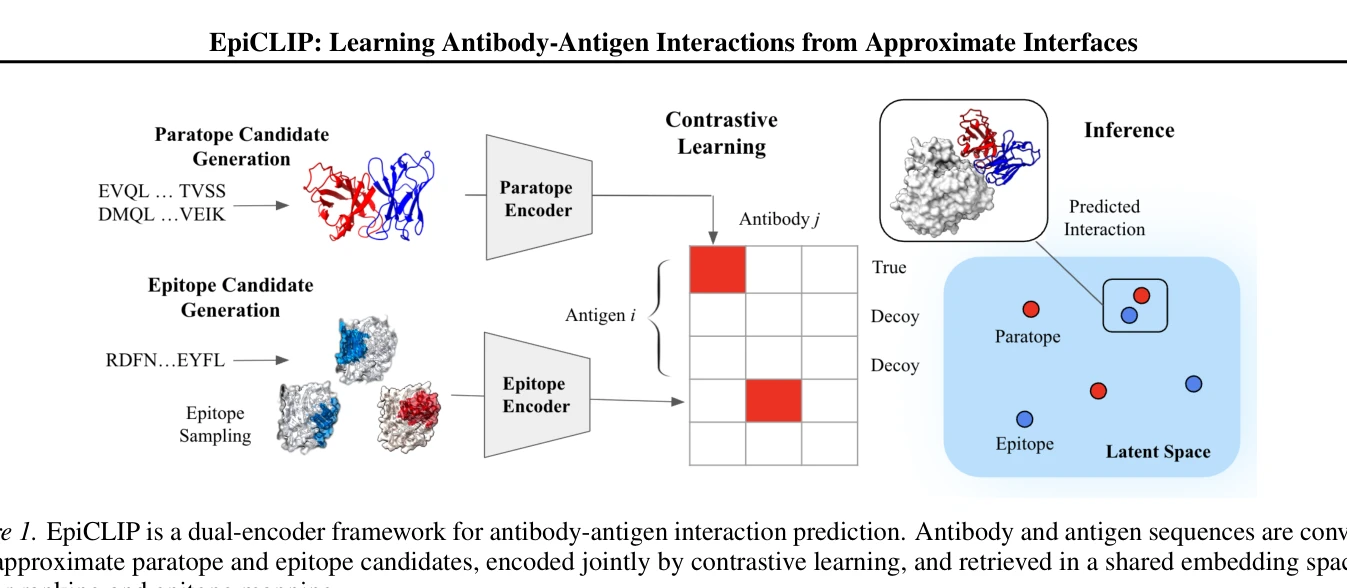
Figure 1. EpiCLIP is a dual-encoder framework for antibody-antigen interaction prediction. Antibody and antigen sequence
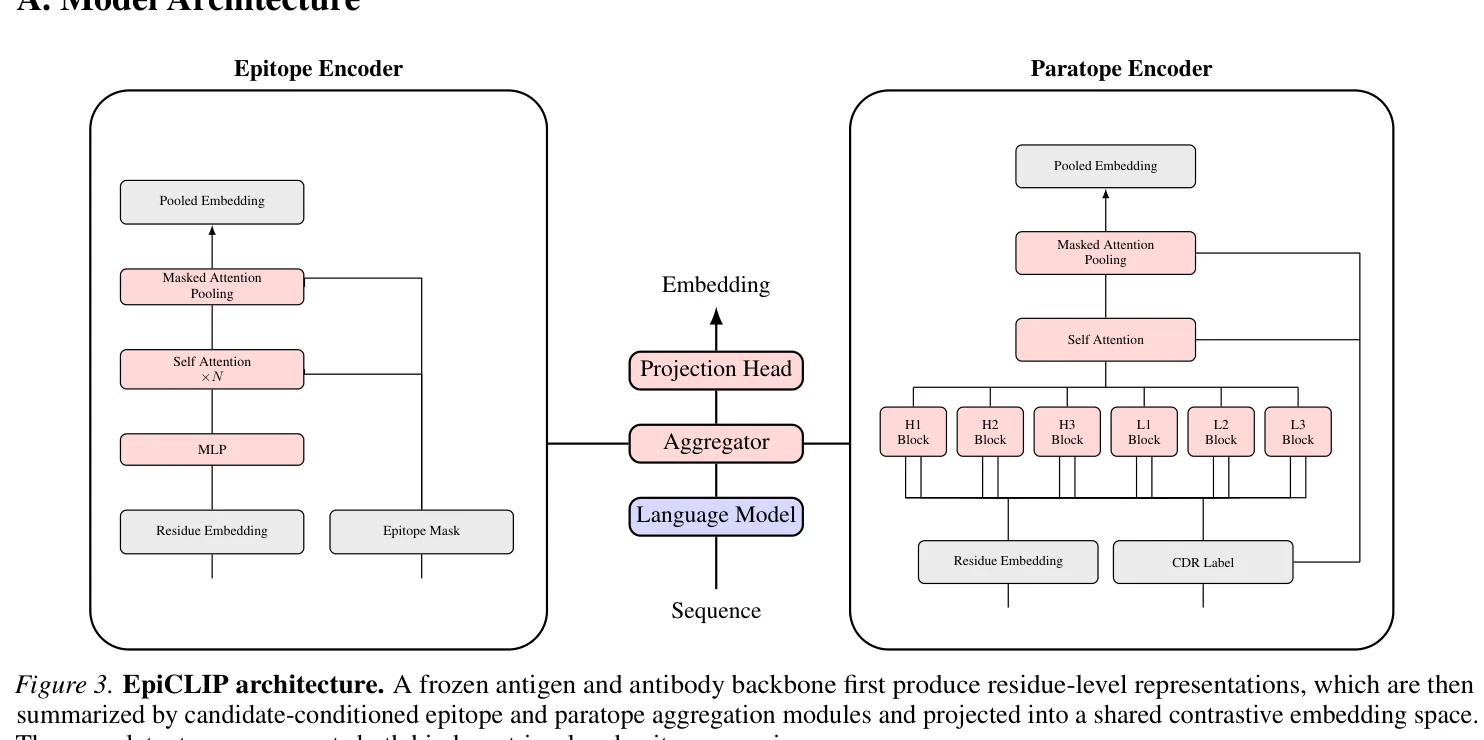
EpiCLIP은 항체-항원 상호작용 모델링을 근사적인 epitope와 paratope 후보들에 대한 dense retrieval 문제로 재정의하는 contrastive dual-encoder 프레임워크로, binder retrieval과 epitope mapping을 하나의 shared embedding space에서 동시에 수행한다.
Achievement
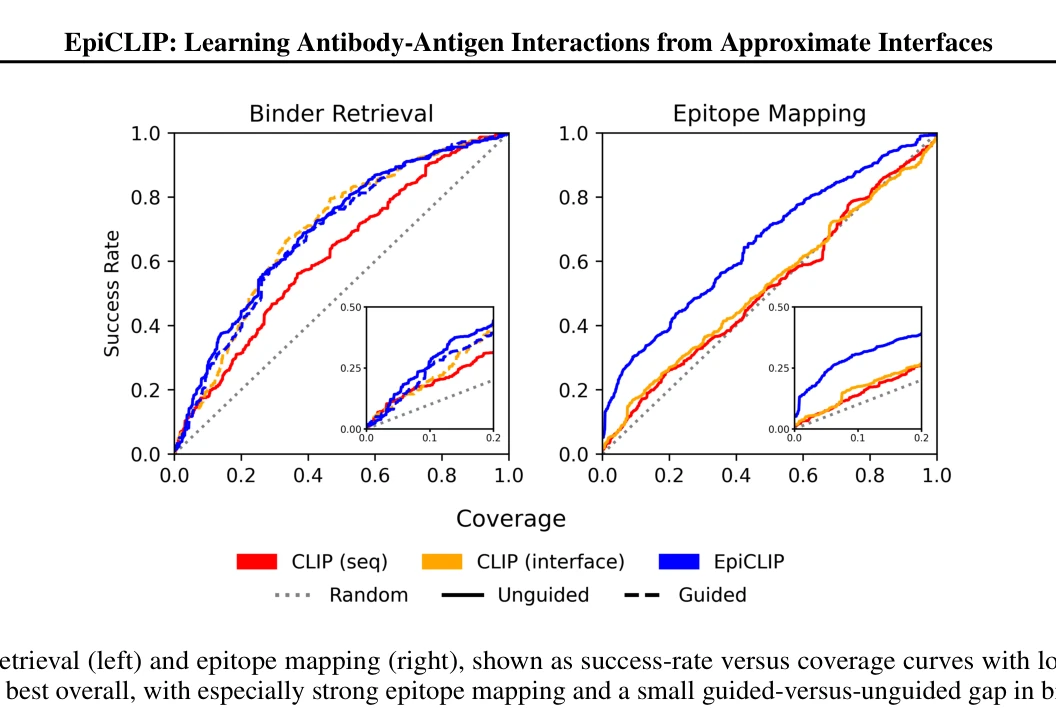
Figure 2. Binder retrieval (left) and epitope mapping (right), shown as success-rate versus coverage curves with low-cov
EpiCLIP은 근사적인 interface 후보만으로도 binder retrieval과 epitope mapping 두 과제 모두에서 강력한 성능을 달성함으로써, 근사 interface에 대한 retrieval이 정확한 interface supervision이나 전수 pairwise 구조 모델링을 대체할 수 있는 확장 가능한 대안임을 보였다.
Evaluation
Novelty: 4/5 Technical Soundness: 4/5 Significance: 4/5 Clarity: 4/5 Overall: 4/5
총평: 근사 interface에 대한 retrieval이라는 새로운 문제 정식화와 이에 맞춘 synthetic epitope sampling 및 dual-encoder 아키텍처 설계가 실용적이고 확장 가능한 항체-항원 상호작용 예측의 유의미한 대안을 제시하는 잘 구성된 workshop 논문이다.
같이 보면 좋은 논문
기반 연구SPECTER2 유사도 0.92 기준으로 'EpiCLIP: Learning Antibody-Antigen Interactions from Approximate Interfaces'의 AI4S 방법론을 'Fragment and Geometry Aware Tokenization of Molecules for Structure-Based Drug Design Using Language Models'의 과학 생산·평가 맥락과 함께 보면 연구 자동화의 의미를 입체적으로 볼 수 있다.
기반 연구SPECTER2 유사도 0.92 기준으로 'EpiCLIP: Learning Antibody-Antigen Interactions from Approximate Interfaces'의 AI4S 방법론을 'Boltz-1 Democratizing Biomolecular Interaction Modeling'의 과학 생산·평가 맥락과 함께 보면 연구 자동화의 의미를 입체적으로 볼 수 있다.
기반 연구언어모델과 구조 모델을 결합한 앙상블 방식을 확장하는 관련 연구
기반 연구contrastive dual-encoder 구조의 기반이 되는 방법론을 제공할 가능성이 있다.
기반 연구contact 기반 구조 설계를 항체 CDR 문제에 적용한다.
기반 연구epitope-paratope 매핑의 기초적 모델링 방법을 제공한다.
다른 접근TCR-pMHC 상호작용 예측에 다른 사전학습 전략을 사용한다.
기반 연구SPECTER2 유사도 0.95로 Computational Molecular Design와 AI-Driven Drug and Materials Discovery가 맞닿아, 'Contrastive learning for antibody-antigen sequence-to-specificity prediction'가 이 ICML 2026 논문의 배경·대안·응용 맥락을 보완한다.
후속 연구contrastive learning 기반 서열 임베딩 정렬 방법론의 이론적 토대를 제공한다.
기반 연구항체-항원 결합 예측에 언어모델을 적용한 유사 사례
기반 연구SPECTER2 유사도 0.92 기준으로 'EpiCLIP: Learning Antibody-Antigen Interactions from Approximate Interfaces'의 AI4S 방법론을 'AF2BIND: predicting small-molecule binding sites using the pair representation of AlphaFold2'의 과학 생산·평가 맥락과 함께 보면 연구 자동화의 의미를 입체적으로 볼 수 있다.
기반 연구SPECTER2 유사도 0.94로 Computational Molecular Design와 AI-Driven Drug and Materials Discovery가 맞닿아, 'Linear-time prediction of proteome-scale microbial protein interactions'가 이 ICML 2026 논문의 배경·대안·응용 맥락을 보완한다.
기반 연구SPECTER2 유사도 0.94로 Computational Molecular Design와 AI-Driven Drug and Materials Discovery가 맞닿아, 'Biologically-Grounded Multi-Encoder Architectures as Developability Oracles for Antibody Design'가 이 ICML 2026 논문의 배경·대안·응용 맥락을 보완한다.
다른 접근동일한 항체-항원/epitope 예측 문제를 dense retrieval 대신 co-generation 방식으로 접근하는 대안적 방법이다.
다른 접근항체 서열 모델링에서 유사한 통계적 표현 방식을 사용한다.
다른 접근항체-항원 상호작용 모델링에 대한 다른 접근 방식을 제안한다.
다른 접근항체-항원 결합 특이성 예측을 위한 다른 protein language model 접근으로 보임
후속 연구dense retrieval 기반 상호작용 예측을 확장한 연구이다.
다른 접근PU learning 기반 분자 상호작용 예측이라는 유사 문제의 대안적 접근이다.
후속 연구synthon 기반 표현의 기초가 되는 분자 표현 방법론을 제공한다.