Essence
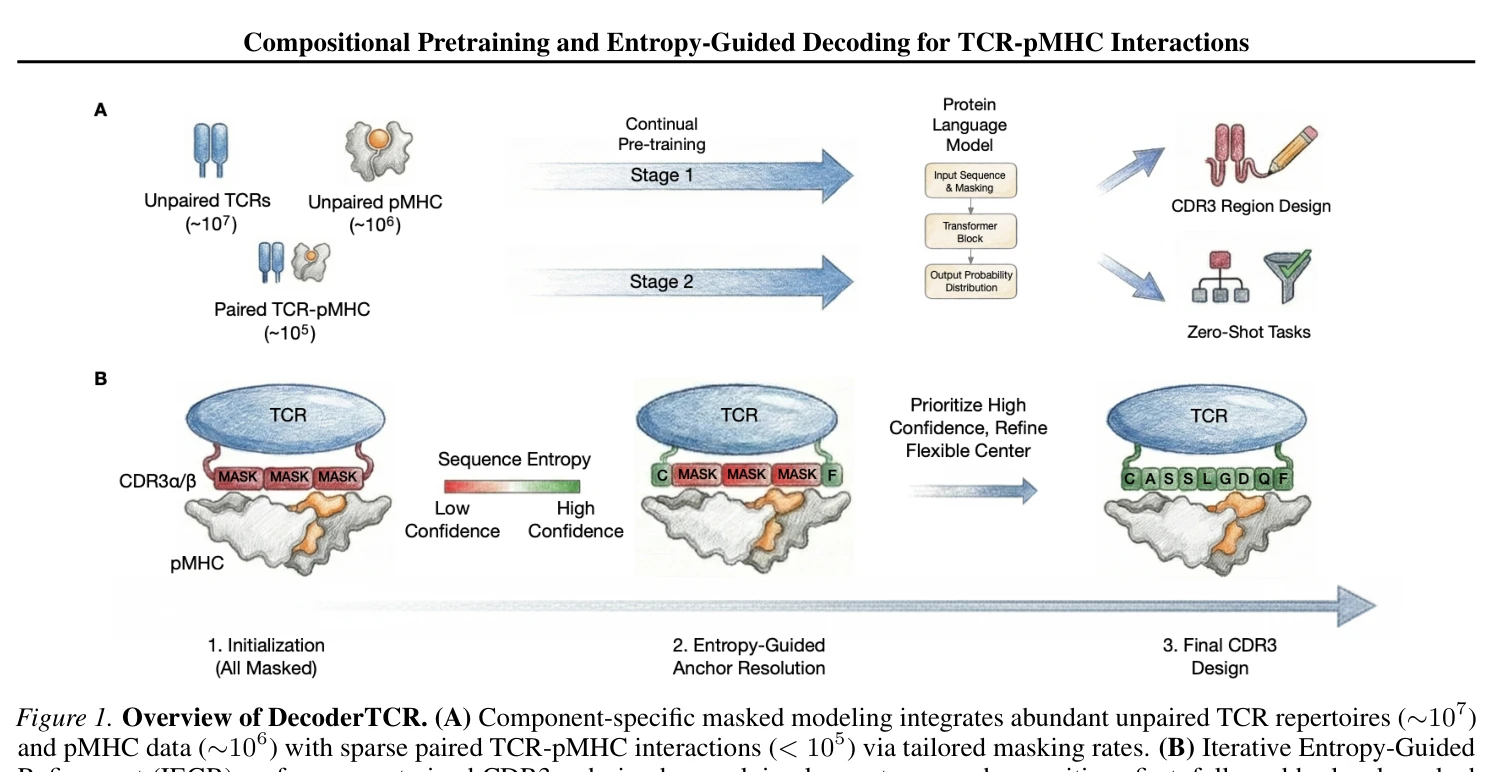
Figure 1. Overview of DecoderTCR. (A) Component-specific masked modeling integrates abundant unpaired TCR repertoires (∼
DecoderTCR는 TCR-pMHC 상호작용을 모델링하기 위해 구성적(compositional) 연속 사전학습 커리큘럼과 엔트로피 기반 반복 디코딩(IEGR)을 결합한 masked language model 프레임워크로, 희소한 paired 데이터와 풍부한 unpaired 데이터 간의 간극을 해소하여 zero-shot pMHC 결합 예측과 TCR 서열 생성을 동시에 수행한다.
Evaluation
Novelty: 4/5 Technical Soundness: 4/5 Significance: 4/5 Clarity: 4/5 Overall: 4/5
총평: 데이터 희소성 문제를 구성적 사전학습과 엔트로피 기반 디코딩으로 해결하며 예측과 생성을 통합한 실용적이고 실험적으로 검증된 프레임워크로, computational immunology 분야에 의미 있는 기여를 하지만 실제 생성 성능의 한계도 솔직하게 드러낸 균형 잡힌 연구이다.
같이 보면 좋은 논문
기반 연구SPECTER2 유사도 0.93로 Computational Molecular Design와 LLMs for Molecular Biology & Chemistry가 맞닿아, 'Evolutionary-scale prediction of atomic-level protein structure with a language model'가 이 ICML 2026 논문의 배경·대안·응용 맥락을 보완한다.
기반 연구결합된 모델을 실제 항체 설계 문제에 적용한 사례이다.
후속 연구compositional pretraining 개념을 확장 적용함
기반 연구antigen conditioning을 명시적으로 다루는 확장된 설계 프레임워크이다.
기반 연구생물학적 시퀀스 모델을 실제 변이 분석에 적용한다.
기반 연구molecular language model을 LoRA로 fine-tuning하는 확장된 방법론을 공유한다.
기반 연구affinity guidance를 활용해 기존 접근을 확장한 연구이다.
기반 연구단백질-펩타이드 상호작용 모델링의 사전학습 기반을 공유함
기반 연구SPECTER2 유사도 0.94로 Computational Molecular Design와 AI-Driven Drug and Materials Discovery가 맞닿아, 'Contrastive learning for antibody-antigen sequence-to-specificity prediction'가 이 ICML 2026 논문의 배경·대안·응용 맥락을 보완한다.
기반 연구SPECTER2 유사도 0.94로 Computational Molecular Design와 AI-Driven Drug and Materials Discovery가 맞닿아, 'How to make the most of your masked language model for protein engineering'가 이 ICML 2026 논문의 배경·대안·응용 맥락을 보완한다.
기반 연구SPECTER2 유사도 0.94로 Computational Molecular Design와 AI-Driven Drug and Materials Discovery가 맞닿아, 'Biologically-Grounded Multi-Encoder Architectures as Developability Oracles for Antibody Design'가 이 ICML 2026 논문의 배경·대안·응용 맥락을 보완한다.
기반 연구SPECTER2 유사도 0.93로 Computational Molecular Design와 LLMs for Molecular Biology & Chemistry가 맞닿아, 'Orthrus: toward evolutionary and functional RNA foundation models'가 이 ICML 2026 논문의 배경·대안·응용 맥락을 보완한다.
다른 접근항체/나노바디 서열 모델링에 대한 다른 접근법을 제시한다.
다른 접근TCR-pMHC 상호작용 예측에 다른 사전학습 전략을 사용한다.
후속 연구epitope-paratope 매핑의 기초적 모델링 방법을 제공한다.
다른 접근항체 CDR-H3 설계를 위한 다른 구조적 프라이어 결합 방법이다.
다른 접근유사한 목적의 항체 결합친화도 예측 모델이다.
다른 접근면역 수용체 분석을 위한 다른 비지도 학습 접근법
후속 연구bimodal masked language modeling 방법론이 본 연구의 기반이 된다.
후속 연구대규모 서열 데이터 기반 protein language model의 방법론적 토대를 제공하는 연구로 판단됨