Essence
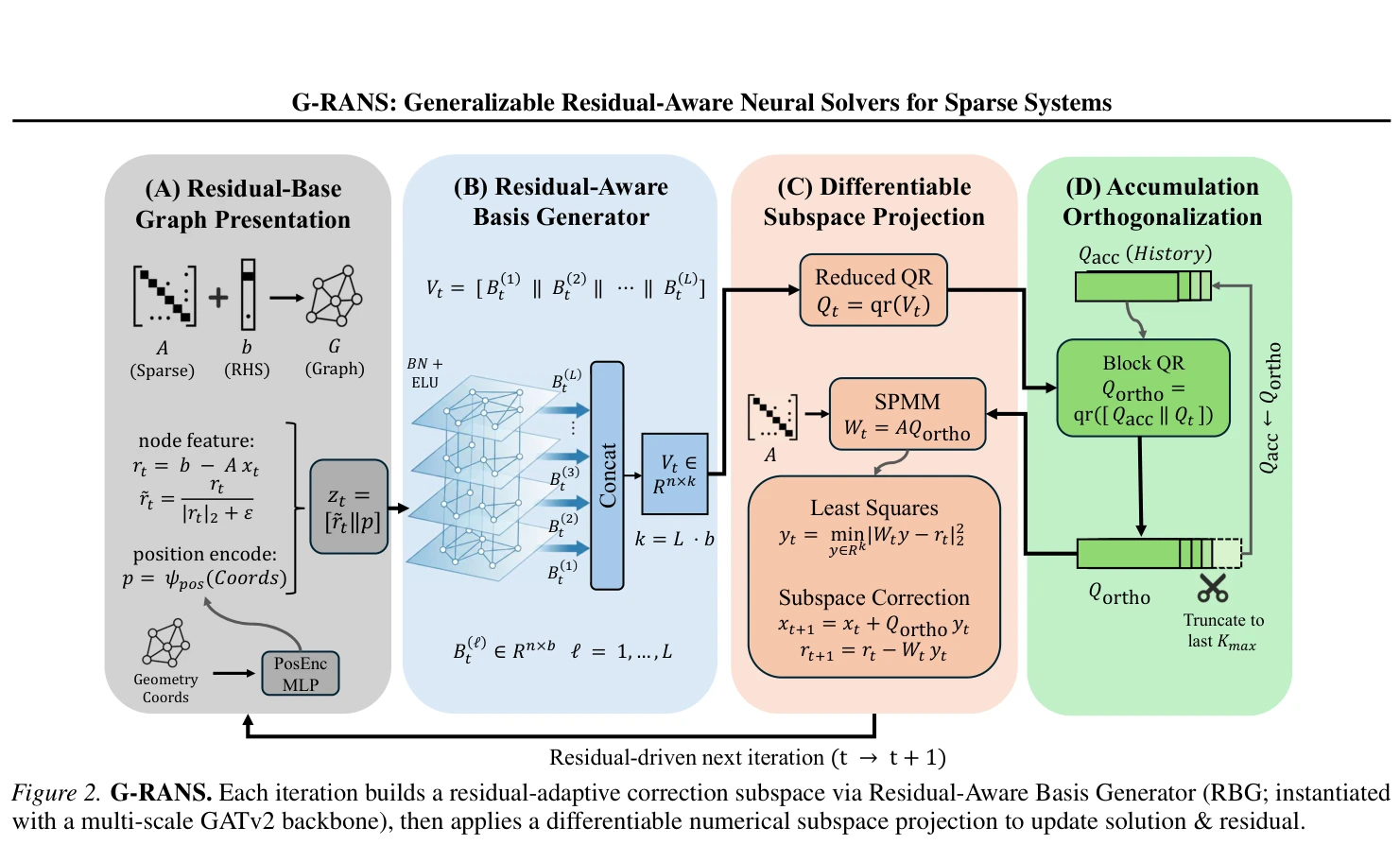
Figure 2. G-RANS. Each iteration builds a residual-adaptive correction subspace via Residual-Aware Basis Generator (RBG;
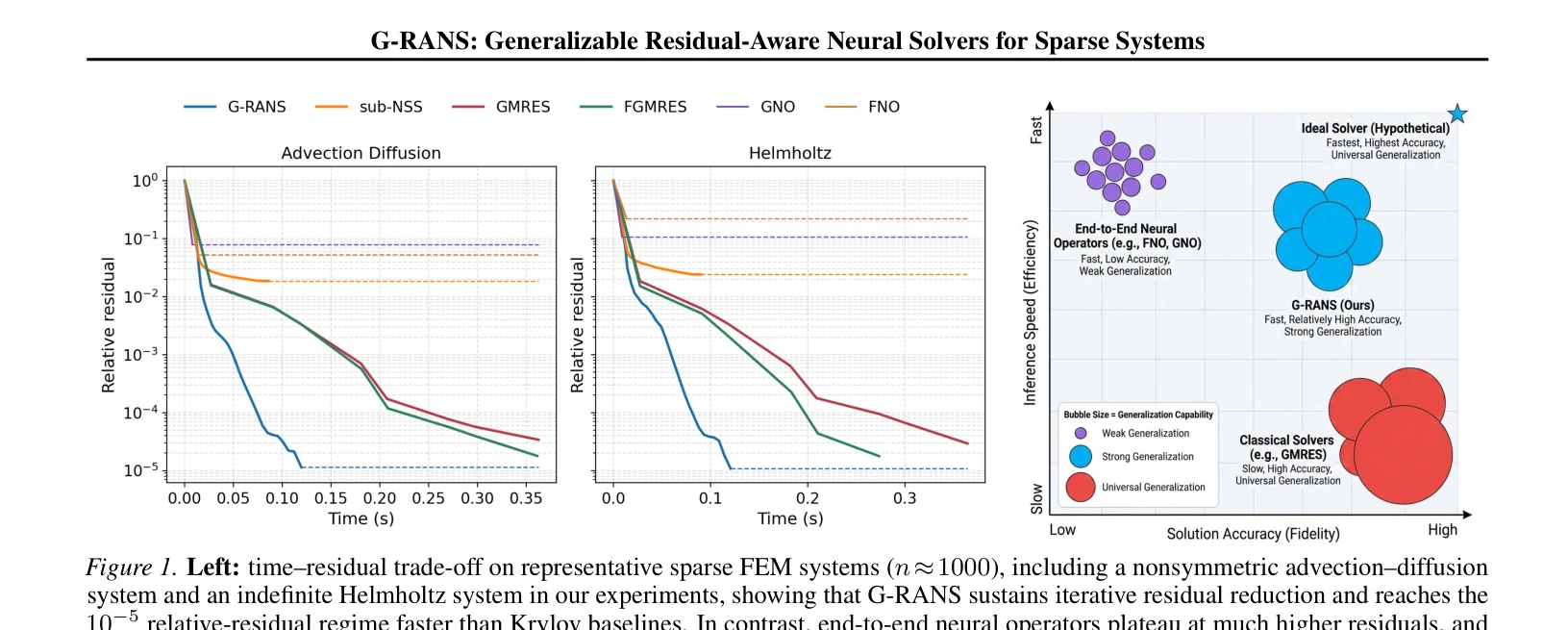
G-RANS는 sparse 선형계 Ax=b를 반복적으로 풀기 위해 residual을 matrix graph에 매핑하고, GATv2 기반의 multi-scale basis generator로 correction subspace를 생성한 뒤 differentiable QR+least-squares projection으로 residual-minimizing update를 계산하는 neuralized iterative solver이다.
Evaluation
Novelty: 4/5 Technical Soundness: 4/5 Significance: 4/5 Clarity: 4/5 Overall: 4/5
총평: neural operator와 classical iterative solver 사이의 간극을 residual-aware subspace correction이라는 새로운 패러다임으로 메우며, self-supervised 학습과 이론적 뒷받침을 겸비한 실용적이고 독창적인 연구로 평가된다. 다만 대규모 시스템과 더 넓은 PDE class에 대한 추가 검증이 향후 영향력 확대에 중요할 것이다.
같이 보면 좋은 논문
기반 연구SPECTER2 유사도 0.92로 Scientific Machine Learning for Dynamics와 Scientific AI for Physics and Environment가 맞닿아, 'Physics-Informed Neural Networks and Extensions'가 이 ICML 2026 논문의 배경·대안·응용 맥락을 보완한다.
기반 연구SPECTER2 유사도 0.93로 Scientific Machine Learning for Dynamics와 Scientific AI for Physics and Environment가 맞닿아, 'From Theory to Application: A Practical Introduction to Neural Operators in Scientific Computing'가 이 ICML 2026 논문의 배경·대안·응용 맥락을 보완한다.
기반 연구SPECTER2 유사도 0.93로 Scientific Machine Learning for Dynamics와 Scientific AI for Physics and Environment가 맞닿아, 'Physics-Informed Neural Networks with Unscented Kalman Filter for Sensorless Joint Torque Estimation in Humanoid Robots'가 이 ICML 2026 논문의 배경·대안·응용 맥락을 보완한다.
기반 연구flux-balance 적분 기반 PINN 방법론을 복잡한 유체 채널로 확장 적용함
다른 접근residual 기반 반복적 solver 설계라는 방법론적 기반을 공유한다.
기반 연구물리 정보 기반 신경 연산자 학습을 PDE 문제에 적용한 유사 응용 사례이다.
응용 사례graph-based 접근을 대규모 시스템 해석에 응용한다.
기반 연구PDE residual constraint를 결합한 physics-anchored operator learning의 확장 연구이다.
기반 연구병리 영상 처리라는 유사한 응용 분야를 다룬다.
기반 연구graph neural network 기반 solver 설계의 이론적 기초를 제공한다.
기반 연구graph 기반 신경망 구조를 unstructured mesh 상의 diffusion 모델에 응용한다.
기반 연구dynamics-aware self-supervision을 다른 물리 도메인으로 확장한다.
기반 연구고주파 성분 복원을 위한 반복적 refinement 기법을 확장한 연구이다.
기반 연구SPECTER2 유사도 0.92 기준으로 'G-RANS: Generalizable Residual-Aware Neural Solvers for Sparse Systems'의 AI4S 방법론을 'Projected Hessian Learning: Fast Curvature Supervision for Accurate Machine-Learning Interatomic Potentials'의 과학 생산·평가 맥락과 함께 보면 연구 자동화의 의미를 입체적으로 볼 수 있다.
기반 연구SPECTER2 유사도 0.92 기준으로 'G-RANS: Generalizable Residual-Aware Neural Solvers for Sparse Systems'의 AI4S 방법론을 'GMT: A Geometric Multigrid Transformer Solver for Microstructure Homogenization'의 과학 생산·평가 맥락과 함께 보면 연구 자동화의 의미를 입체적으로 볼 수 있다.
다른 접근유사한 residual-aware 반복 solver 문제를 다른 구조로 해결한다.
다른 접근GNN 기반 sparse 선형계 solver라는 동일한 문제를 다루는 대안적 접근이다.
후속 연구constitutive model 기반 real-to-sim gap 감소의 이론적 배경을 제공한다.
다른 접근dense visual semantics를 diffusion 모델에 주입하는 유사한 접근을 다른 조건화 방식으로 구현한다.
다른 접근sparse 선형계 풀이를 위한 다른 신경망 기반 접근을 제시한다.
후속 연구PINN 기반 시간 의존 문제 해결의 이론적 배경을 제공하는 선행 연구이다.
후속 연구PDE forward/inverse 문제를 위한 neural operator의 이론적 기반을 제공한다.