A Survey of Embodied Learning for Object-Centric Robotic Manipulation
저자: Ying Zheng, Lei Yao, Yuejiao Su, Yi Zhang, Yi Wang, Sicheng Zhao, Yiyi Zhang, Lap-Pui Chau | 날짜: 2024-08-21 | URL: https://arxiv.org/abs/2408.11537📄 PDF
⚠️ 이 페이지의 요약·평가·해설은 생성형 AI(Claude)가 자동 생성한 2차적 분석물입니다. 논문 원문의 저작권은 원저작자에게 있으며, 정확한 내용은 원문(위 DOI·arXiv 등 출처)을 확인하세요.
라이선스: arXiv 비독점 라이선스
Essence
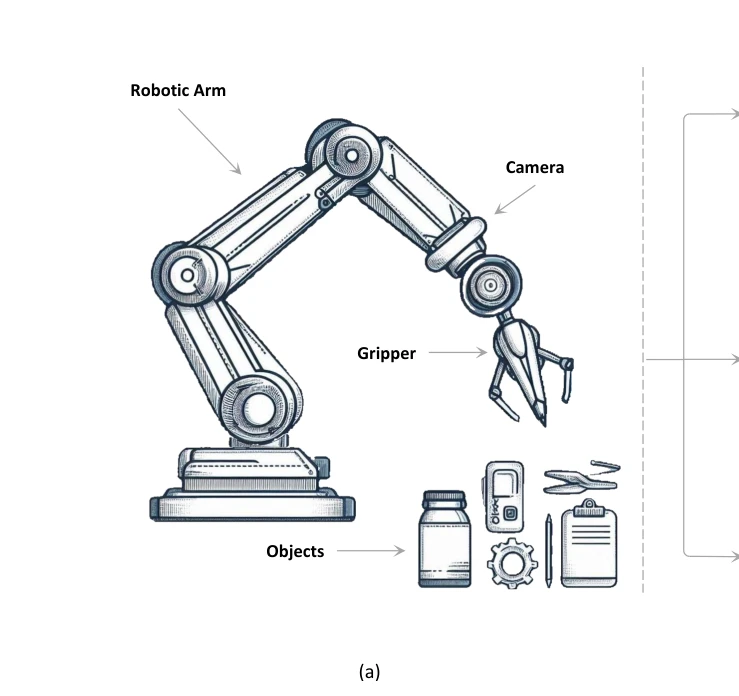
Fig. 1. An illustration of robotic manipulation system (left) and the typology of embodied learning methods for object-c
본 논문은 object-centric robotic manipulation을 위한 embodied learning의 최신 동향을 체계적으로 조사하며, embodied perceptual learning, embodied policy learning, embodied task-oriented learning의 세 가지 주요 분야로 분류하여 종합적인 서베이를 제공한다.
Motivation
Known: Deep learning의 발전으로 computer vision과 NLP 분야에서 큰 성과를 이루었으나, 전통적인 machine learning은 정적 데이터셋에 의존한다. 로봇 조작을 위한 다양한 embodied learning 방법들이 제안되어 왔다.
Gap: 기존 서베이들(특히 Cong et al. 2021)은 3D vision-based 방법에만 국한되어 있으며, 2021년 이후의 최신 연구(LLMs, NeRFs, Diffusion Models, 3D Gaussian Splatting 등)를 포함하지 않는다. 또한 policy learning과 task-oriented learning을 체계적으로 다루는 종합 서베이가 부재하다.
Why: Object-centric robotic manipulation은 차세대 지능형 로봇 개발에 필수적이며, embodied learning을 통한 물리적 상호작용과 지각 피드백 기반의 학습은 전통적 data-driven 방식보다 로봇 조작에 특히 적합하다.
Approach: 논문은 robotic manipulation 시스템의 세 가지 핵심 지능 측면(advanced perception, precise policy generation, task-orientation)에 따라 embodied learning 방법들을 체계적으로 분류하고, 최신 딥러닝 기술들의 응용을 포함하여 종합적으로 검토한다.
Achievement
Fig. 1. An illustration of robotic manipulation system (left) and the typology of embodied learning methods for object-c
체계적 분류체계: Embodied learning을 3개 주요 분야(perceptual, policy, task-oriented)와 7개 세부 방향(data representation, pose estimation, affordance learning, policy representation, policy learning, object grasping, object manipulation)으로 계층적으로 분류
최신 기술 포함: LLMs, NeRFs, Diffusion Models, 3D Gaussian Splatting 등 2021년 이후의 최신 AI 기술을 robotic manipulation에 적용한 연구들을 체계적으로 정리
다양한 데이터 표현 방식: Image-based, 3D-aware, tactile-based 세 가지 representation 방식을 포괄적으로 다루고 비교
포괄적 자료 제공: Public datasets, evaluation metrics, representative applications, current challenges, future research directions을 모두 포함하는 완전한 서베이 제공
상위 연구와의 비교: 기존 41개 관련 서베이와의 차이점을 명확히 하고 본 논문의 우월성 입증
How
Fig. 1. An illustration of robotic manipulation system (left) and the typology of embodied learning methods for object-c
Object-centric robotic manipulation의 시스템 아키텍처를 로봇 암, 센서, 말단 장치(그리퍼)로 구성하여 설명
기존 Cong et al. (2021)의 3D vision-centric 접근을 벗어나 image, 3D-aware, tactile 세 가지 representation 방식을 균형있게 다룬 점
최신 generative models(Diffusion Models), foundation models(LLMs), novel 3D representation(3D Gaussian Splatting) 등을 robotic manipulation 맥락에서 체계적으로 정리한 점
Policy learning과 task-oriented learning을 perceptual learning과 동등한 수준의 주요 분야로 격상하여 embodied learning의 전체 파이프라인을 통합적으로 제시한 점
Object-centric manipulation이라는 명확한 초점으로 navigation, planning 등 다른 embodied AI 분야와 구분하고 집중도를 높인 점
Limitation & Further Study
2024년 8월 프리프린트 기준이므로 그 이후의 최신 발전(예: multimodal LLMs의 급속한 발전)을 완전히 포함하지 못할 수 있음
Real-world deployment의 성공률, 강건성, 일반화 능력에 대한 정량적 비교가 충분하지 않을 수 있음
Sim-to-real transfer의 성능 격차와 해결 방안에 대한 심층 분석이 필요함
다중 모달(vision + tactile + force feedback) 통합 학습의 최적 방법에 대한 합의가 부재함
후속 연구는 (1) foundation models의 robot manipulation 적용, (2) 복잡한 다중 객체 상호작용 시나리오, (3) 실시간 제약 환경에서의 효율적 학습 방법 개발에 집중할 필요가 있음
총평: 본 논문은 object-centric robotic manipulation을 위한 embodied learning의 최신 동향을 체계적이고 포괄적으로 정리한 우수한 서베이이며, 기존 연구와 달리 최신 generative/foundation models을 포함하고 perception-policy-task의 통합적 관점을 제시함으로써 로봇 조작 분야 연구자들에게 매우 유용한 참고자료가 될 것으로 판단된다.
다른 접근A Survey of Embodied Learning for Object-Centric Robotic Manipulation은 deformable object manipulation을 포함한 물체 중심 embodied policy 학습의 다양한 방법론을 탐구한다.