저자: Konstantinos Bousmalis, Giulia Vezzani, Dushyant Rao, Coline Devin, Alex X. Lee, Maria Bauza, Todor Davchev, Yuxiang Zhou, Agrim Gupta, Akhil Raju, Antoine Laurens, Claudio Fantacci, Valentin Dalibard, Martina Zambelli, Murilo Martins, Rugile Pevceviciute, Michiel Blokzijl, Misha Denil, Nathan Batchelor, Thomas Lampe, Emilio Parisotto, Konrad Żołna, Scott Reed, Sergio Gómez Colmenarejo, Jon Scholz, Abbas Abdolmaleki, Oliver Groth, Jean-Baptiste Regli, Oleg Sushkov, Tom Rothörl, José Enrique Chen, Yusuf Aytar, Dave Barker, Joy Ortiz, Martin Riedmiller, Jost Tobias Springenberg, Raia Hadsell, Francesco Nori, Nicolas Heess | 날짜: 2023-06-20 | URL: https://arxiv.org/abs/2306.11706 📄 PDF
Essence
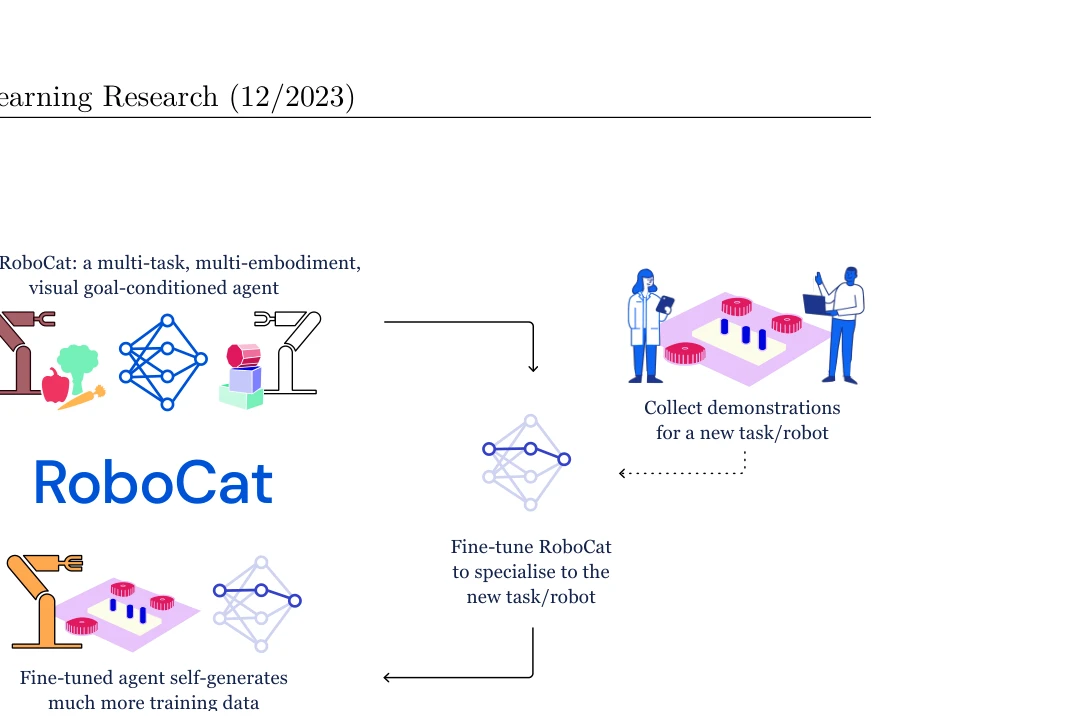
Figure 1: The self-improvement process. RoboCat is a multi-task, multi-embodiment visual goal-conditioned
RoboCat는 서로 다른 로봇과 작업 경험을 활용하여 다중 embodiment과 다중 작업을 처리할 수 있는 시각 기반 goal-conditioned decision transformer 기반의 자가 개선 로봇 조작 에이전트이다. 100-1000개의 예제만으로 새로운 작업과 로봇에 적응하며, 자체 생성 데이터를 이용한 반복적 개선이 가능하다.
Evaluation
Novelty: 4/5 Technical Soundness: 3/5 Significance: 4/5 Clarity: 4/5 Overall: 4/5
총평: RoboCat는 foundation model 패러다임을 로봇 조작에 성공적으로 적용하여 이질적 embodiment 처리, 효율적 적응, 자가 개선을 동시에 달성한 획기적 연구이다. 광범위한 실험 검증과 명확한 presentation이 강점이나, 복잡도 증가와 장기 scaling에 대한 분석이 향후 과제이다.
같이 보면 좋은 논문
기반 연구RoboCat은 상호 embodiment 조작 적응과 자기 개선 루프를 통해, RoboAgent의 범용성 강화 방향을 실증적으로 발전시킨다.
다른 접근RoboCat은 범용 에이전트로 robotic manipulation 중심 발전을 보여주며 Gato와 다양한 신경망 구조 및 스케일링 비교 가능하다.
다른 접근Perceiver-Actor는 RoboCat과 달리 Perceiver 기반 다중 태스크 정책을 통해 일반화된 조작을 연구한다.
다른 접근Learning Universal Policies via Text-Guided Video Generation 논문은 RoboCat의 자기 개선 및 적응 과정을 영상-텍스트 주도 정책 학습 접근과 비교할 수 있다.
다른 접근Scaling Cross-Embodied Learning 논문은 다양한 embodiment에서 단일 정책 학습을 실험하며, RoboCat과 유사한 목표를 가진 대안 방법론이다.
다른 접근RoboCat은 다양한 embodied 환경 및 과제에서 일반화 가능한 정책을 연구하여, OctoNav의 generalist agent 연구에 대안을 제공한다.
다른 접근NORA-1.5는 멀티태스크 및 멀티로봇 정책을 학습하는 VLA 모델로, RoboCat과의 데이터 생성 및 자기개선 전략 비교가 유용합니다.
후속 연구Structured World Models from Human Videos는 자기개선과 더불어 대규모 인간 시연 데이터를 활용한 RoboCat의 자기생성 데이터 확장 사례를 보여줍니다.
후속 연구OneTwoVLA는 RoboCat의 generalist 정책 개념을 reasoning 및 acting 통합 프레임워크로 concretize한다.