⚠️ 이 페이지의 요약·평가·해설은 생성형 AI(Claude)가 자동 생성한 2차적 분석물입니다. 논문 원문의 저작권은 원저작자에게 있으며, 정확한 내용은 원문(위 DOI·arXiv 등 출처)을 확인하세요.
라이선스: arXiv 비독점 라이선스
Essence
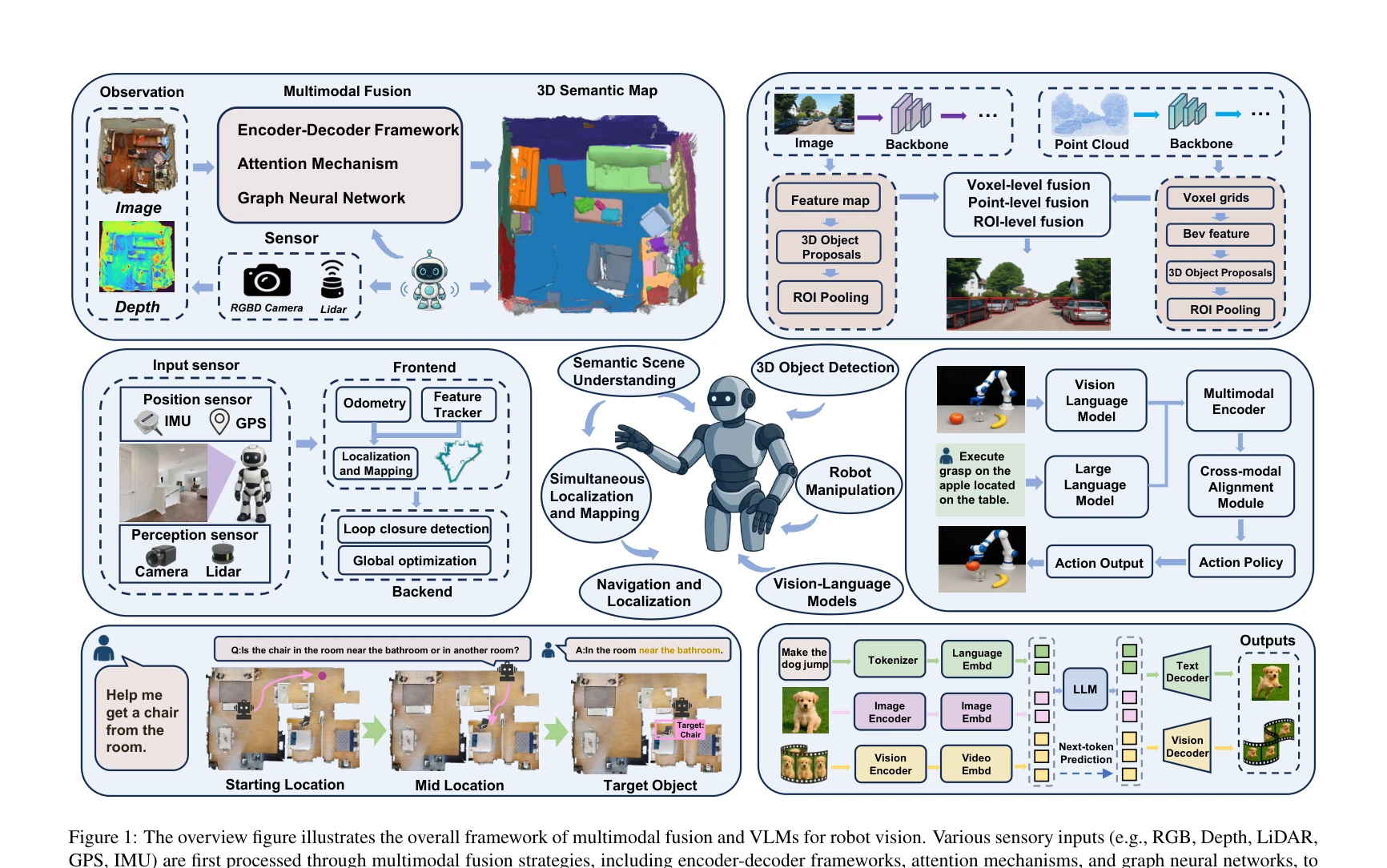
Figure 1: The overview figure illustrates the overall framework of multimodal fusion and VLMs for robot vision. Various
로봇 비전을 위한 멀티모달 융합 기법과 Vision-Language Model(VLM)의 응용을 체계적으로 리뷰하며, encoder-decoder, attention, graph neural network 등의 융합 전략과 SLAM, 3D 객체 감지, 네비게이션, 조작 등 핵심 로봇 태스크에서의 실제 구현을 분석한다.
Motivation
Known: 전통적인 unimodal 접근법은 occlusion, 조명 변화, 텍스처 부족 등의 복잡한 환경에서 인식 제약을 겪으며, encoder-decoder, Transformer, contrastive learning 등이 모달리티 간 의존성 모델링에 널리 사용되고 있다.
Gap: 기존 리뷰들은 semantic segmentation과 object detection 같은 기본 태스크에 주로 집중하였으며, multimodal SLAM, 로봇 조작, embodied navigation 같은 복잡한 추론과 장기 결정 태스크에 대한 체계적 분석이 부족하다.
Why: 멀티모달 융합과 VLM은 로봇의 강건한 장면 이해, 일반화, 자연스러운 인간-로봇 상호작용을 가능하게 하며, 동적이고 불완전하게 관찰 가능한 환경에서의 실용적 가치가 크다.
Approach: task-oriented 관점에서 semantic scene understanding, SLAM, 3D detection, navigation, manipulation 등 5개 핵심 태스크에 대해 멀티모달 융합 아키텍처와 VLM을 비교 분석하며, 주요 데이터셋과 실제 배포 시 직면하는 과제를 도출한다.
Achievement
Figure 1: The overview figure illustrates the overall framework of multimodal fusion and VLMs for robot vision. Various
전통적 융합과 VLM의 통합 분석: 아키텍처 설계, 기능 특성, 적용 태스크 측면에서 encoder-decoder, attention, graph neural network 기반 방법과 LLM 기반 VLM의 연결성과 상호보완성을 체계적으로 비교
복잡한 로봇 태스크 확장: multimodal SLAM, 로봇 조작, embodied navigation 등 복잡한 추론과 장기 결정 태스크에서의 멀티모달 융합과 VLM의 잠재력을 시연
멀티모달 우위 명확화: unimodal 접근법 대비 강화된 인식 강건성, 의미론적 표현성, cross-modal alignment, 고수준 추론의 이점 강조
멀티모달 데이터셋 체계화: 모달 조합, 커버 태스크, 적용 시나리오, 한계를 포함한 주요 로봇 데이터셋의 심층 분석 제공
핵심 과제 및 미래 방향 제시: cross-modal alignment, efficient training, real-time optimization 과제를 식별하고 self-supervised learning, structured spatial memory, adversarial robustness 등 해결책 제안
How
Figure 1: The overview figure illustrates the overall framework of multimodal fusion and VLMs for robot vision. Various
Encoder-decoder framework를 통한 heterogeneous 모달리티 통합 및 unified feature representation 설계
Attention-based 아키텍처를 이용한 modality alignment과 cross-modal attention 메커니즘 적용
Graph neural network를 활용한 scene 내 relational structure 모델링
Transformer 기반 구조로 모달리티 간 의존성 모델링
Contrastive learning과 자체 지도 학습(self-supervised learning)을 통한 robust multimodal representation 학습
대규모 pretrained VLM (LLM 기반)의 zero-shot, instruction following, visual question answering 능력 활용
SLAM, 3D detection, navigation, manipulation 등 5개 핵심 태스크에서의 실제 구현 분석
공개 데이터셋의 모달 조합, 커버리지, 한계 평가
Originality
전통적 multimodal fusion 방법과 emerging VLM을 통합하여 아키텍처, 기능, 적용 측면에서 체계적으로 비교 분석한 최초의 종합 리뷰
기존 리뷰 대비 5개 핵심 로봇 태스크(semantic understanding, SLAM, 3D detection, navigation, manipulation)를 모두 포함한 확장된 스코프
Cross-modal self-supervised learning과 lightweight fusion 방법론을 명시적으로 다룬 첫 번째 리뷰
Multimodal SLAM과 embodied navigation 같은 복잡한 장기 결정 태스크에서의 VLM 활용 분석을 최초로 제시
Real-world robotic deployment 관점에서의 domain adaptation, adversarial robustness, human feedback 통합 등 실용적 과제 제시
Limitation & Further Study
현재 리뷰의 범위가 RGB, depth, LiDAR, tactile 등 기본 센서 모달리티에 주로 제한되어 있으며, thermal, event-based camera 등 추가 모달리티의 활용 가능성 미흡
Cross-modal alignment 문제에 대한 일반화된 솔루션이 부재하여 task-specific 해법에 의존
제한된 주석 데이터(limited annotated data)와 동적 환경에서 pretrained VLM의 적응성 여전히 제한적
Real-time deployment와 계산 효율성 간의 trade-off에 대한 구체적 설계 지침 부족
후속 연구 방향: (1) efficient training 메커니즘으로 computational cost 감소, (2) cross-modal self-supervised learning 강화, (3) structured spatial memory와 environment modeling으로 spatial intelligence 향상, (4) adversarial robustness와 human feedback 통합으로 윤리적 배포 실현
총평: 본 리뷰는 로봇 비전 분야에서 멀티모달 융합과 VLM의 응용을 가장 포괄적으로 다룬 첫 번째 종합 리뷰로서, 5개 핵심 로봇 태스크, cross-modal self-supervised learning, lightweight fusion 등을 체계적으로 분석하고 명확한 미래 방향을 제시하여 향후 로봇 비전 연구의 중요한 참고 자료가 될 수 있다.