⚠️ 이 페이지의 요약·평가·해설은 생성형 AI(Claude)가 자동 생성한 2차적 분석물입니다. 논문 원문의 저작권은 원저작자에게 있으며, 정확한 내용은 원문(위 DOI·arXiv 등 출처)을 확인하세요.
라이선스: arXiv 비독점 라이선스
Essence
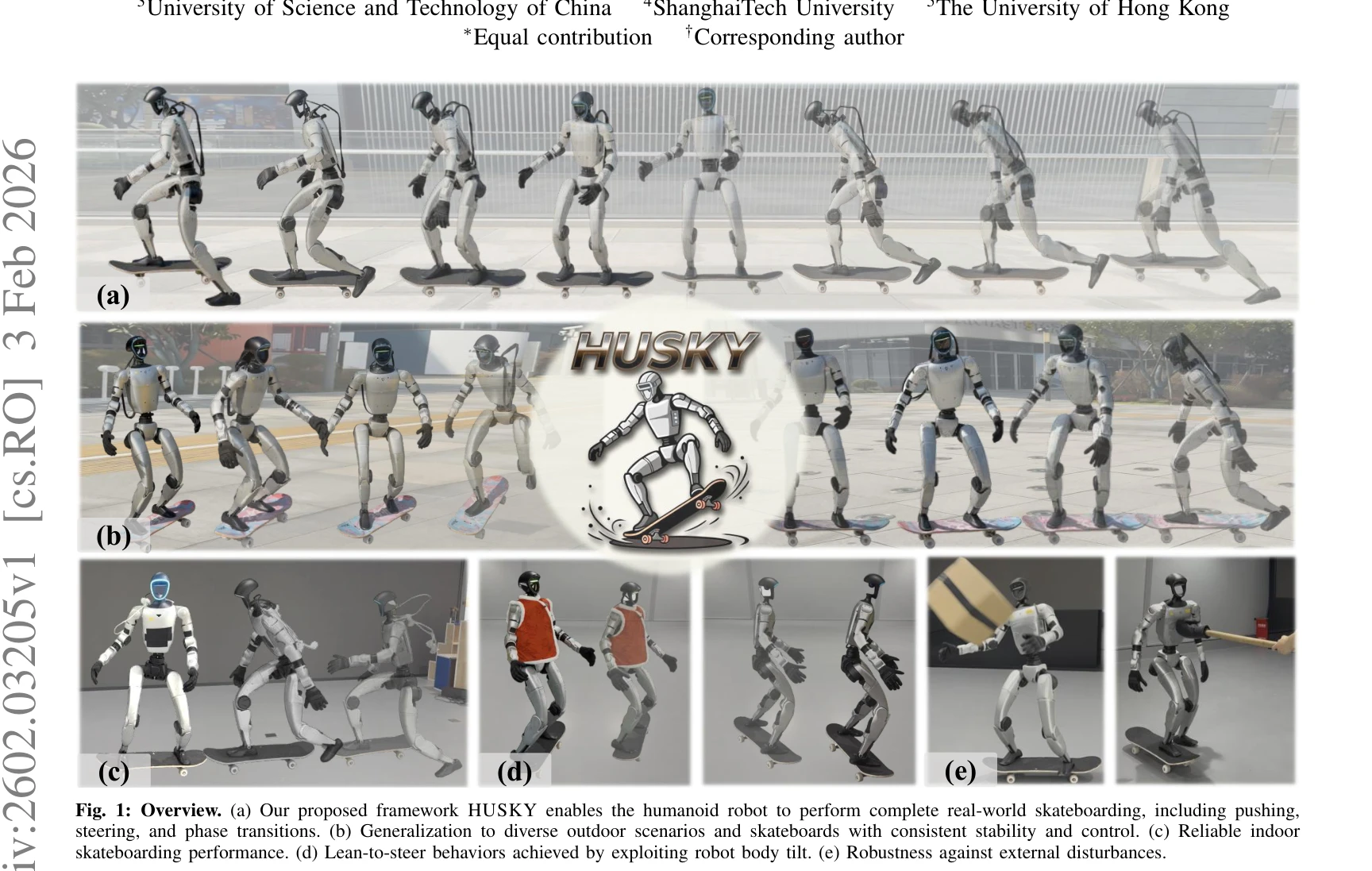
Fig. 1: Overview. (a) Our proposed framework HUSKY enables the humanoid robot to perform complete real-world skateboardi
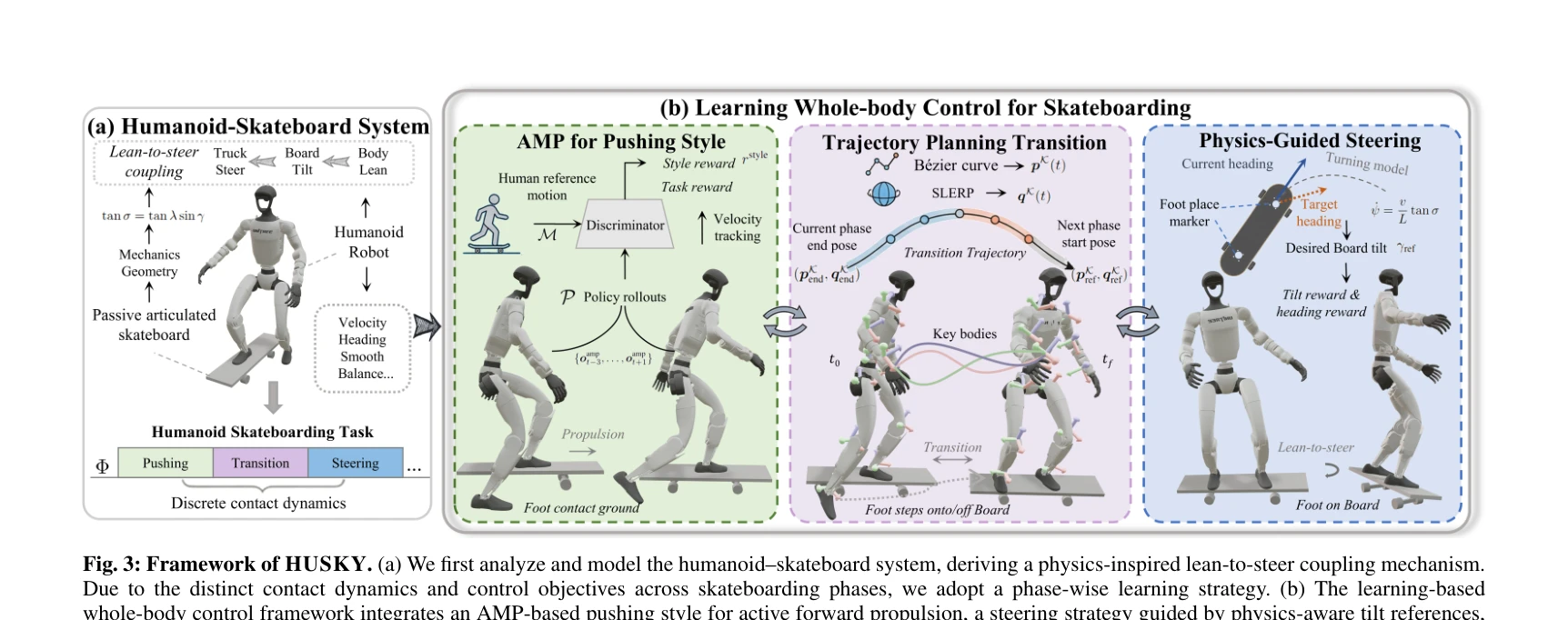
HUSKY는 humanoid 로봇이 skateboard 위에서 안정적으로 skating을 수행하기 위한 physics-aware whole-body control 프레임워크이며, lean-to-steer 제약과 hybrid contact dynamics를 명시적으로 모델링하여 AMP 기반 pushing과 physics-guided steering을 통합한다.
Motivation
Known: 최근 humanoid robots는 complex terrains에서의 locomotion, dancing, loco-manipulation 등 다양한 whole-body control 태스크를 수행할 수 있으나, underactuated wheeled platform 위에서의 skateboarding은 non-holonomic constraints와 tightly coupled human-object interactions로 인해 매우 도전적이다.
Gap: 기존 RL 기반 접근법들은 high-dimensional humanoid state/action space와 dynamic skateboard 간의 tight coupling으로 인한 instability와 sim-to-real gap을 해결하지 못하고 있으며, skateboarding의 hybrid contact dynamics와 phase transitions를 체계적으로 다루지 않는다.
Why: Humanoid skateboarding은 real-world robotics의 복잡한 동역학과 로봇-환경 상호작용을 다루는 중요한 벤치마크 태스크이며, 성공적인 구현은 underactuated systems에서의 robust whole-body control 능력을 입증한다.
Approach: HUSKY는 board tilt과 truck steering angle 간의 kinematic coupling (tan σ = tan λ sin γ) 을 명시적으로 모델링하고, hybrid dynamical system 프레임워크에서 AMP를 통한 human-like pushing 학습과 physics-guided lean-to-steer 전략, 그리고 trajectory planning 기반 phase transition mechanism을 통합한다.
Achievement
Fig. 1: Overview. (a) Our proposed framework HUSKY enables the humanoid robot to perform complete real-world skateboardi
Physics-informed System Modeling: Board tilt과 truck steering angle의 coupling relationship을 수식적으로 유도하여 non-holonomic skateboard dynamics를 tractable하게 분석
Hybrid Control Framework: Pushing과 steering 두 개의 distinct contact phases를 명시적으로 구성하여 각 phase의 역학과 제어 목표를 독립적으로 다룸
AMP와 physics-guided strategy를 결합하여 human-like propulsion과 natural steering behaviors를 동시에 달성
Trajectory planning을 통한 smooth phase transitions 메커니즘이 기존 whole-body control과 구별되는 특징
Underactuated wheeled platform에서의 humanoid control은 robot skateboarding 분야에서 미개척 영역
Limitation & Further Study
Simplified kinematic skateboard model은 suspension의 full dynamics (compliance, damping)를 완전히 capture하지 못할 수 있으며, 실제 skateboard의 mechanical characteristics 변화에 따른 adaptation 가능성 미검토
DRL 학습이 simulation에서 수행되므로 sim-to-real gap의 완전한 해결이 아직 과제이며, real-world에서의 generalization에 대한 systematic analysis 부족
Humanoid의 23 DoF 중 wrist 3 DoF를 제외한 설정이 특정 hardware에 종속적이므로, 다른 humanoid platforms에 대한 adaptability 불명확
Outdoor environments의 terrain variations (slope, surface friction 등)에 대한 robustness 평가가 제한적
High-speed maneuvers에서의 control stability 한계나 extreme scenarios (급격한 turn, high-speed obstacle avoidance)에 대한 분석 필요
향후 연구: Active suspension 모델 통합, multi-task learning으로 diverse skateboard designs 대응, 더 aggressive maneuvers의 exploration, long-horizon planning과의 결합 등이 필요