Essence
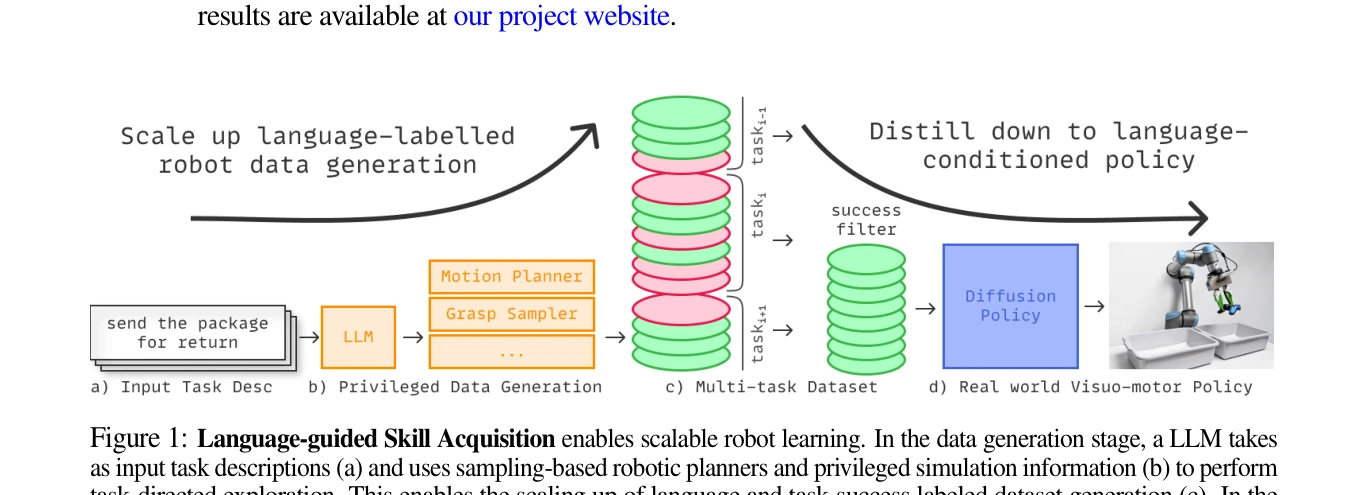
Figure 1: Language-guided Skill Acquisition enables scalable robot learning. In the data generation stage, a LLM takes
LLM 기반 고수준 계획과 sampling-based robot planner를 활용하여 언어-레이블 로봇 데이터 생성을 확장하고, 이를 diffusion policy를 통해 다중 작업 언어-조건 visuo-motor 정책으로 증류하는 로봇 스킬 획득 프레임워크를 제시한다.
Evaluation
Novelty: 4/5 Technical Soundness: 3/5 Significance: 4/5 Clarity: 4/5 Overall: 4/5
총평: 본 논문은 LLM 기반 계획과 sampling-based planning을 결합한 자동 로봇 데이터 생성과 multi-task diffusion policy 학습의 novel한 통합 프레임워크를 제시하며, 33.2% 성능 향상과 함께 로봇 스킬 습득의 확장 가능성을 입증한다. 다중 작업 벤치마크와 함께 로봇 학습 분야에 의미 있는 기여를 하고 있다.
같이 보면 좋은 논문
기반 연구Diffusion Policy: Visuomotor Policy Learning 논문은 확산 정책을 통한 비쥬얼-모터 제어의 이론적 기초를 제공해, 본 논문의 diffusion policy 기반 증류에 개념적 토대를 마련한다.
기반 연구LIBERO: Benchmarking Knowledge Transfer for Lifelong Robot Learning은 다양한 스킬 셋 전이와 증류를 위한 벤치마킹 환경을 제공하여, skill acquisition 프레임워크의 실험적 기반을 제공한다.
기반 연구Scaling Up and Distilling Down 논문은 언어 유도형 로봇 스킬의 규모 확장·지식 증류 방법론으로 PSL의 실질 확장 모델 사례다.
기반 연구Scaling Up and Distilling Down은 대규모 behavior cloning과 RL을 결합해 gradient stable adaptation을 달성하는 방향에서 FLaRe 프레임워크를 실질적으로 확장합니다.
다른 접근Robotic Skill Acquisition via Instruction Augmentation 논문은 언어 명령 기반으로 스킬 획득을 확장하는 다른 접근법을 제시하여 scaling skill acquisition의 다양한 방법을 비교할 수 있다.
다른 접근CoT-VLA는 체인오브쏘트 기반의 시각-언어-행동 추론을 로봇 플래닝에 적용하여 행동지시 생성 프레임워크와 비교 분석할 수 있다.
다른 접근InstructVLA: Vision-Language-Action Instruction Tuning from Internet Data는 LLM을 활용한 instruction 기반 데이터 생성과 정책 증류를 통해 습득된 기술 전이 프레임워크를 다룬다.
응용 사례AutoRT는 대규모 실제 로봇 오케스트레이션과 실행 측면에서 diffusion policy 기반 멀티태스크 정책 증류와 연계 가능한 실제 적용 사례를 제공한다.