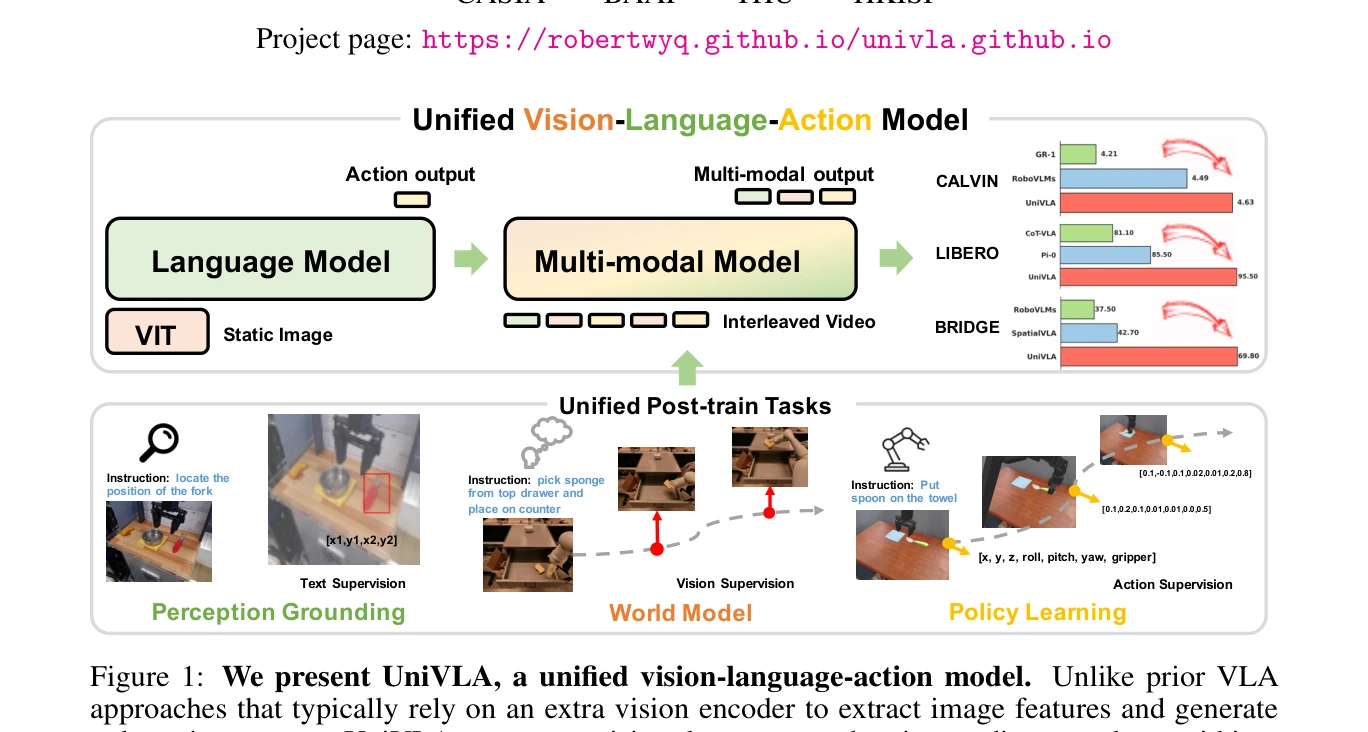
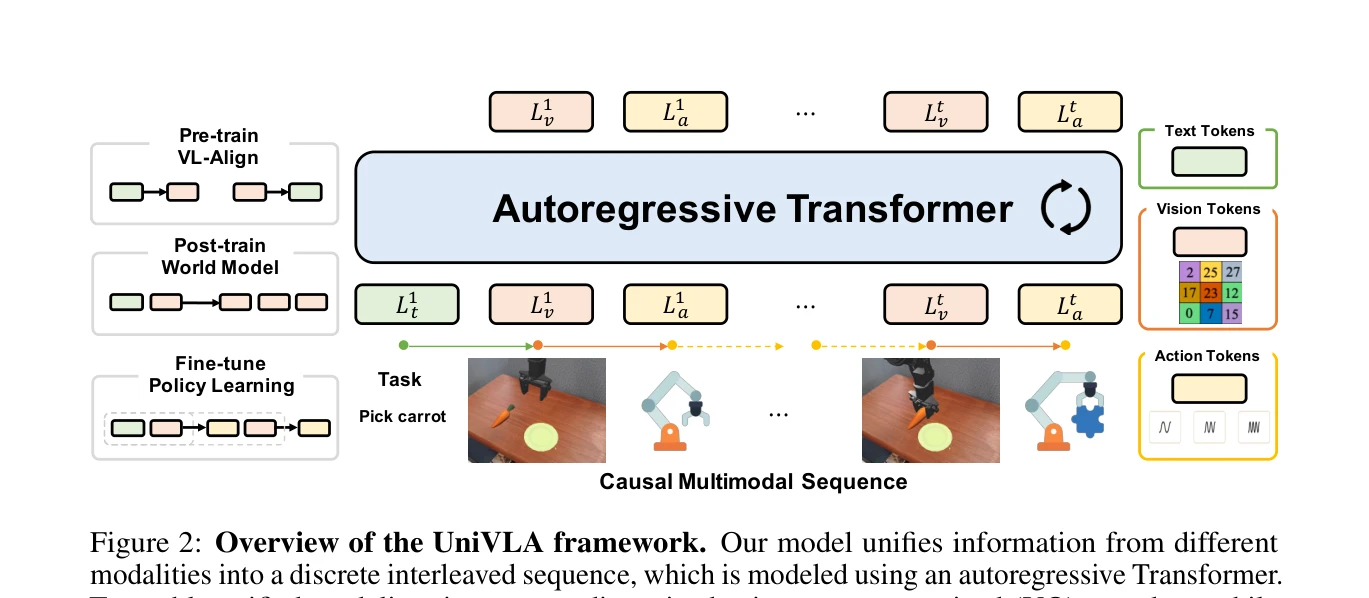
Known: 기존 VLA 모델들은 VLM의 semantic comprehension을 활용하여 action signal을 생성하지만, 주로 static image에서 action으로의 late-fusion 전략을 사용한다. RT-2, OpenVLA 등이 pure action prediction 패러다임을 선도하고 있다.
Gap: 기존 접근법들은 heterogeneous modalities를 unified representation으로 모델링하지 못하며, temporal과 causal dependencies를 충분히 포착하지 못한다. 또한 static paradigm으로 인해 대규모 비디오 데이터의 temporal information을 효과적으로 활용하지 못한다.
Why: Unified multimodal modeling은 더 긴밀한 cross-modal integration을 가능하게 하며, world model을 통한 causal dynamics 학습은 특히 long-horizon task와 out-of-distribution 시나리오에서 정책 학습을 크게 향상시킬 수 있다.
Approach: Vision, language, action을 shared vocabulary의 discrete token으로 변환하고 unified autoregressive framework에서 모델링한다. Markov chain 기반의 interleaved observation-action sequence 구조로 causal dependencies를 자연스럽게 통합하고, world model post-training을 통해 대규모 robotic video에서 temporal dynamics를 학습한다.
Achievement
Figure 1: We present UniVLA, a unified vision-language-action model. Unlike prior VLA
State-of-the-art 성능: LIBERO 95.5% (vs π0-FAST 85.5%), CALVIN, SimplerEnv-Bridge 등에서 기존 방법 대비 유의미한 성능 향상 달성
Unified multimodal capability: 단일 architecture로 action prediction, spatial reasoning, video prediction 등 다양한 multimodal tasks 지원
Large-scale video training: Discrete token 기반 설계로 대규모 robotic video 데이터의 효과적인 활용 가능
총평: UniVLA는 heterogeneous modalities를 unified discrete token 프레임워크로 통합하고 world model post-training으로 temporal dynamics를 학습하는 혁신적인 VLA 모델이다. 다중 벤치마크에서 SOTA 성능을 달성했으며, multimodal capability와 large-scale video training 가능성으로 generalist embodied AI의 새로운 방향을 제시한다.
후속 연구Unleashing Large-Scale Video Generative Pre-training... 논문은 비디오 생성 기반 사전학습이 UniVLA 같은 joint vision-language-action 정책의 post-training world model 통합에 실질적 성능 향상을 도모한다.