Emergent Active Perception and Dexterity of Simulated Humanoids from Visual Reinforcement Learning
저자: Zhengyi Luo, Chen Tessler, Toru Lin, Ye Yuan, Tairan He, Wenli Xiao, Yunrong Guo, Gal Chechik, Kris Kitani, Linxi Fan, Yuke Zhu | 날짜: 2025-05-18 | URL: https://arxiv.org/abs/2505.12278📄 PDF
⚠️ 이 페이지의 요약·평가·해설은 생성형 AI(Claude)가 자동 생성한 2차적 분석물입니다. 논문 원문의 저작권은 원저작자에게 있으며, 정확한 내용은 원문(위 DOI·arXiv 등 출처)을 확인하세요.
라이선스: arXiv 비독점 라이선스
Essence
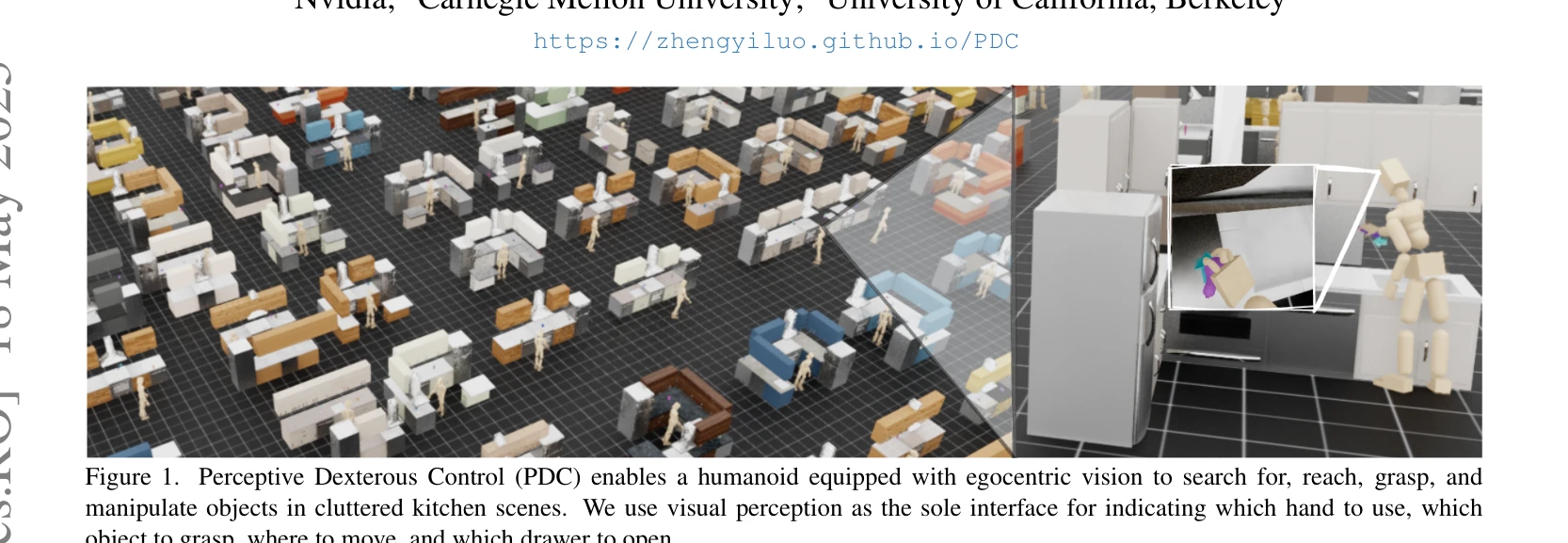
Figure 1. Perceptive Dexterous Control (PDC) enables a humanoid equipped with egocentric vision to search for, reach, gr
본 논문은 egocentric vision만을 사용하여 simulated humanoid가 복잡한 household tasks를 수행하도록 하는 Perceptive Dexterous Control (PDC) 프레임워크를 제안하며, visual perception을 task specification의 인터페이스로 활용하여 active search 등의 emergent behaviors를 유도한다.
Motivation
Known: Humanoid loco-manipulation 제어와 visual dexterous manipulation은 각각 활발히 연구되고 있으나, 대부분의 기존 연구는 privileged state information (3D object pose/shape)에 의존하거나 fixed camera 등의 제약이 있다.
Gap: Egocentric vision만으로 humanoid의 whole-body dexterous control을 달성하면서 동시에 human-like active search 같은 emergent behaviors를 유도하는 방법이 부재하다.
Why: Vision-driven humanoid control은 로봇공학, embodied AI, animation 분야에서 실질적 응용 가치가 높으며, perception-action loop의 폐곡선화는 real-world deployment의 핵심 요소이다.
Approach: Control priors를 motion capture data로부터 학습하고, visual cues (object masks, 3D markers)를 통한 perception-as-interface 패러다임으로 task를 지정하여 RL을 통해 단일 정책으로 다중 tasks를 학습한다.
Achievement
Figure 1. Perceptive Dexterous Control (PDC) enables a humanoid equipped with egocentric vision to search for, reach, gr
Vision-driven whole-body dexterous control 실현: RGB, RGB-D, Stereo 등 다양한 visual modalities에서 naturalistic household environments에서의 humanoid 제어 달성
Perception-based task specification: Predefined state variables 없이 visual cues만으로 object selection, target placement, skill specification을 가능하게 하는 task-agnostic paradigm 제안
Emergent human-like behaviors: Active search, whole-body coordination 등의 behaviors가 vision-driven RL training으로부터 자연스럽게 emergence됨을 실증
Visual modality별 성능 비교: Stereo vision이 RGB 대비 9% 더 높은 success rate 달성 등 systematic evaluation 제시
How
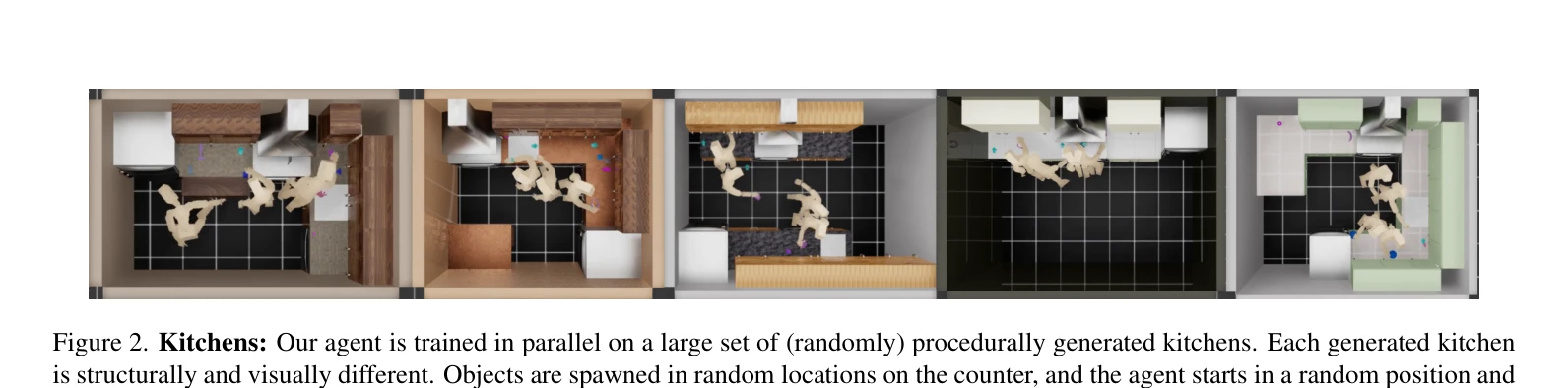
Figure 2. Kitchens: Our agent is trained in parallel on a large set of (randomly) procedurally generated kitchens. Each
Large-scale motion capture 데이터로부터 control priors 학습을 통한 humanoid의 기본 운동 능력 확보
Egocentric vision (RGB/RGB-D/Stereo)과 proprioception을 policy input으로 사용
Object masks와 3D markers를 통한 visual perception-based task encoding으로 perception-as-interface 구현
Multiple household tasks (reaching, grasping, placing, articulated object manipulation)에 대한 unified policy 학습
Originality
Egocentric vision만으로 full humanoid loco-manipulation을 handling하는 첫 시도로, privileged information 제거로 인한 partial observability 및 active perception 문제를 체계적으로 해결
Perception-as-interface 패러다임을 humanoid control에 적용하여 task-agnostic input representation 제안, 기존 phase variables나 predefined state variables의 한계 극복
Visual cues를 통한 task specification이 lifelong learning과 fine-tuning을 가능하게 하여 policy의 재학습 없이 새로운 tasks 처리 가능
Emergent active search behaviors의 명시적 입증으로, vision-driven RL의 이점을 human-like behavior generation 측면에서 새롭게 해석
Limitation & Further Study
Simulated 환경에서의 결과이므로 sim-to-real transfer의 실행 가능성이 검증되지 않음
Visual cues (object masks, 3D markers) 사용이 real-world deployment에서 practical하지 않을 수 있으며, end-to-end natural language instructions으로의 확장이 미충분
Procedurally generated kitchens에 국한되어 다양한 household 환경 (living room, bathroom 등)에 대한 generalization 미검증
Computational cost와 training sample efficiency에 대한 상세 분석 부족
후속 연구로 real-world humanoid에 대한 sim-to-real transfer, natural language grounding, long-horizon task planning의 개선이 필요
총평: 본 논문은 egocentric vision을 유일한 정보원으로 하는 humanoid whole-body dexterous control의 실현이라는 도전적 문제를 perception-as-interface 패러다임과 hierarchical RL을 통해 창의적으로 해결하며, emergent active search behaviors의 명시적 입증을 통해 vision-driven control의 이점을 새롭게 조명한다.